

Audio By Carbonatix
One of the principal sponsors of the Human Sexual Rights and Family Values Bill, 2025 (Anti-LGBTQI+ Bill) and Minister for Communications, Digital Technology and Innovation, Samuel Nartey George, has strongly opposed calls for Parliament to reconsider the legislation, insisting that the House has completed its constitutional mandate and must now transmit the bill to the President for further action.
His comments come in response to concerns raised by Speaker of Parliament Alban Bagbin, who recently requested a reconsideration of the bill following its passage by Parliament on May 29, 2026.
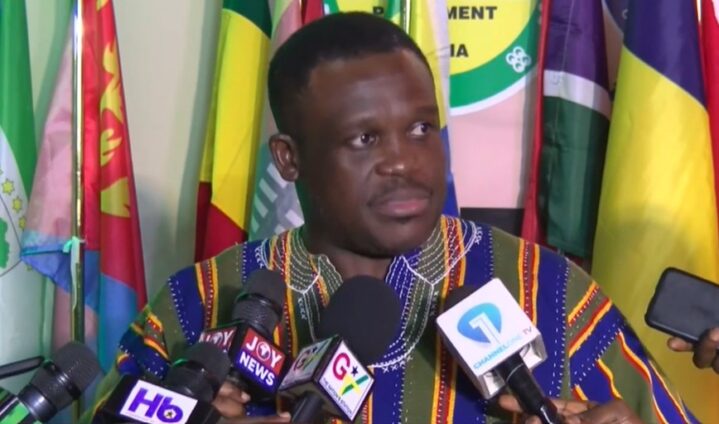
Speaking after addressing lawmakers, diplomats, and policy experts at the 4th African Inter-Parliamentary Conference on Family Sovereignty and Values, held within the precincts of Parliament, Mr George argued that the Standing Orders of Parliament do not provide any legal basis for reopening debate on a bill after it has successfully passed its third reading.
“Everything that we do in this House, Parliament is a house of rules. Respectfully to Mr Speaker, it’s not a house of appeals. It’s a house of rules. And so if there’s no rule in the rule book that gives us room to do what he wants to do, I'm saying that there is still a room in there; the Presidency can come back to us," he argued, shutting down the possibility of Parliament going in the direction requested by Speaker Bagbin.
Parliament's role completed
Mr George maintained that Parliament had fulfilled its legislative responsibilities once the bill was passed and that the next constitutional step was for the legislation to be forwarded to the President.
“When Parliament passes a bill, Parliament becomes functus officio. I think that the only role that Parliament has today is to transmit the bill to the President,” he said.
He explained that the Constitution clearly outlines the options available to the President once a bill reaches his desk.
According to him, the President may assent to the bill if he has no objections, refer it to the Council of State for advice, or return it to Parliament with specific recommendations for reconsideration.
“The Constitution spells out the steps the President can take to scrutinise the bill. He has a number of days after it has been transmitted to him to report back to the House and say, ‘I have no objection. I’m signing it; I’m assenting to it.’
“If he has an issue, he can write back to us and say, ‘I have an issue with this provision, that provision. Parliament should reconsider it with his recommendations.’ He cannot just raise objections; he must make recommendations through his Attorney-General,” he explained.
No room for reversal
The Ningo-Prampram Member of Parliament further argued that any attempt to reverse or suspend the passage of the bill at this stage would be inconsistent with parliamentary procedure.
He stressed that while Parliament's Standing Orders permit the rescission of certain decisions of the House, such provisions do not apply after a bill has completed all legislative stages and been formally passed.
“The act of rescission of a passed bill is alien to our Standing Orders,” he stated.
“Once the bill has gone through the third reading, Parliament has no role again to play. So once the bill passes after the third reading, that’s it. We have to transmit it.”
Mr George suggested that if there are concerns about the legislation, the proper avenue would be through the constitutional processes available to the President rather than an internal parliamentary review.
“Let’s transmit it. Let the Presidency come back to us with any challenges that they have. If they have concerns, Parliament can then reconsider those recommendations in accordance with the Constitution. That is the only route I see here for any reconsideration to happen,” he added.
Defence of family values
Beyond the procedural issues, Mr George used the platform to reiterate his support for the bill, describing it as a measure aimed at protecting Ghanaian family values and cultural identity.
He called on African countries to unite against what he termed external influences seeking to undermine traditional social structures across the continent.
The minister cited social challenges in some Western countries as justification for African nations developing policies that reflect their own cultural and moral values.
He also referenced recent legal and political developments in parts of Europe and North America which, he said, indicate growing debate over issues related to LGBTQ+ rights and gender identity.
Background
The Human Sexual Rights and Family Values Bill, popularly known as the Anti-LGBTQ+ Bill, was passed by Parliament on May 29, 2026, after months of debate and public controversy.
The legislation seeks to prohibit activities related to LGBTQ+ advocacy, promotion and same-sex relationships, while imposing sanctions for violations.
Its passage has generated intense debate both locally and internationally, with supporters arguing that it protects Ghanaian cultural and family values, while critics contend that it could infringe on constitutional rights and freedoms.
The bill is currently awaiting transmission to President John Dramani Mahama, whose decision on whether to assent to it, return it for reconsideration, or seek advice from the Council of State is expected to shape the next phase of the legislative process.
Mr George's intervention now adds another layer to the growing debate, setting the stage for a possible constitutional and political contest over the future of one of the most contentious pieces of legislation in Ghana's recent history.
Latest Stories
-
Ghana warns medical travellers to South Africa to obtain visas for treatment beyond 90 days
5 minutes -
Canada suspends plans to expand assisted dying to people with mental illness
6 minutes -
Minority accuses Sports Ministry, NSA of creating fake portfolios for VISA applicants
7 minutes -
6th Inter Tourism Expo comes off in Cape Coast this October; register now
27 minutes -
Afenyo-Markin accuses government of diverting attention from cocaine seizures linked to Ghana
27 minutes -
GJA gives Armed Forces 14 days to account for alleged assaults on Sika Official, Bullet TV’s Philip Abutiate
29 minutes -
PAC gives CWSA 30 days to recover GH¢10m in unpaid water bills from police, army, hospitals, other public institutions
31 minutes -
Major Accra roads to get facelift ahead of Ghana’s 70th Independence anniversary – Agbodza
52 minutes -
Account for GH¢650bn allocated to existing programmes before new economy – Oppong Nkrumah to gov’t
1 hour -
‘You’re an action man’ – Abena Osei-Asare hails Rent Commissioner’s hostel fee crackdown
1 hour -
Mahama directs Finance Minister to allocate GH¢1bn for Housing Fund in 2027 Budget
1 hour -
NPP celebrates Bawumia on birthday, prays for 2028 election victory
1 hour -
Mahama recounts ‘exhausting and frustrating’ struggle to find a home as a young spouse
1 hour -
‘Take damaged banknotes to commercial banks for replacement’ – BoG warns against repairing cedi notes for resale
1 hour -
Lebanon’s Hezbollah gets $200 million from Iran to help displaced, sources say
1 hour