

Audio By Carbonatix
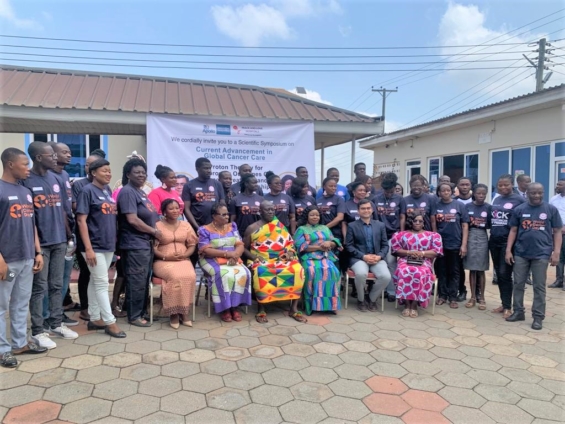
The Apollo Proton Cancer Centre is partnering with the Peace and Love Hospital to offer cancer treatment in Kumasi.
This partnership seeks to make cancer treatment accessible to patients in Ghana and increase the survival rate of patients with cancer.
The treatment known as Proton therapy is a type of radiation therapy that uses high-powered energy to treat cancer and some non-cancerous tumours.
It has shown some promise in treating several kinds of cancer.
Studies have suggested that proton therapy causes fewer side effects than traditional radiation since doctors can better control where the proton beams deliver their energy.
The Apollo Proton Cancer Centre is the first and only proton therapy centre in South Asia and Middle East.
It is the first accredited Cancer Centre in India that has fully integrated treatment that offers the most advanced treatment in surgical, radiation and medical procedures.
“When we talk about cancer, we know it to be a multi-specialty treatment where people think that multi-specialty care is about having surgery and chemotherapy and radiation together.
“But having the best of the services actually means it is first the patient that needs to be aware of their status,” said Dr. Ashu Abishak who is the senior consultant and radiation oncologist at the Apollo Proton Cancer Centre.
He also spoke on the need for health personnel and patients to be abreast with the collaboration.
“First we need to have a capacity building so that with our experience and technology we help the doctors and the people out there to understand that cancer is the next epidermic,” he said.
The Chief Executive Officer for Peace and Loved Hospital, Dr. Beatrice Wiafe Addai highlighted on the need to address stigma faced by cancer patients.
“Unfortunately, stigma is one of the problems we have especially when it comes to breast cancer, the level of stigmatization is very high.
“And we can reduce it when we have more people surviving it and when we have more people talking about it,” she said.
She also said “this partnership is going to enhance awareness creation, screening and ways by which we can have early detection.
“And if we are able to detect it early then we’ll have the options because if we can do breast conserving surgeries for most women, the number of women defaulting treatment will reduce which means that we'll get more people surviving cancer.”
Non-communicable disease coordinator of Ghana Health Service in Ashanti region, Lydia Owusu Ansah wants regular screening for early detection and treatment of cancer.
“We are now pleading with the nation at large that whenever you hear, whenever you see that screening is being conducted, please don’t hesitate to run towards that area to have your self-screened so that any anomalies will be detected as early as possible so that mortalities can be reduced,” she said.
Latest Stories
-
Boxing: Abdul Ahmed wins WBA Africa Cruiserwight title after dispatching Nigeria’s Eradeye
1 minute -
Nearly 2,000 displaced, schools damaged as windstorm wreaks havoc in Gushegu
20 minutes -
Ghana’s Derrick Kohn to work under Marie-Louise Eta as she becomes first woman to coach men’s Bundesliga team
24 minutes -
Accra Open Championships conclude with strong performances ahead of African Championships
32 minutes -
Ghana to begin camping with 12 athletes after Accra Open Championships – Bawa Fuseni
53 minutes -
Anthony Joshua declines showdown with Tyson Fury but admits they ‘probably’ clash next
1 hour -
Tyson Fury dominates Makhmudov, calls out Joshua next
1 hour -
I have supported highway authority financially to fix roads in my constituency – A Plus
3 hours -
US, Iran fail to reach peace agreement after marathon talks in Pakistan
3 hours -
ECG kicks off Phase Two of transformer upgrades at Lashibi; brief outages expected
3 hours -
Port crises loom as 11,000 drivers threaten four-day strike
4 hours -
A source of excellence across generations – Vice President Opoku-Agyemang lauds Mfantsipim
5 hours -
(Photos) Mfantsipim School launches historic 150th anniversary
6 hours -
Knights and Ladies of Marshall group backs Catholic Bishops’ stance on anti-LGBTQ+
7 hours -
Bright Simons: All the Filla in the Ibrahim Mahama/E&P – Gold Fields Saga
7 hours