

Audio By Carbonatix
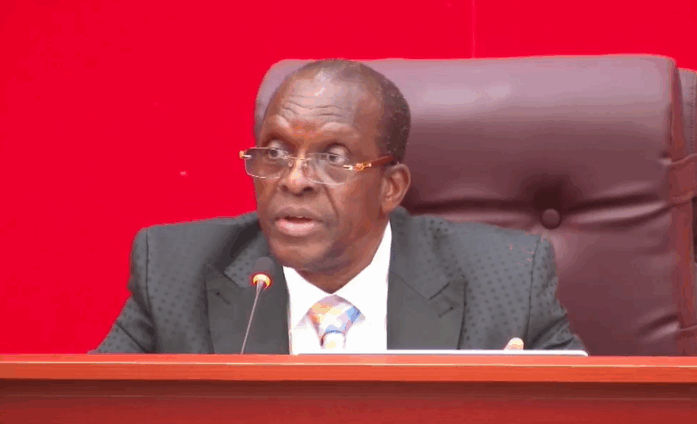
Speaker of Parliament Alban Bagbin has rejected claims that Parliament became functus officio after passing the controversial anti-LGBTQ Bill, insisting that the House has constitutional and procedural powers to revisit legislation before it is presented to the President for assent.
His remarks come amid ongoing debate over the status of the bill following assertions by Communications Minister and co-sponsor of the legislation, Sam George, as well as the Majority Leader, that Parliament's responsibility ended once the bill was passed.
Speaking during a courtesy call by a delegation marking the Supreme Court's 150th anniversary celebrations, Mr Bagbin said Parliament has established post-passage procedures that allow it to correct errors and reconsider decisions before any bill is forwarded to the President.
"There has been a recent debate where some lawyers came out strongly to say that by the Constitution, once a law is passed on the floor of Parliament is functus officio. It's not the law," the Speaker stated.
He explained that the legislative process does not end immediately after a bill is approved by Parliament.
"We have what we call a post-passage process before you send it to the President for assent. And that process gives the opportunity for Parliament to reflect on what it has passed," he said.
The Speaker said that the Constitution deliberately does not impose a deadline for transmitting bills to the President, allowing Parliament to identify and correct mistakes where necessary.
"On many occasions, we usually identify some inconsistencies or some errors, and then we go back to the House through what they refer to as the second reconsideration stage," he explained.
According to him, Parliament uses a motion of rescission to reverse an earlier decision before making amendments.
"You use the process for rescission, a motion of rescission, to rescind the decision of having read the bill at that time, and then use that to do it," he said.
The Speaker revealed that Parliament is preparing to use the same procedure for another piece of legislation.
"In fact, we are very soon going to use it in connection with the Ghana Investment Promotion Authority Bill which was passed in March," he disclosed.
Mr Bagbin stressed that the House has built-in mechanisms for "self-regulation or self-correction" before legislation reaches the President.
He further explained that every bill undergoes a detailed markup process and is reviewed by both the Clerk to Parliament and the Speaker before it is presented for presidential assent.
"All the bills are to be signed by the Clerk... After him, they have to be sent to me, and I have to go through it and make sure that everything is in order before I sign it and then direct that it be presented to the President for assent," he said.
During the engagement, the Speaker also advocated reforms in the appointment of judges, arguing that the Judiciary should have greater authority in selecting its own leadership.
"We don't need to be allowing other people to be appointing who should be judge or who should be the head of the judges and that kind of thing," he said.
"That profession should have the opportunity to do it."
Drawing comparisons with Parliament, Mr Bagbin said that the Speaker is elected rather than appointed by the President.
"Is the Speaker appointed? Are the MPs appointed? No. We are elected," he stated.
He explained that although the President has a role in the election of the Speaker, the final decision rests with Members of Parliament.
"The President will have a say. But that say doesn't mean that will be the decision of the House," he said.
Referring to his own election in 2021, he added, "The President's say did not carry the day."
The Speaker maintained that his allegiance is to Parliament and the nation rather than the Executive.
"So it means that really the Speaker is an appointee of the members of the House. I owe my loyalty and allegiance to them and to the nation. I don't have to listen to what His Excellency and the rest will do."
Mr Bagbin also expressed concern about the increasing number of cases reaching the Supreme Court, warning that the country's highest court risks losing its distinct role.
"We've seen as at now that the Supreme Court is being turned into like an ordinary court," he said.
"All sorts of cases are being pushed to the Supreme Court, which is lowering the value of the Supreme Court, not being supreme."
He said that some disputes should be resolved at lower levels of the judicial system instead of reaching the apex court.
"There are some kinds of things that must end somewhere and not come up to the Supreme Court," he stated.
The Speaker called for broader national discussions on judicial reforms, particularly as Ghana undertakes a constitutional review process.
"We need to look at that and definitely there must be much thinking into it. There shall be conversation and then we synthesise the ideas and come out with something better."
Speaking on behalf of the Judiciary delegation, Justice Gabriel Scott Pwamang Frimpong highlighted the changing role of the Supreme Court over the past 150 years.
"At its inception, it was mainly a tool of dispute resolution," he said.
He noted that the court has gradually assumed a wider constitutional role, particularly over the last three decades.
"The court has had to assume a more expansive role, especially in the past three decades in terms of interpretation of the Constitution and actually assuming a formidable role as a stakeholder in our democratic space, partnering with the Legislature and, of course, the Executive and other stakeholders," he explained.
Justice Frimpong acknowledged that, like any human institution, the court is not perfect but said it has consistently contributed to strengthening Ghana's constitutional democracy.
"It is a human institution and its decisions may not be all the time so crucial. But we believe that over the years the court has acquitted itself creditably through the tool of interpretation and education, playing its role to make sure that the Constitution grows and serves the purpose for which it was enacted," he said.
Latest Stories
-
Don’t let speed of information become your judgement – CJ tells new lawyers
35 minutes -
World Cup visa scandal: People have leveraged public office to facilitate fraud – Senyo Hosi
41 minutes -
Glut! Farmers count losses as prices crash, customers happy
1 hour -
GSA postpones auction of unserviceable vehicles
1 hour -
Man charged with attempted murder after stabbing
1 hour -
World Cup visa scandal: Senyo Hosi says issue goes beyond calls for Sports Minister’s resignation
1 hour -
Yaw Ampofo Ankrah hasn’t taken or received any money to facilitate visas – Lawyer insists
2 hours -
World Cup visa scandal: Senyo Hosi urges focus on constitutional accountability
2 hours -
La Beach demolition: Senyo Hosi condemns lack of consultation
2 hours -
Russian glide bomb attack on Zaporizhzhia kills at least 15 people
2 hours -
Jinapor warns underperforming energy sector CEOs of consequences, says no protection for failure
2 hours -
Fire destroys head of tipper truck on Lower Volta Bridge
2 hours -
Palmer signs new Chelsea contract until 2034
2 hours -
World Cup visa scandal: Mahama will act on corruption allegations – Abass Nurudeen
2 hours -
Abass Nurudeen accuses Minority of ‘scandal scavenging’ over World Cup visa controversy
2 hours