

Audio By Carbonatix
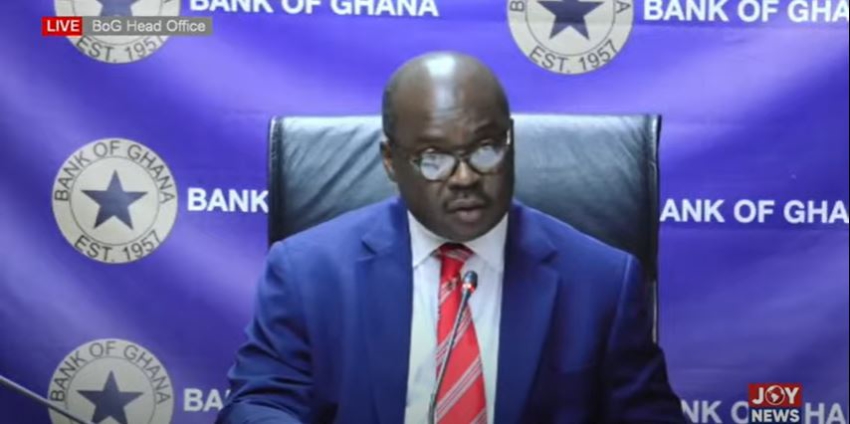
Following widespread criticisms over the GHȼ60 billion loss recorded by the Central Bank in 2022, the Governor of the bank, Dr Ernest Addison has explained that central banks ordinarily do not exist for profits but for national welfare.
Speaking at a news conference on Monday, August 21, to address a number of issues that have emerged since the bank released its annual report and financial statement for 2022, Dr Addison said, “We must recognise the special character of Central Banks and the role they play in an economy. Central Banks are institutions of public policy and do not exist for profit but for national welfare and as such could have a negative equity position and continue to be policy effective.
“Very clear policies have been put in place to return to positive equity in the medium term. And as we do this, we will continue to rebuild our policy buffers to continue to provide the necessary assurance of policy support as we rebuild a stronger and more resilient and inclusive economic post-pandemic"he noted.
He added that the bank remains strong, and that its operations will not be affected by the losses.
“Let me end by reassuring the public on the policy solvency of the Bank of Ghana to achieve its statutory mandate going forward. Every central bank’s credibility depends on its ability to achieve its mandate. These technical losses do not jeopardize that ability and are sometimes the price to pay for achieving those aims. It is important that we place the central bank’s policy mandate ahead of profits."
Dr Addison said his assertion that the loss will not affect the bank’s operation was validated by the International Monetary Fund’s (IMF) Technical Assistance mission before granting Ghana a bailout.
“It is worth noting that Central Banks are not commercial banks. Bank of Ghana’s current financial condition will not impact negatively on the operations of the Bank,” he stated.
According to him, the IMF declared the bank “was policy solvent and would remain so, as it had enough income to cover monetary policy operational costs.”
He said BoG will also manage to reduce its operational costs during this period – 2023.
He further explained that the loss the bank recorded last year were technical losses arising from the “haircut and the application of accounting standard (in particular IFRS 9) to estimate credit losses over the tenure of the government dealt by Bank of Ghana.”
He noted that the financial loss was not money lost by the bank through its operations in 2022.
“Rather, one should look at this as the reflection of the total cost of the economic and social crises that the country has faced over the years and an attempt to resolve a major structural problem of the Ghanaian economy,” he added.
He said loss recorded by the bank is not the first time since the bank has gone into negative equity before, according to historical financial statements.
According to him, in the period of 2017, and 2018, BoG incurred similar negative equity from the impairment of legacy liquidity support loans granted in 2015 and 2016 to insolvent banks.
He stated that the external auditors were impaired due to the uncertain prospects of recovering from those insolvent banks. However, the bank recovered and generated profits from 2019 to 2021.
“During the early years of structural adjustment, very large exchange rate depreciations led to revaluation losses that drove the Bank into negative Equity. Indeed, anytime the economy faces major challenges, the Bank of Ghana's balance sheet suffers, and the equity position moves into negative territories,” he said.
The BoG Governor noted that in all its dealings, the Bank acted within the applicable laws, adding that it is not true that the Bank of Ghana has been providing financing for the government every year.
“There has been zero financing in 2017, 2018, 2019 and 2021. The Bank of Ghana has only had to support in the pandemic year of 2020 and the crisis year of 2022."
The Minority in Parliament at a press conference on Tuesday, August 8, disclosed the cost of the central bank’s new head office under construction. Its Leader, Dr Cassiel Ato Forson said the bank spending a whopping $250 million to build a head office in the current economic crisis was untenable.
It has thus demanded the resignation of the BoG Governor and his two deputies for the GHȼ60 billion loss the bank incurred in 2022.
But the Governor has explained that the losses were not occasioned by mismanagement but largely by the government through its initiatives like the Domestic Debt Exchange Programme and other factors.
Latest Stories
-
Bahass Foundation launches vocational skills training to support mental health recovery in Wa
32 minutes -
NPP orders parliamentary aspirants and their supporters to suspend campaign activities
1 hour -
Techiman unites against child marriage: Joy Impact Makers Awardee leads charge on International Day of the Girl Child
1 hour -
Ghana Psychological Association calls for greater involvement of people with lived experience in mental health care
2 hours -
Ablakwa says Ghana could evacuate more citizens from South Africa if the situation worsens
3 hours -
Violence against girls must be tackled through individual responsibility – Gender advocate
3 hours -
Ghana’s BRICS bid must be guided by national interest – International Affairs Analyst
3 hours -
Journalists look back on a decade of breast cancer reporting in Ghana
4 hours -
President Mahama ends Resetting Ghana tour of Ahafo Region
6 hours -
African negotiators seek delivery of climate commitments at COP31
6 hours -
BoG develops AI rules for financial sector
6 hours -
‘Big Push’: Government assures contractors of prompt payments
6 hours -
Court fines miner for breaking into gold buying shop
6 hours -
Tarkwa court jails labourer for three years over GH¢123,000 theft
7 hours -
GAEC must retain nuclear scientists for Ghana’s nuclear ambitions – Minister
7 hours