

Audio By Carbonatix
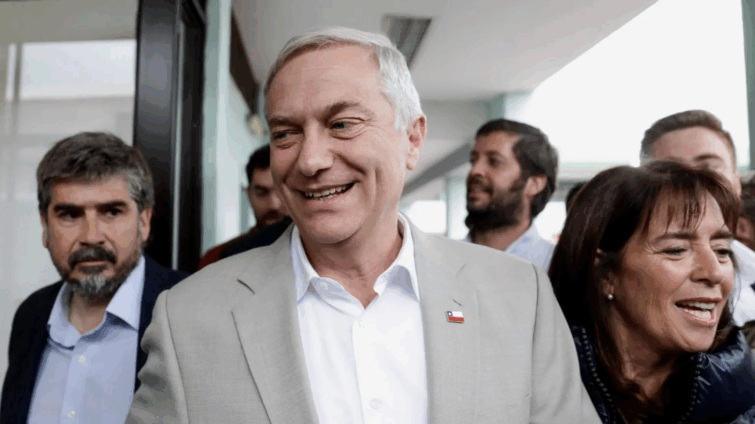
Chile has elected the far-right wing José Antonio Kast to be its next president, after an election campaign that was dominated by themes of security, immigration and crime.
Kast won decisively with more than 58% of the vote in his third attempt at running for president.
It marks the biggest shift to the right since the end of Chile's military dictatorship in 1990. Kast has openly praised Chile's former right-wing dictator, Augusto Pinochet.
He beat the governing left-wing coalition's candidate, Jeannette Jara, from the Communist Party.
At a gathering of his supporters in the capital Santiago, many draped in Chilean flags, chanting and taking selfies, there was jubilation as the results came through.
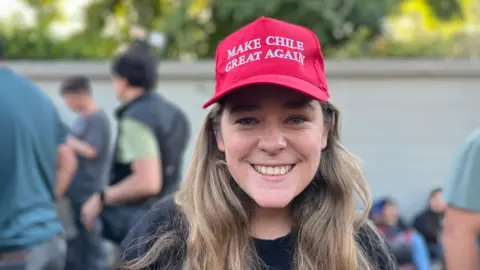
"I'm happy we can recover the country's security and patriotism," said Augustina Trancoso, donning a red "Make Chile Great Again" cap.
"We've been trying to win an election for years," said Belem Valdivieso. "In Chile, you used to be able to walk the streets peacefully, lately we've experienced problems with insecurity. I'm hoping his promises will be kept and he'll focus on security."
Throughout the campaign, Kast portrayed Chile as a country that was descending into chaos and insecurity. He pledged to restore order and crack down on irregular immigration, as well as implement sharp spending cuts.
Kast is an admirer of Donald Trump, who is likely to become a close ally, and his policies echo those of the US president. He has pledged a border wall on Chile's porous frontier with Peru and Bolivia, maximum-security prisons, and mass deportations of irregular migrants, many of whom are from Venezuela.
Chile is one of the safest and more stable countries in South America, but a rise in immigration and organised crime in recent years has concerned many voters. Kast regularly drew links between the two.
His critics, though, say the problem is being exaggerated.
One voter in Santiago, Javiera Carrasco, liked some of Kast's policies but ended up voting for Jara. She said she felt "like a false sense of insecurity is becoming widespread."
"In other countries, there are much worse things happening than here. It just doesn't add up for me."
Chile's murder rate is now falling, and some studies suggest those born abroad commit fewer crimes on average. But the perception of growing insecurity was the motivation for many of Kast's voters.
"We are transforming into Colombia, a lot of terrorism, thieves, robbery, society is very unsafe," one voter Max Struber said.
"It may sound harsh to say it, but we need the government to continue Pinochet's work. Human rights abuses existed, that's true. But as a government it was good, we used to have peace and tranquility."
Kast's brother was a minister during Pinochet's dictatorship, and his father was a member of the Nazi party. Pinochet was an army general who led a US-backed military coup in 1973 and established a 17-year-long military dictatorship that was marked by brutal human rights abuses, forced disappearances and free-market economic policies.

Chile's current left-wing President Gabriel Boric, who could not run again, had suffered from low approval ratings. Kast's rival, Jeannette Jara, may have suffered from being seen as a "continuity vote.
A supporter at his victory party, Francisco Otero, said neither candidate represented everybody perfectly, but that a continuation of the government was seen as "much worse".
After the result, Jara posted that "democracy has spoken loud and clear" and wished Kast "success for the good of Chile."
"We will continue working to advance a better life in our country," she added.
Her supporters fear Kast's election marks a return to Chile's far-right past.
"Kast's family helped the dictator Augusto Pinochet," Ricardo Herrera said, adding that he lived through Pinochet's dictatorship and it was "brutal".
Some are sceptical, though, that Kast will actually do what he's pledged.
"Kast says he wants to expel 360,000 undocumented migrants. He won't be able to do that. It's physically impossible," one voter Hector Lunes said.
Kast has also been firmly against abortion, even in cases of rape, and environmental protection policies.
Investors will likely welcome his victory as he has pledged a free-market approach to economics to shrink the state and deregulate certain industries.
This was the first presidential election in Chile where voting was mandatory, and registration was automatic for those eligible.
This left some voters feeling like they had to pick whichever they say was the "least-worst" option.
"I don't know if I'd say the lesser of two evils, but I think Chile needs a change," Claudio Sanjuez said, "and I clearly think Kast could be that alternative".
"Both candidates were like opposite extremes," Cintia Urrutia said, but added she'd hoped for Jeannette Jara who she perceived as more "centrist".
Kast's victory in Chile follows a string of elections in Latin America that have shifted the region to the Right in recent years – including in Argentina, Ecuador, Costa Rica, and El Salvador.
He will be inaugurated on 11 March 2026. At rallies, he regularly counted down the days until this date warning undocumented immigrants that they should leave before then if they ever want the chance to return.
Latest Stories
-
GAF sets Sept. 28–30 for Documentation, Body Selection Exercise
25 minutes -
I resigned five months ago – BoG Governor Asiama explains GoldBod Board exit
41 minutes -
Trump says men arrested at UK air base used by US were looking to do ‘big damage’
57 minutes -
Trump confirms meeting with Anthropic’s Amodei, repeats dismissal of AI fears
1 hour -
China pushes back against US on Iran and Cuba in UN speech
1 hour -
OpenAI, Anthropic CEOs called to appear at Australian AI probe
2 hours -
WHO says Congo Ebola outbreak spreads to two new health zones
4 hours -
Nigeria come from benhind to win in AFCON 2027 qualifier
4 hours -
South African white genocide does not exist, new ambassador to US tells BBC
4 hours -
T-bills auction: Government exceeds target marginally; yield on 91-day bill remains unchanged
5 hours -
Pope says ‘scourge’ of abuse must be rooted out as he visits Lourdes
5 hours -
GPL 2026/27: 10-man Aduana hand Kotoko defeat in Kumasi
5 hours -
News media must stay relevant or ‘society will struggle’, says World News Day boss
5 hours -
Kenyan High Commissioner hosts Heads of Mission from 25 countries
5 hours -
Embattled Serbian president resigns, paving way for early elections
5 hours