

Audio By Carbonatix
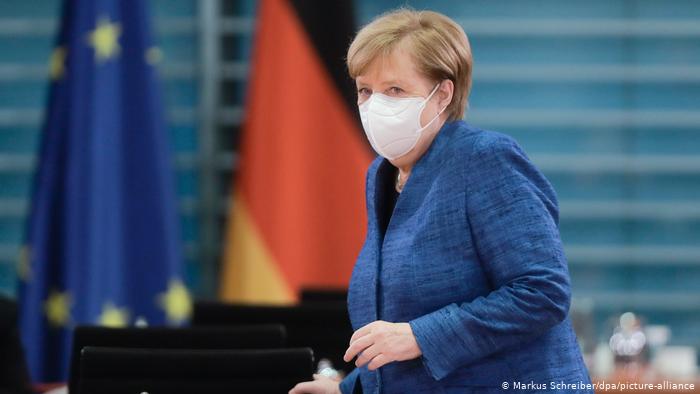
German Chancellor Angela Merkel warned citizens to stay at home and reduce all unnecessary contact and travel after the number of infections hit a new record high. The country's death toll also passed 10,000 on Saturday.
German Chancellor Angela Merkel warned citizens to stay at home and reduce social contact to an absolute minimum on Saturday, following another notable rise in the number of infections.
"We are not powerless against the virus, our behavior determines how strongly and how quickly it spreads. And the order of the day for all of us is: reduce contacts. Meet a lot fewer people," Merkel said in her weekly video podcast.
She then replayed footage of her appeal of the previous weekend for people to refrain from both travel and celebrations that are "not really necessary."
"Please stay at home, wherever possible, whenever possible," she said. "The pandemic is spreading rapidly again, even faster than at the start of it more than half a year ago".
Germany confirmed a new daily record of 14,714 new cases on Saturday, up from about 13,500 cases the day before, according to data from the Robert Koch Institute for infectious diseases. However, the figure was thought to be inflated due to a technical glitch earlier this week.
The country's pandemic death toll also passed 10,000 on Saturday. The rise in infections has spurred a number of local measures to be implemented across the country, and officials have warned of a national lockdown.
States take lead on restrictions
Germany currently leaves decisions on restrictions to local and regional authorities. Germany's 16 states are free to impose their own rules, leading to a patchwork of regulations nationwide.
Measures are typically implemented at the local level once infections in a district rise above the threshold of 50 per 100,000 residents.
Those measures include travel restrictions, curfews for restaurants and bars, and tighter limits on social gatherings.
However, many are calling for a return to the nationwide restrictions seen at the start of the pandemic.
Meanwhile, the capital and one of the country's top virus hotspots, Berlin, implemented new restrictions on Saturday, requiring facemasks in markets and on 10 particularly busy streets, in shopping malls and in queues.
The city is also set to deploy over 1,000 police officers to enforce the new rules.
Germany has recorded over 426,000 cases and 10,010 deaths since the start of the pandemic.
Latest Stories
-
GPRTU wants full TRAFFITECH-GH implementation to start in 2027
1 minute -
Mahama announces plans to import electric wheelchairs for PWDs
5 minutes -
KGL U17 Colts 2026: Western beat Prempeh Elite Academy to set up final final with Greater Accra Region
24 minutes -
Late Solanke strike salvages 10-man Spurs draw at Man United
34 minutes -
Gender Ministry to monitor welfare of Nana Akua Addo’s children amid domestic violence case
41 minutes -
Benedict Okyere Yeboah: Ghana’s football problem goes beyond sacking a coach
50 minutes -
GPL 2026/27: Darkwah Wiafe’s winner sees All Blacks beat Kotoko
56 minutes -
ITF World Tour : Patel Wins Boys’ Singles Final at J100 Accra
1 hour -
Ghana must pursue BRICS partnership if it brings economic benefits – Kpebu
1 hour -
Success and Wright Claims J100 Accra Girls’ Doubles Championship
1 hour -
ITF J100: America’s Wright wins J100 Accra Girls’ Singles Title
1 hour -
Expedition hopes to find aviator Amelia Earhart’s plane on remote island
1 hour -
US seeks changes to rejected $109m health compact with Ghana – Mahama
2 hours -
Nine dead in mass shooting at Pennsylvania home
2 hours -
‘Time for Ukraine to get new president,’ says Trump after Zelensky condemns diesel deal
2 hours