

Audio By Carbonatix
The Savanna Agricultural Research Institute of the Council for Scientific and Industrial Research (CSIR-SARI) has introduced farmers in Manwe and Goripie in the Wa East District to stress-tolerant and hybrid maize varieties.
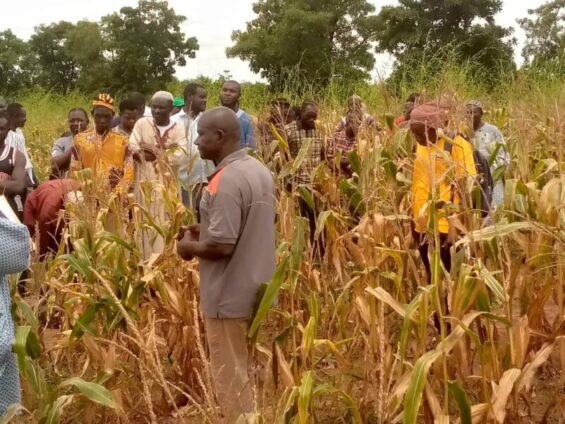
This introduction took place during a farmers' field day organised by CSIR-SARI in Manwe, where the farmers were acquainted with the benefits of these improved maize varieties. The demonstration fields showcased climate-resilient maize hybrids as part of the “Participatory On-Farm Testing of Stress-Tolerant Maize in the Upper West Region of Ghana” project, funded by the International Institute of Tropical Agriculture (IITA).
Addressing the farmers, Dr Mahama G. Yakubu, a Senior Research Scientist at CSIR-SARI, Wa station, noted that these demonstration fields were designed to facilitate the testing, promotion, and eventual adoption of the maize varieties by farmers. He emphasised the importance of adopting climate-smart maize varieties and hybrids to improve economic gains.
“Due to climate change, it is crucial to develop climate-smart hybrids. Climate-smart means the variety matures early, is stress-tolerant, high-yielding, and also meets consumer preferences to enhance livelihoods,” Dr Yakubu explained.
He added that the hybrids possess built-in tolerance mechanisms for water shortage, allowing them to produce more than traditional maize varieties during drought conditions. Additionally, several of these improved varieties have shorter maturity periods, which are better suited to the increasingly erratic rainfall in northern Ghana.
“With a stress-tolerant maize genotype, farmers are more likely to achieve food security, allocate less land to maize, and invest in other crops, promoting a more balanced diet, higher incomes, and improved soil fertility,” he stated.
However, Dr Yakubu, who is also an agronomist, advised that the yield potential of the hybrid maize varieties could only be realised if farmers adhered to good agronomic practices (GAPs), such as proper land preparation and timely weeding. Other essential GAPs he mentioned included the “4Rs” of nutrient stewardship (right source, right rate, right time, and right place), pest control, and timely harvesting.
Some farmers, who spoke to the Ghana News Agency (GNA) during the field visit, expressed optimism that the improved maize varieties would help them address the challenges posed by irregular rainfall patterns.
Latest Stories
-
Friends of Bridget Bonnie Marks her 35th birthday with donation to Kasseh Model Health Centre
30 minutes -
Landfilling waste management creates no value, it’s an economic waste
57 minutes -
Photos: Speaker Bagbin Commissions MPs constituency office under parliamentary decentralisation programme
1 hour -
Black Stars technical advisor Winfried Schäfer sacked as GFA shakes up backroom staff
1 hour -
Wenchi water project almost complete, critical to gov’t agenda – GWL MD
2 hours -
Anti-LGBTQ+ bill not part of government’s legislative agenda – Inusah Fuseini
2 hours -
Anti-LGBTQ Bill: Forget the rumour mongers, I’m a man of action, and will pass the bill – Speaker
2 hours -
Women and children among those killed in Sudanese army shelling of wedding celebration
2 hours -
President Mahama is not sincere with Ghanaians on LGBTQ bill matter – Hassan Tampuli
3 hours -
Gov’t to establish Prison Industrial Hub to equip inmates with income-generating skills – Prison Service boss
3 hours -
Alhassan Tampuli donates cement, roofing sheets to support storm victims in Gushegu
3 hours -
Alhassan Tampuli appeals for urgent support for storm victims in Gushegu
3 hours -
The hypocrisy must stop; pass Anti-LGBTQ+ Bill now – Alhassan Tampuli to Mahama
3 hours -
Imprisonment should be rehabilitative, not punitive – Ghana Prisons boss at UNGA
4 hours -
Ga Adangbe traditional priests petition Mahama over McDan aviation licence revocation
4 hours