

Audio By Carbonatix
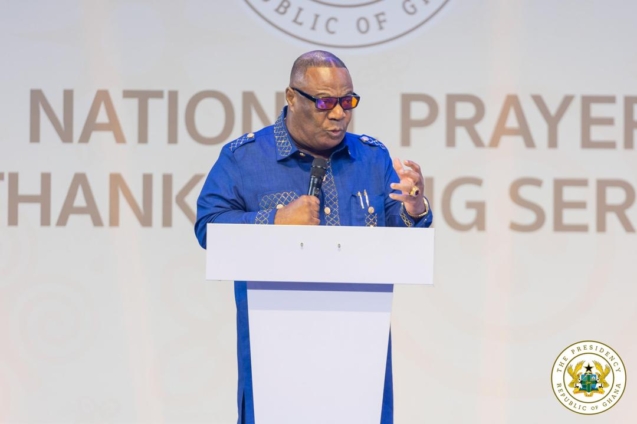
Nicholas Duncan-Williams, Founder and General Overseer of Action Chapel International (ACI), has weighed in on the growing controversy over prophecies linked to political elections, calling for deeper scriptural understanding when addressing such matters.
His comments follow a public apology by Bernard Elbernard Nelson-Eshun, an Accra-based preacher, whose widely circulated prediction that Kennedy Ohene Agyapong would emerge victorious in a recent internal party contest proved false.
The unexpected outcome reignited discussions about the role of prophetic declarations in competitive democratic politics.
Archbishop Duncan-Williams addressed the intense public reactions that surfaced before, during and after the primaries, during which several prophecies were publicly shared regarding the eventual winner.
Responding to a question about how spiritual leaders should navigate public scrutiny when prophetic words intersect with politics, he stressed the importance of distinguishing between Old Testament and New Testament prophecy.
According to him, in the Old Testament era, individuals were guided by prophets because the Spirit of God came upon selected persons but did not dwell permanently within them.
In contrast, he explained that under the New Testament dispensation, believers are led by the indwelling Holy Spirit.
Quoting Revelation 19:10, he stated that “the spirit of prophecy is the testimony of Jesus,” emphasising that authentic prophecy must ultimately affirm the Lordship of Christ.
He also cited Hebrews 1:1–2, noting that while God spoke through prophets in earlier times, He now speaks through His Son, Jesus Christ, who promised the Holy Spirit as the Spirit of truth.
The Archbishop suggested that many disputes surrounding election-related prophecies stem from limited biblical grounding rather than a lack of secular education.
He pointed out that prophets in ancient Israel addressed kings installed by God within a theocratic framework — a system fundamentally different from modern democratic governance.
He spoke on Channel One TV.
“Our countries and nations are secular. They are not the state of Israel,” he remarked, urging caution and discernment when applying biblical prophetic models to contemporary political contests.
While affirming that God continues to speak today, Archbishop Duncan-Williams maintained that prophetic ministry, especially in politically sensitive contexts, must be exercised with theological depth, wisdom and responsibility.
Latest Stories
-
Let The Constitution direct Chieftaincy to deliver “All Development Is Local”
8 minutes -
Ghana explores centre of excellence for hearing, communication and cochlear implant care
2 hours -
Schizophrenia-related disorders lead mental health cases recorded in Ghana
2 hours -
Dutch authorities enlist Ghana in hunt for fugitive drug lord Bolle Jos
2 hours -
Ghana housing finance conference adopts communiqué to improve affordable housing access
7 hours -
Special Initiatives Minister urges Wa Technical Institute to enrol more girls as EU-backed solar training lab opens
7 hours -
In the matter of my first year at the Bar
7 hours -
ActionAid Ghana calls for an end to child marriage, greater investment in girls’ rights
7 hours -
Newsfile to tackle World Cup visa scandal, beach demolitions, education strikes, BRICS bid
8 hours -
UK-Ghana Trade & Investment Summit: Trade Resource Centre to help businesses maximise UK-Ghana trade opportunities
8 hours -
Embassy of Denmark celebrates World Maritime Day
8 hours -
Linking LEAP to productive inclusion could cut extreme poverty by 2030 – UNICEF
9 hours -
Trade Ministry backs use of creative arts to rehabilitate prison inmates
9 hours -
Negotiations with government to continue despite strike suspension – GNAT
9 hours -
‘Ghana cannot afford to waste public resources; every cedi has a job’ – Ato Forson
9 hours