

Audio By Carbonatix
Executive Secretary of the Comprehensive Nuclear-Test-Ban Treaty Organization (CTBTO), Dr. Robert Floyd, has warned of the lingering threat of nuclear weapons and the importance of a Comprehensive Nuclear-Test-Ban Treaty (CTBT) for Africa.
Reflecting on the nuclear age at a public lecture at the Graduate School of Nuclear and Allied Sciences on the Comprehensive Nuclear-Test-Ban Treaty and its relevance to global security architecture, Dr. Floyd noted that in his own lifetime, there had been over 1,500 nuclear weapons tests, compared to just six by North Korea in the lifetime of a typical 22-year-old Ghanaian student. He sadly described the devastating impact of the Hiroshima bombing, where a single nuclear detonation led to what he described as "largest almost instantaneous obliteration of human life ever seen on Earth."
“Visiting the Peace Memorial Museum now, you see photos of those affected. Things found afterwards. Things you can’t forget. That tiny, charred tricycle. Found a kilometre away from the blast-centre. Many natural disasters and massacres down the centuries. But nothing like that.”
Watch Blessed Sogah's interview with Dr. Robert Floyd
Despite the end of the Cold War, nuclear weapons stockpiles remained alarmingly high, with over 60,000 nuclear weapons in the 1980s. Dr. Floyd used a remarkable graphic to convey the scale of these weapons - a cube of TNT 300 meters high, which would be the second-tallest building in Africa.
Highlighting the pan-African impact of these nuclear tests, Dr. Floyd explained how radioactive traces from tests conducted far from Africa's shores were detected across the continent, affecting plants, animals, and even artwork. He emphasized Ghana's proud history of championing pan-Africanism and the need to address this legacy.
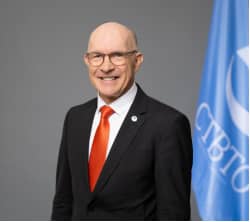
Dr. Robert Floyd, Executive Secretary of the Comprehensive Nuclear-Test-Ban Treaty Organization (CTBTO)
The CTBTO's Executive Secretary praised the Comprehensive Nuclear-Test-Ban Treaty as a "wonder of the scientific world," with its extensive International Monitoring System capable of detecting any nuclear test around the globe. He outlined the organization's ability to quickly identify the nature and location of a nuclear explosion, providing crucial information to member states.
However, Dr. Floyd noted that the CTBT has not yet formally entered into force, as it requires ratification by 44 named states, including China, the United States, and Russia. He stressed the importance of this entry into force, as it would unlock the treaty's full verification tools, including the ability to conduct on-site inspections to confirm the nature of any suspected nuclear test.
The CTBTO's address at the Ghana Atomic Energy Commission served as a powerful reminder of the ongoing nuclear threat and the critical role of the CTBT in enhancing global security and transparency. As African nations continue to champion peace and development, the CTBTO's work remains crucial in safeguarding the continent from the lasting impacts of nuclear testing.
Latest Stories
-
Insults generally are not crimes, but some may be criminal under the law – Samson Lardy Anyenini
4 minutes -
IGP deploys specialised police team, armoured vehicle to strengthen security in Nkwanta
4 minutes -
Dr Bawumia advocates solar power, access to credit, training and certification for artisans
7 minutes -
Trade Minister engages Russia, UAE and UNDP to boost trade, investment
8 minutes -
7 best foods to help keep blood sugar levels steady
11 minutes -
Ghana to host signing of UN trade convention to modernise global cargo documentation on October 26
26 minutes -
Family announces memorial mass for Nana Konadu Agyeman-Rawlings
30 minutes -
Mahama, Trade Minister, tours Afienya and Tema factories, schedules meeting on Free Zones incentives
35 minutes -
Gyakie and FlipTheMusic unveil ‘Your Body’ following a new distribution deal with Warner Music Africa
36 minutes -
Stop looking down on new media practitioners as if they don’t matter – New Media President
37 minutes -
Ghana’s BRICS partnership bid aimed at broadening development opportunities – Mahama
42 minutes -
Fiabci-Ghana inaugurated to promote professionalism and global collaboration in real estate sector
1 hour -
‘No flying in just for matches’ – Kofi Adams sets conditions for next Black Stars coach
1 hour -
Ghana and BRICS: Strategic opportunity, economic imperative or geopolitical gamble?
1 hour -
SML vs GRA: Court grants preservation order in dispute over US$500 million investment
1 hour