

Audio By Carbonatix
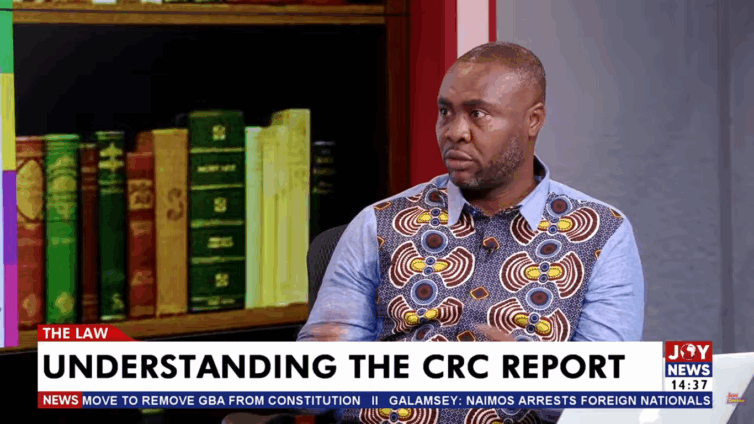
A member of the Constitutional Review Committee (CRC) 2025 and Senior Lecturer at the University of Ghana School of Law, Dr Godwin Djokoto, has called for a constitutional reorientation of public land ownership.
He argued that public lands should be vested directly in the people rather than in the President.
Dr Djokoto made the remarks on Sunday, January 18, while speaking on JoyNews’ programme The Law, as part of discussions on proposed constitutional reforms aimed at strengthening democratic governance and accountability.
According to him, Ghana’s republican system is founded on the principle that all powers of state emanate from the people, making it inconsistent for public lands to be vested in the President, even when held in trust for citizens.
“In a republican state where we say that all powers of state emanate from the people, we are the same people we are talking about,” he said.
“Instead of vesting public lands in the President in trust for the people of this country, public lands should be vested in the people but managed by the Lands Commission.”
Dr Djokoto explained that the CRC 2025 has proposed a framework that maintains institutional oversight while reinforcing popular ownership.
Under the proposal, the Lands Commission would be responsible for the administration and management of public lands on behalf of the people.
He noted that the recommendations are supported by strong safeguards designed to address longstanding concerns about the mismanagement of state lands.
These safeguards focus on accountability, transparency and ensuring value for money in all transactions involving public lands.
A key aspect of the proposal, he revealed, is an enhanced role for the Auditor-General. The Auditor-General would be mandated to ensure that there is a comprehensive and accurate record of all public lands in the country and to scrutinise all transactions, including sales, leases and assignments.
“The Auditor-General has been tasked to make sure there is value for money for all transactions dealing with public lands,” Dr Djokoto stated.
He further explained that where transactions fail to meet established standards, the oversight framework would allow for their nullification.
According to him, the power to nullify non-compliant transactions would serve as a strong deterrent against abuse and help protect public interest.
“To the extent that if it does not conform, there should be the power of nullification. This, we think, could bring some sanity into the public space,” he added.
The Constitution Review Committee presented its final report to President John Dramani Mahama on Monday, December 22, 2025, marking a key milestone in Ghana’s ongoing constitutional reform process.
The committee, chaired by Professor H. Kwasi Prempeh, Executive Director of the Ghana Centre for Democratic Development (CDD-Ghana), was tasked with reviewing the 1992 Constitution and proposing reforms aimed at strengthening Ghana’s democratic governance framework.
The submission of the report brings to a close several months of nationwide consultations and detailed technical analysis conducted by the eight-member committee.
Latest Stories
-
3 Co-wives, 5 children perish in canoe disaster – Maritime Authority insists life jackets use mandatory for all water transport
8 minutes -
Iran war lands ‘triple blow’ to flood-ravaged Sri Lankans
42 minutes -
Gunmen kill at least 11 people at Afghanistan picnic spot
56 minutes -
Woman, 25, in court for stealing baby at Bogoso
57 minutes -
Trump unveils giant gold-accented victory arch design for US capital
60 minutes -
We spoke to the man making viral Lego-style AI videos for Iran. Experts say it’s powerful propaganda
1 hour -
Hungarians vote in big numbers on whether to end Orbán rule and elect rival
1 hour -
At least 30 feared dead in crush at Haitian tourist site
1 hour -
Boxing: Abdul Ahmed wins WBA Africa Cruiserwight title after dispatching Nigeria’s Eradeye
1 hour -
Nearly 2,000 displaced, schools damaged as windstorm wreaks havoc in Gushegu
2 hours -
Ghana’s Derrick Kohn to work under Marie-Louise Eta as she becomes first woman to coach men’s Bundesliga team
2 hours -
Accra Open Championships conclude with strong performances ahead of African Championships
2 hours -
Ghana to begin camping with 12 athletes after Accra Open Championships – Bawa Fuseni
2 hours -
Anthony Joshua declines showdown with Tyson Fury but admits they ‘probably’ clash next
2 hours -
Tyson Fury dominates Makhmudov, calls out Joshua next
3 hours