

Audio By Carbonatix
Former President Nana Addo Dankwa Akufo-Addo has acknowledged that economic difficulties and persistent public protests during his tenure played a key role in diminishing his government’s popularity.
He admitted that the economic downturn, exacerbated by global challenges, fuelled widespread dissatisfaction among Ghanaians, leading to increased public demonstrations.
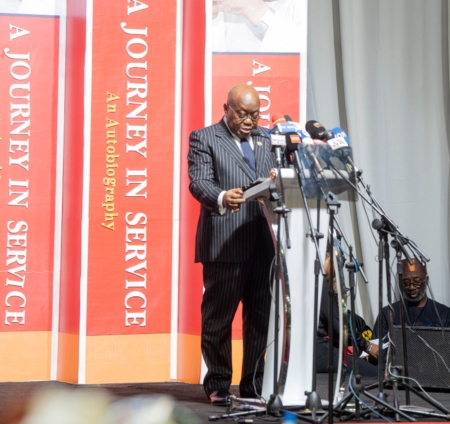
Speaking at the launch of a book by former Nigerian Military President, General Ibrahim Babangida, Akufo-Addo reflected on the economic turbulence that defined his presidency, particularly during the COVID-19 pandemic.
He noted that the crisis severely affected Ghana’s financial stability, limiting the government’s ability to sustain economic growth and meet public expectations.
Akufo-Addo conceded that the economic strain led to nationwide protests, with citizens expressing frustration over rising costs of living and policy decisions.
While he acknowledged that these demonstrations were not as severe as the Structural Adjustment Programme (SAP) riots that swept through Ghana and other African nations in the 1980s, he admitted that they were significant enough to weaken public confidence in his administration.
“We faced a major economic crisis and, with the world’s capital markets closed to us, we ended up going to the IMF. Not an easy decision to make. The economic difficulties brought people onto the streets,” he stated.
He further explained that his government had few options to navigate the crisis due to the limited accessibility of international capital markets.
As a result, the administration was ultimately compelled to seek financial assistance from the International Monetary Fund (IMF) to stabilise the economy.
“Even though the demonstrations were not on the scale of the SAP riots described in the book, they were serious enough, feeding into the growing disaffection against the government,” he noted.
Mr Akufo-Addo maintained that while the global economic downturn posed significant challenges, his government took difficult but necessary measures to restore economic stability.
He stressed that the long-term impact of those decisions would be evident in Ghana’s economic trajectory, urging future leaders to learn from the experience and prioritise policies that foster resilience in times of global uncertainty.
Latest Stories
-
AU’s 10-year reparations agenda is essential to address historic injustices – Spio-Garbrah
8 minutes -
Ghana can’t remain vulnerable to global economic disruptions— Dr Tutu-Boahene
22 minutes -
‘No nepotism’ – Former NSA Board Chairman demands world-class coach after Otto Addo exit
26 minutes -
Volta Region seen as top choice for luxury weekend breaks — V. L. K. Djokoto
36 minutes -
Halt small-scale mining for one year to fight galamsey – Hopeson Adorye
40 minutes -
President Mahama orders full probe into ‘Big Push’ procurement exposé
58 minutes -
Weija-Gbawe MP calls for commissioning of Weija paediatric hospital
1 hour -
Ghanaians dying in Russia–Ukraine war: The danger is real
1 hour -
Player ratings: Oppong earns high marks as Sibo and Adjetey draw low scores in Germany defeat
1 hour -
Pres. Mahama pledges action on 1.2m out-of-school children after School for Life raises concern
1 hour -
Suhum MP vows NPP will probe Gold-for-Reserves in 2029
2 hours -
Ghana to host Zimbabwe’s President Mnangagwa on three-day state visit
2 hours -
Ghana pushes for stronger West African blue economy partnership at Liberia fisheries investment conference
2 hours -
Ghana hosts high-level African climate strategy meeting ahead of COP31 and COP32
2 hours -
Today’s Front pages : Tuesday, March 31, 2026
2 hours