


Audio By Carbonatix
Former Head of the Civil Service, Dr Alex Glover-Quartey, has launched his autobiography, 'The Bureaucrat', with a call for greater attention to the role of public servants and the importance of preserving the country’s institutional history.
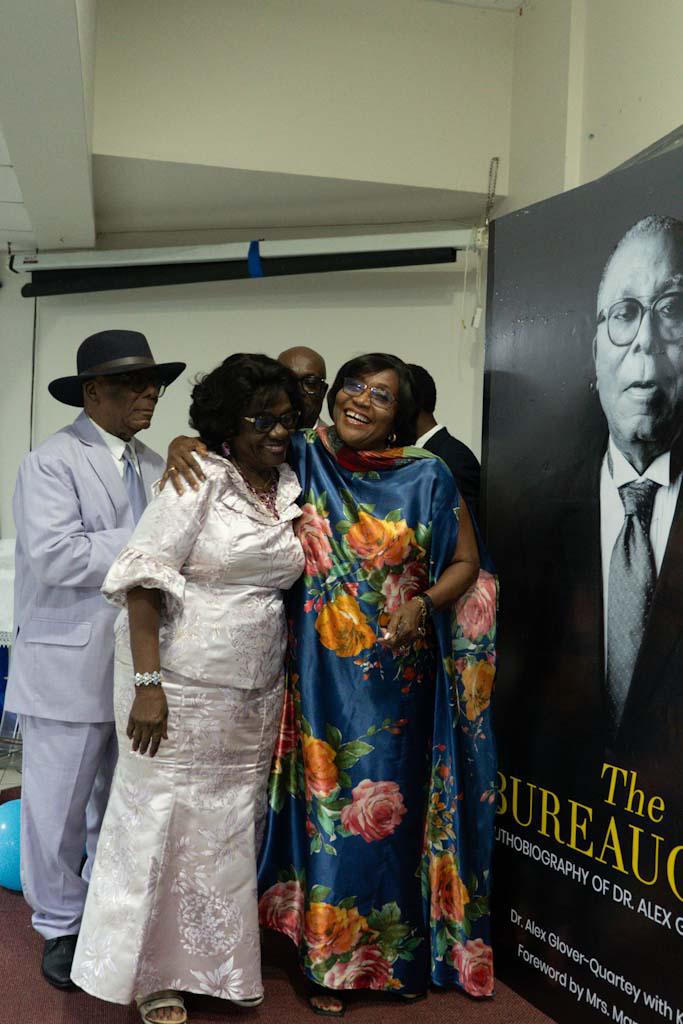
The 420-page book was launched on Wednesday, August 26, 2026, at Ridge Church in Accra, coinciding with Dr Glover-Quartey’s birthday.
The event brought together family, friends, former schoolmates and members of the New Patriotic Party (NPP) Council of Elders, as well as other guests who have been associated with the former civil servant’s career and public life.
Dr Glover-Quartey said the idea for the book began over 15 years ago after repeated conversations with friends about their childhood experiences.
“I quite recall that over a long period, my friends and I would be talking and sharing our experiences as children, and there was always or often the remark that the experiences I had had as a child needed to be documented,” he said.

He said the suggestion stayed with him and eventually prompted him to begin writing down his memories.
“I think this stuck in my head, so about 15 years or so ago, I started writing down what I remembered of my childhood, some of which made me really burst out laughing,” he said.
He initially wrote the stories without following any particular order and later shared the manuscript with friends and relatives for their comments.
Among those who reviewed the early drafts were his Achimota schoolmate, Korkor Jobson, his cousin and friend Martha Hunter, and his daughter, Noyo.
He said their input helped shape the manuscript, although completing the book proved to be a long and difficult process.
“There were times when I felt bored, tired, or simply lazy to write,” he said.
Dr Glover-Quartey revealed that he nearly abandoned the project after losing a significant portion of his manuscript while transferring his files from an old computer to a new laptop.
He recalled that his daughter had brought him a new laptop and encouraged him to start using it. He later asked his grandson to transfer his documents from the old machine to the new one.
However, after the transfer, he discovered that about half of the autobiography had disappeared.
“Lo and behold, half of what I had written down by way of my autobiography was gone,” he said, noting that he sought help from IT specialists but was unable to recover most of the missing material.
“The rest was all gone. And the idea of having to start all over again was so daunting that I decided I wasn't going to do it. So I left it."

The former Civil Service chief stated that after leaving the project for about a year, he eventually returned to it and began rewriting the lost sections.
“It was really painstaking. But eventually I got on to it, and I started writing,” he said.
However, he said his work suffered another setback following the death of Mrs. Charlotte S. Acheampong, whom he had hoped would help him edit and develop the manuscript.
“She agreed that she would give me sessions and we would meet on agreed occasions and then go through what I had written. Unfortunately, she kicked the bucket,” he said.
He said he later connected with publisher and co-author Kyei Amoakoh, whose involvement helped move the project towards completion.
“When I linked up with him, things started moving and I was eager to work and discuss and so on,” he said.
Dr Glover-Quartey also acknowledged the support of his wife, Rosemary, whom he jokingly described as his “boss at home”.
He said the eventual completion and launch of the book was largely a result of what he described as “the sheer grace of God”.
Beyond his personal experiences, Dr Glover-Quartey said 'The Bureaucrat' also examines changes in Ghana’s Civil Service and the country’s public administration over several decades.

He said the book compares the Civil Service he joined in 1976 with how the system evolved following the political changes of the early 1980s.
One of the issues he examines is the gradual breakdown of administrative systems and procedures that he said once ensured proper record-keeping and accountability in government.
He recalled how official correspondence was previously registered when it arrived at a ministry, creating a clear trail that made it possible to trace the movement of a document years later.
“If 10 years later, you're looking for that letter, there was a trail, and you could find where it went, and who was the last person to work on it,” he said.
He contrasted that system with what he described as a later practice where correspondence could be sent directly to ministers, sometimes resulting in documents being misplaced.
“That is when you have the era of letters getting lost, and the need for you to go and look for a copy or bring a copy, because the politician can't find it,” he said.
Dr Glover-Quartey said the decline of such systems had consequences for the efficiency of government and public administration.
He also recalled a 2004 visit to Ottawa, Canada, by a Ghanaian delegation of senior public officials, during which they studied administrative practices that, he noted, were similar to systems Ghana had used before the early 1980s.
He said the experience showed that some of the procedures Ghana had abandoned were still being successfully used elsewhere.
“We went to Ottawa, and what did we learn? I tell you, exactly the same things that we were doing before the advent of the PNDC,” he said.
Dr Glover-Quartey used the occasion to highlight what he considers two major challenges facing Ghana’s governance: the treatment of public servants and the conduct of politicians.

He said the country must recognise the importance of people who choose public service as a career.
“The importance of the public servant, the man or woman who has decided to make a career in serving the country, in applying rules and regulations, in applying or implementing policies that they had worked together to formulate,” he said.
He warned that poor conditions of service could affect the quality of public administration.
“If you want to give a pittance to the public servant, you don't care even whether he eats or not, how he goes to work, what happens to him, whether he is able to feed his family or not, you are going to get the quality of service that comes with it,” he said.
He also expressed concern about the influence of politicians on public institutions and national systems.
“The second thing is the danger of the caliber of most of our politicians in this country. We don't realize the extent to which they undermine everything we hold of value,” he said.
He called on Ghanaians to speak up more about issues affecting the country instead of simply complaining privately.
“So as a people, I know there is very little that can be done, but if we can gradually want to change things and make things what they should be, then we need to wake up and speak more,” he said.
Dr Glover-Quartey said he did not write the book as a set of instructions or lessons, but believed readers would find important lessons in the experiences and comparisons contained in it.
“There are quite a lot of things scattered across the pages, but they don't come as dictates or lessons, but the careful reader might pick a lot,” he said.
He said the book also revisits the workings of government in earlier years and examines how some administrative practices have changed over time.
He cited the system of government responses to reports of committees of inquiry as another example.
According to him, governments previously responded formally to such reports through what was known as a white paper, stating which recommendations were accepted and explaining why others were rejected.
“But now I think it's become even habitual. The government can refuse to write a, you report you send your report to government, and they can just keep quiet, nothing, blank,” he said.
Co-author and publisher Kyei Amoako described the book as a fitting way to celebrate Dr Glover-Quartey’s career in the Civil Service, nation-building and community leadership.
“I think we can call it a capstone, or celebrating an illustrious career in civil service, in nation-building, and being a leader in the community,” he said.
Mr Amoako said books were important because they preserved personal experiences, ideas and lessons for generations that might never meet the people who lived through those experiences.
“Books capture stories, books capture ideas, and they help us pass ideas on, and they will go on even after we are there and gone,” he said.
He encouraged Ghanaians to document their experiences, even if they could not write a full book.
“Use your smartphone, record the stories of your life growing up because it's important,” he said.
He said documenting personal experiences served three purposes: allowing people to reflect on their lives, helping the present generation learn from them, and providing future generations with access to knowledge and wisdom that would otherwise be lost.
“So, Dr. Glover Asante has done that. He has spent the time, many hours, remembering things and putting it down in the book,” Mr Amoakoh said.
Ambassador Dzifa Esther Ofori unveiled 'The Bureaucrat' at the launch.
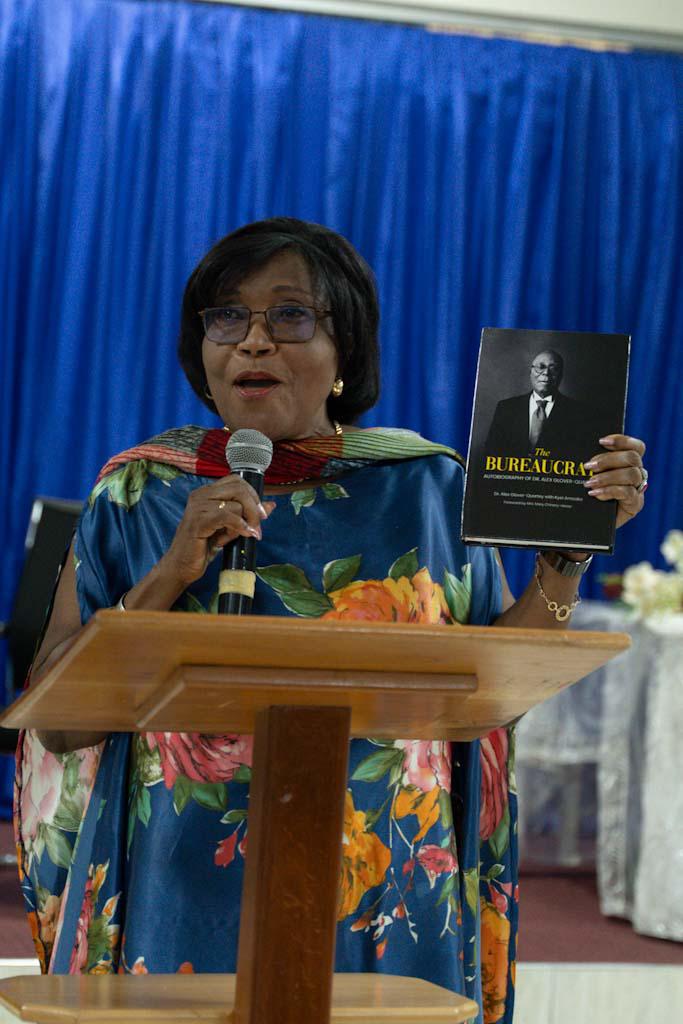
In her remarks, she described the publication as more than a personal memoir and praised Dr Glover-Quartey for presenting public service as a profession rooted in values.
“This book is more than a memoir,” she said.
She said Dr Glover-Quartey had given the word “bureaucrat” a different meaning by showing how public administration could be driven by faith, service and integrity.
“He has shown that bureaucracy driven by faith, service, integrity is a purpose and it's a noble calling in building a nation,” she said.
Ambassador Ofori described the book as “a masterclass” and recommended it to public servants, young professionals and people of different faiths.
“It must be read by every public servant, young professionals, Christians and non-Christians because then you will be also be challenged by your faith you might find a way after reading this book,” she said.
She formally launched the book on August 26, 2026, describing the occasion as a celebration of the author’s birthday and a contribution to preserving his experiences for the benefit of others.
Ambassador Ofori also praised the physical presentation of the book, noting that it contains 420 pages and is available in hard copy and paperback, adding that the writing was accessible and the print was easy to read.
“One of the things that I found very good about the book is that the English flows. It is not pedantic. So it's something that you can easily read,” she added.
Latest Stories
-
Police arrest suspect over jewellery theft during fire outbreak
2 hours -
EOCO returns Hanan’s £6,700, GH¢2,750 and devices after defence challenge
2 hours -
Opplift Youth Entrepreneurs Summit 2026 equips entrepreneurs with skills, mentorship and support
2 hours -
Rival clubs want range of punishments for Man City
2 hours -
Tear gas in Paris and Marseille as school protests grow across France
2 hours -
Kane inspires England to win over Czech Republic in UEFA Nations League
3 hours -
Finland orders halt to work on two Google data centres
3 hours -
Substitute Merino scores twice as Spain win in Croatia
3 hours -
Ronaldo wants Portugal ‘punishment’ but not retiring
3 hours -
White House defends Trump comment to let Iran ‘take out’ LA and San Diego
3 hours -
Asos confirms hackers sent ‘unauthorised’ notification to app users
3 hours -
US televangelist Jim Bakker, disgraced from sex scandal and fraud, dies at 86
3 hours -
Congolese-born golfer to represent Ghana at Turkish Airlines World Cup grand final
3 hours -
Amazon wins global rights to stream Emmys in six-year deal
4 hours -
European Film Festival returns to Ghana after a 5-year break
4 hours