

Audio By Carbonatix
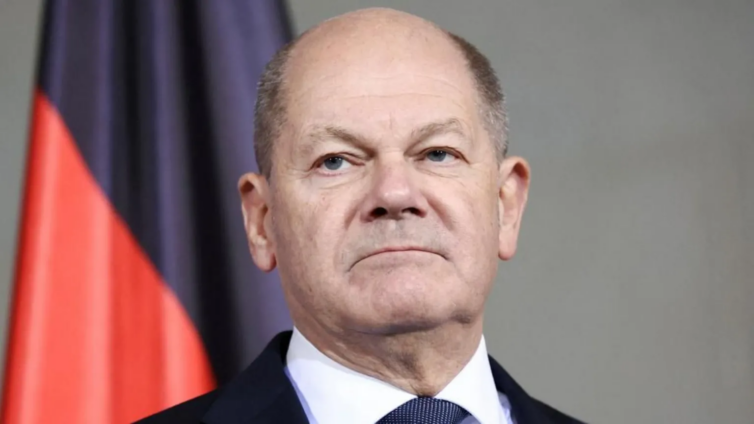
German Chancellor Olaf Scholz has lost a vote of confidence in parliament, paving the way for early elections on 23 February.
Scholz called Monday's vote and had expected to lose it, but calculated that triggering an early election was his best chance of reviving his party's political fortunes.
It comes around two months after the collapse of Scholz's three-party coalition government, which left the embattled chancellor leading a minority administration.
Ahead of Monday's vote, Scholz said it would now be up to voters to "determine the political course of our country", teeing up what is likely to be a fiercely fought election campaign.
Losing Monday's no-confidence vote was the outcome Scholz had wanted.
Thanks to the loss, elections can now happen in February, rather than in September as originally scheduled.
There were 207 MPs, mainly from his own party, who voted for Scholz, while 394 voted against him and 116 abstained.
Since Scholz's argumentative three-party governing coalition collapsed in November, he had been reliant on support from the opposition conservatives to pass any new laws, effectively rendering his administration a lame-duck government.
Given Germany's stalled economy and the global crises facing the West, staggering on until the scheduled election date of September 2025 risked being seen as irresponsible by the electorate.
Scholz's Social Democratic Party (SDP) is trailing heavily in opinion polls, while the conservative Christian Democratic Union (CDU) under Friedrich Merz appears to be on course for a return to government.
Opening the debate ahead of Monday's vote, Scholz said the snap election was an opportunity to set a new course for the country and called for "massive" investment, particularly in defence, while Merz said more debt would be a burden for younger generations and promised tax cuts.
'Kamikaze' move
Scholz's decision to stage a vote he expected to lose in order to dissolve his own government was described as a "kamikaze" move by the German tabloid Bild - but it is generally the only way a German government can dissolve parliament and spark early elections.
The process was designed specifically by the post-war founders of modern Germany to avoid the political instability of the Weimar era.
This vote of confidence is not a political crisis in itself: it is a standard constitutional mechanism that has been used by modern German chancellors five times to overcome political stalemate - and one Gerhard Schröder deployed on two occasions.
However, there is a deeper problem within German politics.
On the surface, the collapse of the coalition was sparked by a row over money. Scholz's centre-left SDP and his Green partners wanted to ease Germany's strict debt rules to finance support for Ukraine and key infrastructure projects.
That was blocked by Scholz's own finance minister, Christian Lindner, who is the leader of the business-friendly liberal Free Democratic Party (FDP), which prioritised driving down the debt.
Lindner was sacked and the coalition collapsed. After years of unedifying bickering, you could almost hear the sigh of relief in Berlin's corridors of power - but the underlying cause is more difficult to resolve and more worrying.
Germany's party political system has become more fragmented, with more parties than ever in parliament. The new upstart political forces are also more radical.
In 2017, the far-right Alternative for Germany (AfD) entered the Bundestag for the first time, winning 12.6%.
In 2021, it slipped to 10.4%, but is now polling at almost 20%.
The AfD will not get into government because no-one will work with it to form a coalition. But the far-right is eating into the share of the vote that goes to the two centrist big-tent parties which have always put forward modern German chancellors.
The bigger the AfD share is, the more difficult it becomes for mainstream parties to form a stable governing coalition.
That was arguably the underlying problem that pulled apart Scholz's fractious coalition: big-spending left-leaning Social Democrats and Greens trying to work with free-market small-state liberals.
Rather than going away after the next election in February, that problem is likely to get worse. If the far-right wins a fifth of seats in parliament, it could be even more difficult after February to form a stable coalition between like-minded parties.
Another new populist political party could also get into parliament for the first time, the anti-migrant nativist far-left Sahra Wagenknecht Alliance BSW, which is named after its firebrand Marxist leader.
The conservatives are leading in the polls, but as things stand their options for coalition partners are limited.
They refuse to work with the far-right and it is hard to imagine they would like to work with the radical left either. The free-market liberals may not even get into parliament, and some conservatives refuse to consider the Greens.
That leaves Scholz's SDP as a possible partner - even though Scholz is likely to be ousted from power after his stint in power saw his popularity plummet.
Whatever the next government looks like, the era of cosy consensual coalitions in Germany seems to be over.
Latest Stories
-
Woman injures three people in third Poland school knife attack in a week
8 seconds -
Ghana should join BRICS as partner, not member – NPP Bono East Regional Secretary
1 minute -
Ghana High Commission warns nationals in South Africa over protests in Johannesburg, Durban
1 minute -
Mahama praises Roads Minister for keeping Big Push contractors on their toes
7 minutes -
World Cup Visa Scandal: ‘My client has not collected money for visas’ – Ampofo Ankrah’s lawyer
18 minutes -
US immigration officials defend ICE agents who shot man in same car as child
28 minutes -
Commentator Katie Zacharia picked as new White House press secretary
31 minutes -
Drone strike by Sudan paramilitary kills 41 near Ethiopian border, rights group says
38 minutes -
King warns malicious online actors are evolving tactics
45 minutes -
Several injured as Saudi capital airport reportedly hit again
47 minutes -
Christa Pike discharged from hospital and returned to prison, her lawyers say
50 minutes -
Ghana’s BRICS move requires clear strategy to manage risks – Godfred Bokpin
3 hours -
Pay teachers realistic income – Duncan Amoah to gov’t
3 hours -
Bechem to become chicken capital of Ghana – Mahama projects
3 hours -
Mentapulse Africa’s Health and Labour Summit calls for better working conditions to retain skilled professionals
3 hours