

Audio By Carbonatix
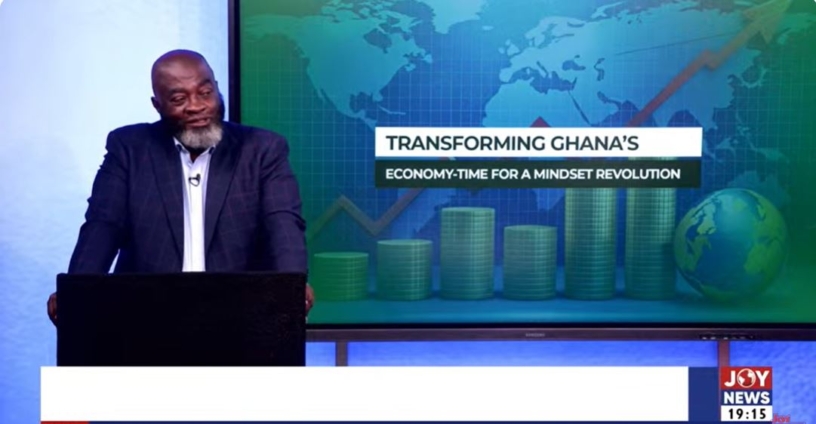
Founder and Senior Partner at AB and David Africa, David Ofosu-Dorte, has said that Ghana is more dependent today than it was before gaining independence, raising deep concerns about the country's mindset, productivity, and political culture.
Speaking at the JoyNews and Amalgam of Professional Bodies Speaker Series, Mr Ofosu-Dorte traced the roots of Ghana’s deep-seated disempowerment to a historical lineage of chieftaincy, slavery, and colonisation.
According to him, these experiences have left an indelible mark on the national psyche, affecting generations and creating a society that struggles with true autonomy.
He challenged the traditional interpretation of Ghana's independence, arguing that the nation never truly achieved full independence but rather transitioned into self-rule without dismantling the systems of dependency.
“So far as I'm concerned, we were never a dependent nation in the true sense," he noted. "Dependence means being entirely reliant on others. What we attained was self-rule, but ironically, it appears we are more dependent today than we were previously."
He lamented that over the years, post-colonial leadership — whether civilian or military — and now multi-party democracy, have worsened this culture of dependence. Citizens increasingly expect politicians to be the sole agents of national transformation, a mindset he says has led to political sycophancy and worsened national disempowerment.
"Unfortunately, multi-party democracy, which was supposed to liberate us, has led to a situation where citizens align with parties primarily for personal gain, deepening the worship of leaders even more," he said.
Drawing on examples from global history, Ofosu-Dorte compared Ghana's lack of bold, transformational projects today to the ambitious national efforts of the 1960s, such as Russia’s launch of Sputnik One, America’s moon landing, and China’s aggressive modernization under its "996" work culture. He emphasized the urgent need for Ghana to reignite a spirit of ambition and hard work.
"In a country with very low productivity, increasing productivity through various means is essential," he added. "If we don't rebuild a confident, hardworking society, the transformative change we hope for will remain elusive."
Latest Stories
-
Pastor William Gyimah remanded over threats against Vice President Prof Opoku-Agyemang
24 minutes -
Sunyani Technical University dismisses 3 students over examination malpractice
28 minutes -
NPRA prosecutes 11 employers, recovers GH¢27m in 2025
30 minutes -
NAIMOS cracks down on illegal mining activities along River Tano
31 minutes -
2026 World Cup: Officials selected are the world’s very best – FIFA defends referees list
39 minutes -
NAIMOS taskforce embarks on major anti-galamsey operations at GREL plantation and along Ankobra River
41 minutes -
Akufo-Addo arrives in Cotonou to lead ECOWAS mission to observe Benin presidential election
48 minutes -
AMA, Mexican Embassy renew commitment to strengthen bilateral cooperation, deepen sister-city ties
52 minutes -
Bolt pushes for expanded support for women-owned enterprises
1 hour -
Today’s Front pages : Friday, April 10, 2026
2 hours -
‘We don’t have time’ – Fianoo calls for Schäfer to lead Black Stars temporarily
3 hours -
CAF will not favour any country – President Motsepe
3 hours -
Otto Addo was appointed through the backdoor – Kudjoe Fianoo slams GFA
3 hours -
UG Corporate Football League back from the Easter break
3 hours -
Qualcomm unveils startup selection for Qualcomm Make in Africa 2026
3 hours