

Audio By Carbonatix
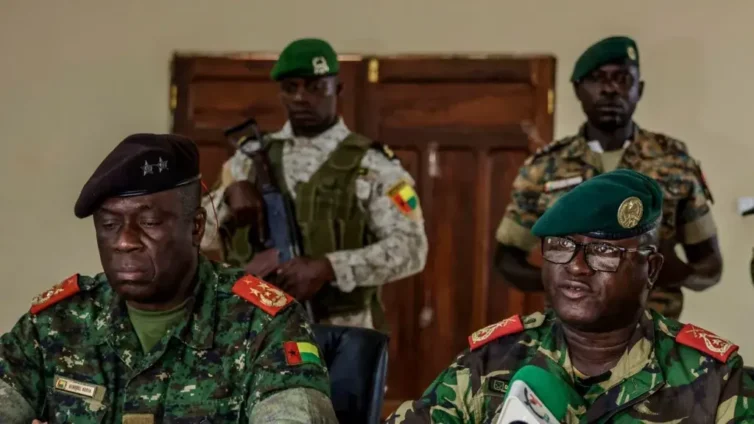
A new analysis by the Global Security for Africa Research and Good Governance (GLOSARGG) has attributed the recent coup in Guinea-Bissau to years of constitutional violations, institutional decay, and deep-seated criminal infiltration of the state.
The organisation’s Executive Secretary, security expert and humanitarian critic Francis Ahovi, issued the assessment in a press statement dated 27th November 2025, calling for decisive regional and international action to restore stability.
According to him, the current crisis is the product of a sustained breakdown in constitutional order. Repeated unlawful dissolutions of parliament, the unilateral dismissal and appointment of prime ministers, interference in the judiciary, and the politicisation of the security forces have created what Mr Ahovi describes as a “governance vacuum”.
This vacuum, he noted, emboldened military factions and criminal actors, ultimately culminating in the overthrow of constitutional authority.
GLOSARGG identifies multiple, interlinked drivers of instability. These include executive overreach, competing command structures within the military and police, the growing influence of narcotrafficking networks, weak parliamentary oversight, and widespread economic hardship.
Organised crime, in particular the narcotics trade, has, according to Mr Ahovi, penetrated political circles and is shaping decision-making at the highest levels.
He was also critical of the regional response, pointing to weaknesses within ECOWAS and the African Union. He highlighted slow consensus-building, reluctance to sanction sitting presidents who breach constitutional norms, limited rapid-deployment capability, and gaps in intelligence-sharing.
Inconsistent enforcement of sanctions, he warned, has further undermined regional credibility.
The statement outlines several immediate priorities designed to reverse the escalating crisis. These include deploying neutral observers to safeguard civilians, instituting targeted sanctions such as travel bans and asset freezes, and stabilising the security forces by halting politically motivated promotions.
GLOSARGG also calls for an independent fact-finding mission comprising ECOWAS, the AU and the UN to document constitutional breaches and human rights violations.
Looking ahead, the organisation proposes a short-term transitional arrangement lasting six to twelve months, led by a civilian authority and backed by a Security Oversight Mechanism to prevent further factional clashes.
Plans also include intensified anti-narcotics operations with UNODC and EU partners, alongside scaled-up humanitarian assistance for vulnerable and displaced populations.
Medium-term reforms, spanning six to 24 months, include comprehensive security sector reform, tightening constitutional checks on executive power, improving electoral integrity, and strengthening anti-corruption systems such as asset recovery and transparent budgeting.
GLOSARGG also advocates a judicial fast-track system to resolve electoral disputes more efficiently.
In the longer term, the organisation recommends structured civil–military training, enhanced regional intelligence-sharing, civic education programmes to reinforce democratic values, and youth employment initiatives to reduce the appeal of extremist or criminal recruitment.
To strengthen regional responses, Mr Ahovi urged ECOWAS and the AU to establish a Rapid Stabilisation Force, adopt automatic sanctions for unconstitutional actions, including those committed by sitting presidents, and create a permanent joint monitoring commission involving the UN and CPLP, with public updates every 90 days.
He concluded that resolving Guinea-Bissau’s political and security crisis will require more than negotiation between political elites.
“A viable solution must confront breaches of executive constitutional authority, the politicisation of the security sector, and the criminal economies that perpetuate instability,” he stated, adding that only bold institutional reforms and firm regional leadership will ensure long-term resilience and prevent future upheavals.
Latest Stories
-
Church of Pentecost supports over 2,000 BECE candidates in Obuasi with career guidance seminar
9 minutes -
Brandon Asante and Coventry all but promoted to Premier League despite Sheffield Wednesday draw
30 minutes -
GPL 2025/26: Late Kwartemaa strike downs Hearts in Tema
37 minutes -
Ghana Faces Sierra Leone Moment as Prosecutorial Powers come under strain
47 minutes -
Don’t consume fish or seafood from Tema Shipyard until further notice – FDA warns
51 minutes -
Why volunteering might be Africa’s most underrated career accelerator
58 minutes -
ActionAid Ghana raises concern over gender gaps in Feed Ghana Programme
60 minutes -
Windstorm wreaks havoc in Gushegu, displacing nearly 2,000 residents and damaging schools
1 hour -
Friends of Bridget Bonnie Marks her 35th birthday with donation to Kasseh Model Health Centre
2 hours -
From Ekumfi Kokodo to the Pulpit Stage: Essi Donkor’s gospel journey takes shape
2 hours -
Landfilling waste management creates no value, it’s an economic waste
2 hours -
Photos: Speaker Bagbin Commissions MPs constituency office under parliamentary decentralisation programme
3 hours -
Black Stars technical advisor Winfried Schäfer sacked as GFA shakes up backroom staff
3 hours -
Wenchi water project almost complete, critical to gov’t agenda – GWL MD
3 hours -
Anti-LGBTQ+ bill not part of government’s legislative agenda – Inusah Fuseini
3 hours