

Audio By Carbonatix
Haiti's government declared a 72-hour state of emergency on Sunday after armed gangs stormed a major prison. At least 12 people were killed and about 3,700 inmates escaped in the jailbreak.
Gang leaders are demanding the resignation of Prime Minister Ariel Henry, whose whereabouts are unknown since he travelled to Kenya.
Gangs control around 80% of the capital, Port-au-Prince.
Gang violence has plagued Haiti for years.
A government statement said two prisons - one in Port-au-Prince and the other in nearby Croix des Bouquets - were stormed over the weekend.
It said the acts of "disobedience" were a threat to national security and said it was instituting an immediate night-time curfew in response, which started at 20:00 local time (01:00 GMT on Monday).
Haitian media reported that police stations were attacked, distracting authorities before the coordinated assault on the jails.
Speaking to the BBC from Haiti, Serge Dalexis from the International Rescue Committee said that many police stations were under gang control on Friday, with "many police killed over the weekend".
Among those detained in Port-au-Prince were suspects charged in connection with the 2021 killing of President Jovenel Moïse.
Gang violence has further escalated since his assassination in 2021. Mr Moïse has not been replaced and presidential elections have not been held since 2016.
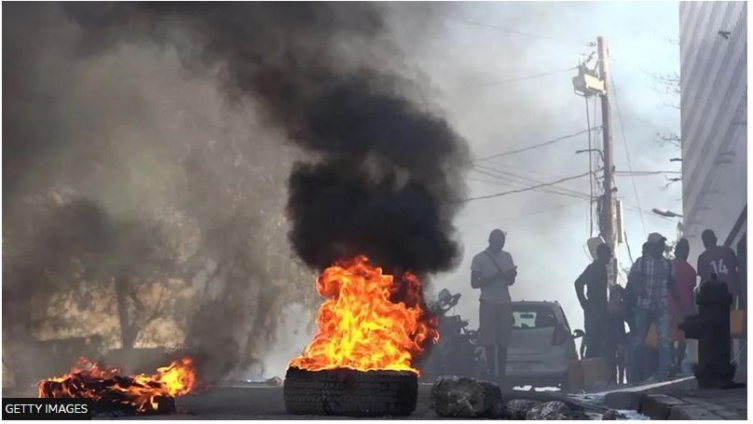
In the capital, gangs have erected barricades to prevent security forces from encroaching on their territory, while their strongholds in Port-au-Prince's vast shantytowns are still largely on lockdown.
Schools and many businesses are closed, and there are reports of looting in some neighbourhoods.
People are scared and the streets are empty, Boby Sander from the humanitarian aid organisation Food for the Hungry told the BBC.
Since Friday, 15,000 people have been displaced from their homes and many are now staying in a school building in the centre of Port-au-Prince, Mr Sander said.
His organisation has only been able to provide them with hygiene kits to last a few days. "We don't have adequate capacity to deal with the complexity of the need increasing," he added.
The latest upsurge in violence began on Thursday, when the prime minister travelled to Nairobi to discuss sending a Kenya-led multinational security force to Haiti.
Gang leader Jimmy Chérizier (nicknamed Barbecue) then declared a co-ordinated attack to remove him.
"All of us, the armed groups in the provincial towns and the armed groups in the capital, are united," said the former police officer, who is accused of being behind several massacres in Port-au-Prince.
Haiti's police union had asked the military to help reinforce the capital's main prison, but the compound was stormed late on Saturday.
On Sunday the doors of the prison were still open and there were no signs of officers, Reuters news agency reported. Three inmates who tried to flee lay dead in the courtyard, the report said.
A journalist for the AFP news agency who visited the prison saw around 10 bodies, some with signs of being shot.
One volunteer prison worker told the Reuters news agency that 99 prisoners - including former Colombian soldiers jailed over President Moïse's murder - had chosen to remain in their cells for fear of being killed in crossfire.
Anger at the shocking levels of violence, on top of the political vacuum, have led to several demonstrations against the government, with protesters demanding the resignation of the prime minister.
Under a political deal, he was due to stand down by 7 February - but planned elections were not held and Prime Minister Henry remains in post.
Speaking to the BBC's Newsday, Claude Joseph - who was serving as acting prime minister when President Moïse was assassinated and who is now head of the opposition party called Those Committed to Development - said Haiti was living through a "nightmare".
"He [Ariel Henry] agreed to step down on 7 February. Now he decides to stay, despite the fact that there are huge protests throughout the country asking him to step down… now those criminals are using violent means to force him to step down."
Latest Stories
-
Prime Insight: Making room for meaningful national conversations on Joy Prime
8 minutes -
FABAG commends Ato Forson’s over removal of 20% excise duty on locally manufactured fruit juices
15 minutes -
HIV stigma discourages testing, prevention and treatment in Ghana – Ghana AIDS Commission
17 minutes -
Blocking cocaine probe lends weight to claims of political protection for traffickers – Assin South MP
21 minutes -
NPP Vice Chair race: I may be the youngest, but most experienced – Nana B
23 minutes -
Last UK and US troops leave Iraq as anti-Islamic State mission ends
23 minutes -
Don’t stay home idle, embrace entrepreneurship while awaiting posting – Unemployed nurses urged
35 minutes -
Aayalolo buses not speeding on contra-flow lanes – GAPTE assures commuters
38 minutes -
Effia MP calls for Kurt Okraku’s removal, overhaul of Ghana football structure
38 minutes -
CAS hearing on AFCON final appeal by Senegalese Football Federation set for October 8
39 minutes -
STC fares to go up by up to 8% this week – Deputy MD
40 minutes -
Photos: Accra-Kumasi bypasses get new lease of life as contractors return to site
40 minutes -
Man allegedly swallows five SIM cards to conceal evidence after arrest
41 minutes -
After three finals, Ayikuma Methodist Basic School finally lifts National Juniors Challenge trophy
41 minutes -
Black Stars management ignored players’ health conditions ahead of Gambia game – Ernest Thompson alleges
42 minutes