

Audio By Carbonatix
The IAEA profiles employees to provide insight into the variety of career paths that support the Agency’s mission of Atoms for Peace and Development and to inspire and encourage readers, particularly women, to pursue careers in STEM (science, technology, engineering and mathematics) or STEM-adjacent fields. Read more profiles of women at the IAEA.
For Hannah Affum, a chemical engineer turned nuclear scientist, curiosity has always been her compass. From mixing household chemicals as a child in Ghana to launching the IAEA’s Non-Destructive Testing (NDT) Centre, her journey defied expectations — and shows that science thrives on passion, not stereotypes.
A Spark for Science
Affum’s love for science began early. “I was fascinated by reactions — how combining substances could create new colours, even explosions,” she said. Excelling in math and chemistry, she studied chemical engineering, inspired by an aunt who was the family’s first physicist. “She showed me science wasn’t just a career; it was a way to solve problems,” Affum said.
After completing her bachelor’s degree, she was assigned to the Ghana Atomic Energy Commission (GAEC) for her mandatory national service. There, she became interested in air pollution monitoring and pursued further studies (MPhil) at the University of Ghana. “That was my turning point,” she recalled. “I realized engineering could directly improve lives.” Her research applied nuclear activation analysis to characterize established biomarkers of exposure to heavy metals from air pollution. Following on from this research, she joined GAEC’s radiotracer laboratory, collaborating closely with seasoned industrial experts in advancing radiotracer applications in Ghanaian industries.
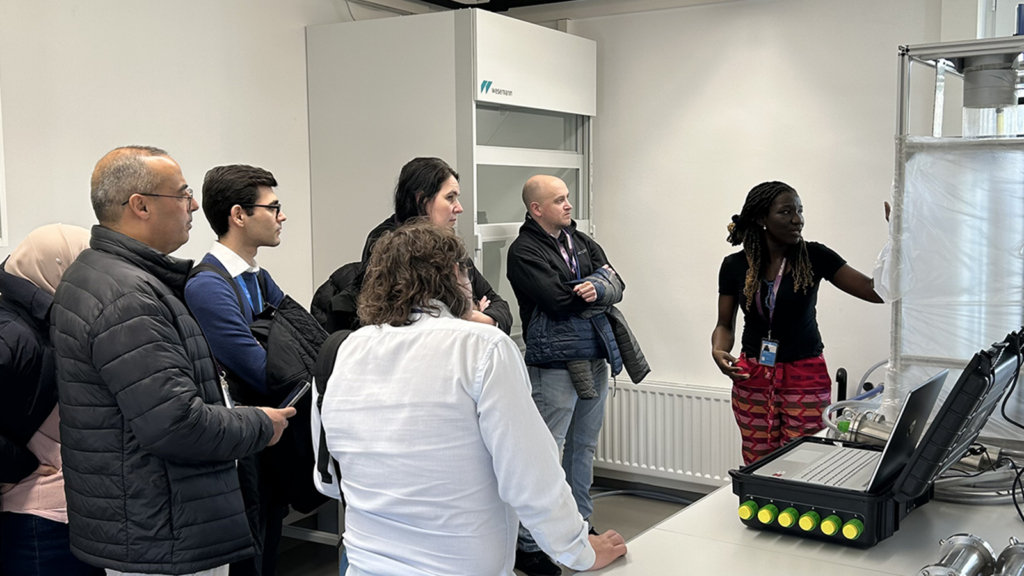
Challenges and Champions
Early on, scepticism loomed. Affum said that people were worried, asking her if she would find a job as a woman in engineering. But mentors like Professor Francis Allotey, a mathematician and nuclear physicist at GAEC, pushed her forward. “He was relentless — encouraging me to publish, speak at conferences, and mentor other women,” she said. Only two women worked in her centre at GAEC, but Affum thrived. Her parents had always encouraged her curiosity — her father through storytelling, and her mother through unwavering support. She blended her father’s journalistic ethos with scientific rigor. “He taught me to communicate complex ideas simply. Science must serve the public,” Affum said. “And my mum was my biggest fan!”
An Unexpected Path to the IAEA
Joining the IAEA was never part of the plan. “I thought it was out of reach,” she said. But one of her international mentors, Professor Jovan Thereska, urged her to apply. “I doubted my qualifications, but he saw my potential.” In 2022, she took up a post as an IAEA industrial technologist. She uses radiotracer technology and NDT to help process industries track how substances move through industrial systems — such as pipelines or reactors — and to identify defects in infrastructure. This work also supports disaster preparedness by ensuring critical systems function safely.
Her proudest achievement? Launching the IAEA’s Non-Destructive Testing Centre in Seibersdorf, Austria, in 2024. “After years of planning post-Fukushima, we now have a hub to train countries in NDT emergency response,” she said. The Centre equips countries — especially those prone to natural disasters — with cutting-edge tools to inspect critical civil infrastructure accurately and safely. “It’s about saving lives before crises strike,” Affum said.
Advocating for Women — and the Power of Nuclear
Affum actively mentors young women through Women in Nuclear Ghana, emphasizing early exposure to math and science. “Many girls think STEM is ‘too hard,’ but it’s about passion, not innate genius,” she said. Affum challenges misconceptions about radiation head-on: “Yes, it can be harmful if misused, but its benefits — in cancer treatment, agriculture and industry — are transformative.”
Outside work, Affum and her husband mentor underprivileged youth in Ghana. “If I weren’t a scientist, I’d be a social worker,” she said. “Empowering people is my purpose.”
Her advice to young scientists? “Jump at opportunities, even if you feel unready. And remember science isn’t that difficult — it’s just a puzzle waiting for your unique solution.”
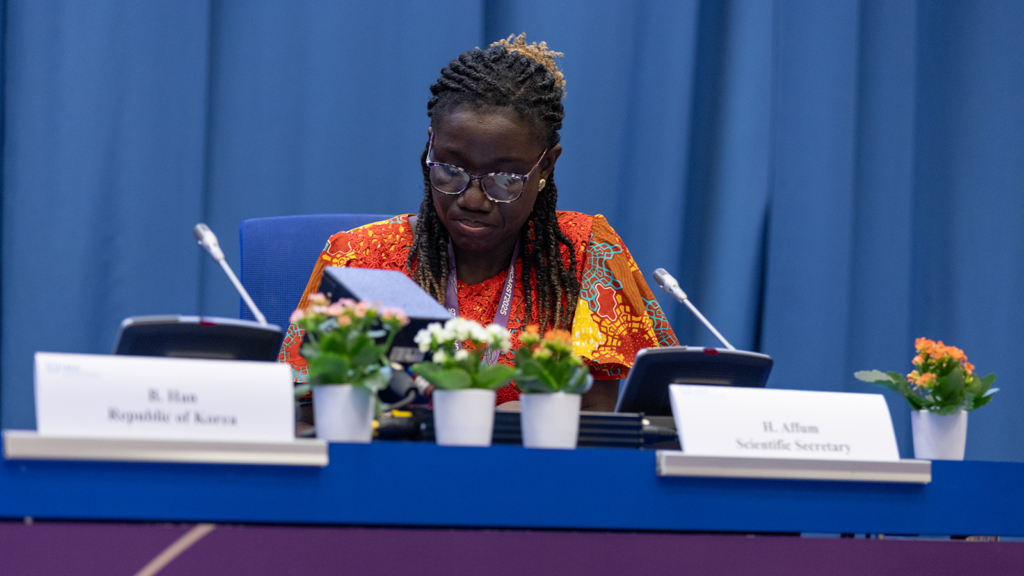
The IAEA’S Commitment to Gender Equality
The IAEA is committed to gender equality and to supporting the ability of all individuals, regardless of gender, to equally contribute to and benefit from its programmes and activities.
The IAEA’s Marie Sklodowska-Curie Fellowship Programme supports the next generation of women nuclear professionals by offering scholarships for master’s degree in nuclear-related fields, and the Lise Meitner Programme offers early- and mid-career women multi-week training visits to nuclear facilities.
Credit: IAEA Profile
Latest Stories
-
Leeds say boos during Ramadan pause ‘disappointing’
38 minutes -
Premier League deletes Vicario social media post
49 minutes -
Real Madrid beaten at home by Getafe for second successive loss
58 minutes -
‘Clubs refused to look at me after my crash’ – Antonio on Qatar move
1 hour -
Mayweather to fight kickboxer before Pacquiao rematch
1 hour -
India and Canada reset ties with ‘landmark’ nuclear energy deal
1 hour -
Mahama should equally credit NPP for economic stability – Economist
2 hours -
Mbappe has knee sprain with no surgery planned
2 hours -
Interior Ministry releases funds to settle 2025 rent allowance arrears for security services
2 hours -
Ghana evacuates diplomatic staff from Iran; embassy shut indefinitely — Ablakwa
2 hours -
France to boost nuclear arsenal and extend deterrence to European allies
3 hours -
Chinese community in Ghana marks ‘Year of the Horse’ with grand new year festival
3 hours -
When regional instability becomes national risk: Ghanaian tomato traders killings
3 hours -
Photos: President Mahama meets Tanzania President Suluhu Hassan
3 hours -
Mahama calls for cessation of Iran-US-Israel conflict, urging return to dialogue
4 hours