

Audio By Carbonatix
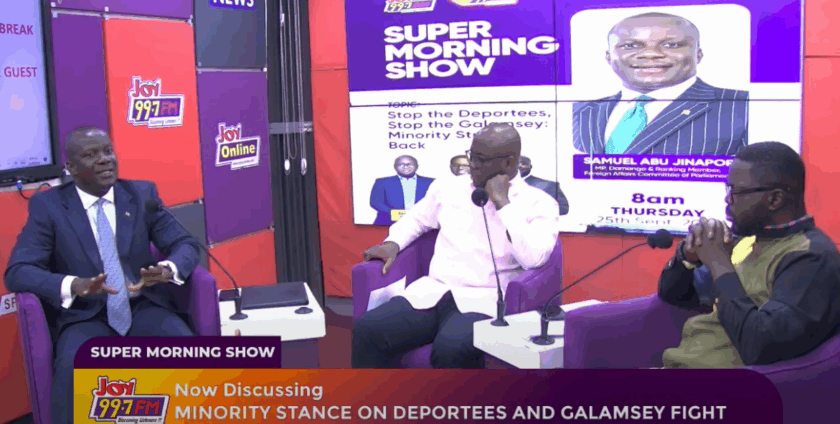
Ranking Member of Parliament’s Foreign Affairs Committee, Samuel Abu Jinapor, has said it is not too late for the Foreign Affairs Minister, Samuel Okudzeto Ablakwa, to present the MoU on the controversial agreement on U.S deportees for ratification.
Speaking on Joy FM’s Super Morning Show, the Damongo MP responded to a question on whether the deal could still be revisited after some deportees had already arrived in the country.
“I am not too sure it’s too late,” he said. “I think it is just the perfect time, especially that Parliament is going to resume in October for the agreement to be laid before Parliament, and for Parliament to take a look at it.”
According to him, minority members on the Foreign Affairs Committee will make use of every available option in Parliament to ensure due process is followed.
“The minority members on the Foreign Affairs Committee intend to resort to all the parliamentary tools available, including also contemplating or examining the legal route to get to the point where the right thing is done,” he noted.
Mr Jinapor expressed confidence that the government would eventually act in line with the law. “I am sure the Minister will obviously have taken note of our comment and our statement, and I want to believe that good reason will prevail and he will take the step to lay the MoU before Parliament for ratification.”
Mr Jinapor explained that Ghana’s Constitution gives clear direction on such matters. He pointed to Article 75, which states that treaties or agreements that place obligations on the country must receive parliamentary ratification.
“The framers of our Constitution, specifically Article 75, were very deliberate and the provisions of Article 75 are absolutely unambiguous,” he said.
“We’ve had multiple occasions where the Supreme Court has made firm pronouncements that even note verbals, which are administrative exchanges of correspondence, will require parliamentary ratification.”
He added that the purpose of this requirement is to allow the people’s representatives to carefully examine such agreements on behalf of citizens.
“I want to believe that the rationale behind Article 75 is just so that people’s representatives, in the course of the tenure of government, get the opportunity to scrutinise such agreements, and so that we all be on the same page,” Mr Jinapor said.
The MP also said that following the constitutional process would benefit the government itself.
“I think it is even in the interest of the government, for the government to come through the route of Article 75 and make matters absolutely transparent,” he said.
Latest Stories
-
President Mahama ends Resetting Ghana tour of Ahafo Region
1 hour -
African negotiators seek delivery of climate commitments at COP31
1 hour -
BoG develops AI rules for financial sector
1 hour -
‘Big Push’: Government assures contractors of prompt payments
1 hour -
Court fines miner for breaking into gold buying shop
1 hour -
Tarkwa court jails labourer for three years over GH¢123,000 theft
2 hours -
GAEC must retain nuclear scientists for Ghana’s nuclear ambitions – Minister
3 hours -
Man reportedly mistaken for game and shot by hunter dead in forest
3 hours -
19-year-old mason jailed 15 years for defiling seven-year-old pupil
3 hours -
Ghana’s banking sector assets rise 20.47% to GH¢500.2bn – BoG Governor
3 hours -
22 injured as Sprinter bus overturns at Sege after tyre burst
3 hours -
UN housing expert urges Ghana to strengthen Rent Control Department amid housing affordability concerns
3 hours -
Delta-BCI partnership reaches 166,000 people with breast cancer education
3 hours -
Power restoration fault suspected in Kumasi Central Market fire
9 hours -
The 7-foot giant of Ngleshie Amanfro: Seven-foot Ghanaian Ephraim Saawa dreams of joining the national basketball team
9 hours