

Audio By Carbonatix
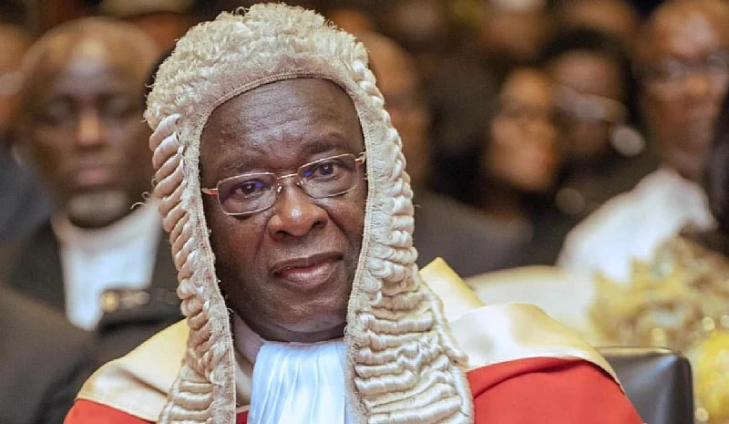
Chief Justice Paul Baffoe-Bonnie has said that the judiciary’s legal vacation does not suspend court proceedings, and urgent cases will continue to be heard.
He said the arrangement allowed judges to take their annual leave while ensuring that cases requiring urgent attention, including injunction applications and applications for the release of bodies, were dealt with.
Justice Baffoe-Bonnie made the clarification during a courtesy call at the Minerals Income Investment Fund (MIIF) in Accra on Wednesday, as part of his institutional visits.
The legal vacation runs from August 1 to September 30 and is intended to provide a break for judges, lawyers and judicial staff, although designated vacation courts continue to sit on urgent matters.
The Chief Justice said concerns surrounding the legal vacation had been “blown out of proportion”, explaining that judges designated as vacation judges remained available to deal with emergency processes from courts whose judges were on leave.
He said under the arrangement, some judges remained at post to handle emergency matters while continuing with their own cases, and would proceed on leave when the other judges returned.
“What it means is that all emergency cases that come from Court One will be handled by the Court Two judge, who is not on leave,” he said.
Justice Baffoe-Bonnie advised lawyers whose cases were fixed during the legal vacation, and who found the dates inconvenient, to approach the courts for adjournments, as they would during the normal legal term.
“It’s a judicial decision. It’s not the Chief Justice who orders a judge to adjourn a case,” he said.
On case delays, the Chief Justice said the judiciary was reviewing its rules to address procedural technicalities that contributed to delays in case determination.
He said a committee had completely revamped the Rules of Court and expected the revised rules to be passed before the end of the year.
On illegal mining, Justice Baffoe-Bonnie said the judiciary had a responsibility to understand the effects of the menace beyond determining cases brought before the courts.
He said judges had been exposed to the effects of illegal mining and to prison conditions as part of efforts to deepen their understanding of issues arising in cases before them.
The Chief Justice also disclosed that specialised courts had been established to deal with specific categories of cases and improve the speed of justice delivery.
He commended MIIF for its performance and resource management, saying the Fund had demonstrated that effective management could generate significant returns for the country.
“Whatever you have been doing, do it better,” he told the management.
Mrs Justina Nelson, Chief Executive Officer of MIIF, said the Fund was established under the Minerals Income Investment Fund Act, 2018 (Act 978), with a mandate to assist the Government in mobilising mineral royalties, monetising them where necessary, and supporting it in addressing budgetary shortfalls.
She said MIIF also had an investment wing mandated to invest across the mining value chain, including equities, alternative investments and fixed-income instruments, to generate revenue for present and future generations.
Mrs Nelson said MIIF recorded a 5.4 per cent increase in royalty collections in 2025 compared with 2024 and generated GH¢1.1 billion in income.
She said the Fund had also recorded strong results in 2026 and projected royalty collections of about GH¢9 billion by the end of the year.
Mr Richard Kwame Asante, Board Chairman of MIIF, said illegal mining posed serious environmental, economic and governance challenges.
He welcomed the establishment of specialised courts to facilitate the timely determination of cases related to illegal mining.
Mr Asante said MIIF remained committed to transparency, accountability, integrity and professionalism, adding that the Fund looked forward to sustained engagement with the Judiciary on matters of mutual interest.
Latest Stories
-
Imagination Africa, Mentors Chess Academy to host second African Genius Chess Championship at Ghud Park
2 hours -
Techiman South MP ends decades of water struggle in Asutia
3 hours -
Three things we’ve learnt about the UK economy from the IMF
3 hours -
Nana B passport claims a diversionary tactic — Abu Jinapor
3 hours -
Pope Leo diagnosed with cancer as doctors remove lobe of lung, Vatican says
3 hours -
Legal Aid Commission takes free legal services to Techiman main lorry terminal
3 hours -
Nana B denies seeking passport favour, accuses Ablakwa of failing to account for GH¢16.4m
3 hours -
Young girls demand climate action, stronger protection against child marriage
4 hours -
Ex-gang boss sentenced to 40 years for orchestrating Tupac Shakur’s murder
4 hours -
From near-deferral to three awards: UMaT graduate’s academic journey
4 hours -
Atta Akyea denies seeking presidential pardon for Wontumi in galamsey case
4 hours -
Sasaabi scam centre busted: 19 arrested, 117 trafficking victims identified in global crackdown
4 hours -
Photos: Mahama commissions 85-bed Police Hospital ward, donates two ambulances
4 hours -
GTEC directs Ghana’s public universities to reopen by October 16 and begin lectures on October 19
4 hours -
Star Oil donates GH¢1million towards construction of new CID facility
5 hours