

Audio By Carbonatix
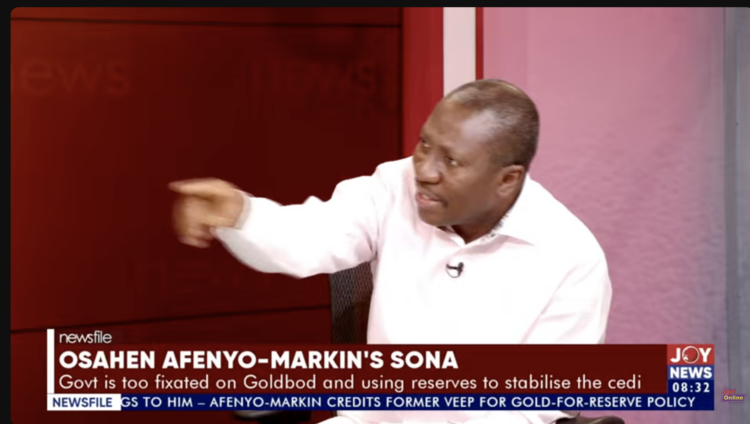
Minority Leader Alexander Afenyo-Markin has criticised the Mahama administration’s flagship 24-hour economy policy, describing it as heavy on publicity but light on practical solutions, especially in the face of Ghana’s rising energy costs.
Speaking on Newsfile a day after President John Dramani Mahama delivered his 2026 State of the Nation Address, Afenyo-Markin said the policy would struggle to create jobs unless the government urgently addressed challenges in the power sector.
According to him, high electricity tariffs and delays in power connections are discouraging private investment and keeping factories idle.
“He’s invested huge sums of money in this factory. He’s done. Meanwhile, if the man had started his business, I’m sure at a minimum he would have created some 100 jobs. Is that okay?” he said, recounting the experience of a friend whose factory has remained closed for more than six months.
The Minority Leader said the investor has been unable to secure a transformer from the Electricity Company of Ghana and is still negotiating the high cost of direct power supply with the Ghana Grid Company.
His comments come days after President Mahama signed the 24-Hour Economy Authority Bill into law on February 19, 2026. The new legislation establishes a coordinating body for the policy and offers tax rebates and import duty waivers to companies operating multiple shifts.
In addition, the 2026 Budget allocated GH¢110 million to begin setting up the Authority and supporting implementation.
However, Afenyo-Markin argues that these incentives mean little if businesses cannot afford power.
Ghana entered 2026 with a 9.86 per cent electricity tariff increase, and further adjustments are expected following reviews by the Public Utilities Regulatory Commission. Energy and gas inflation also rose sharply in early 2026, adding to pressure on manufacturers.
The Minority Leader said these conditions make it difficult for companies to operate around the clock, as envisioned under the government’s policy.
“The PR — they are getting fixated on government PR. Ministers are more interested in social media talk than action,” he said. “The young men and women who followed them and were singing? They are tired of singing. They want jobs.”
Afenyo-Markin, however, insists that more urgent and concrete steps are needed.
Latest Stories
-
Kwahu Business Forum: Ghana Sports Fund calls for stronger corporate backing for sports dev’t
2 minutes -
Penplusbytes’ statement on police action against deepfake and misinformation activities in Ghana
33 minutes -
QNET, EOCO partnership showcased at UN global fraud summit as model for fighting organised crime
33 minutes -
Mussa Dankwah is like a ‘lotto doctor’ – Miracles Aboagye
39 minutes -
Investors target Ho Airport for training and maintenance hub — GACL Chair
44 minutes -
NDC’s ‘grand deception’ on anti-LGBTQ+ bill exposed – Ntim Fordjour
45 minutes -
Speak out against Mahama government’s LGBTQI+ u-turn – Ntim Fordjour to clergy
49 minutes -
Ghanaians worse off despite improved macroeconomic indicators — Miracles Aboagye
52 minutes -
Police intercept narcotics, arrests five suspects in Upper West
58 minutes -
Government to establish Kumasi Machinery Innovation Park under 24-Hour Economy programme
1 hour -
When Hormuz Fails: The day a waterway stops the world
1 hour -
Ghanaian students in UK to protest over unpaid fees, stipends
1 hour -
Inflation to go up marginally in April 2026 – Report
1 hour -
Newborn baby found abandoned at Kronkromase cemetery, residents in shock
1 hour -
VIP Jeoun Transport increases fares effective April 8
1 hour