


Audio By Carbonatix
The Nelson Mandela Foundation has asked the courts to ban "gratuitous displays" of the apartheid-era South African flag.
The foundation argues public displays of the flag amounts to "hate speech, unfair discrimination and harassment".
The flag, it added, was a celebration of the crime against humanity committed by the white minority regime against millions of South Africans.
But some have reacted angrily, saying it would limit freedom of expression.
The foundation, which was set up to continue the legacy of Mr Mandela following his tenure as South Africa's first black president, filed the application with the Equality Court in Johannesburg on Tuesday.
In a statement released the next day, it revealed it had been prompted to act after the flag was on show during the "Black Monday" protests against white farm murders last October.
During debates following the march, the foundation said, it became clear "some South Africans do not fully appreciate that apartheid was a crime against humanity... and that gratuitous displays of apartheid symbols, such as the old flag, are a celebration of that crime and a humiliation of its victims".
What is the flag?
The orange, white and blue flag was brought in in 1928, and came to represent white-minority rule during the apartheid era.
It was based on the Dutch Prince's flag, and included smaller flags of the Orange Free State, South African Republic and the British Union Jack - all reminders of the country's colonial past.
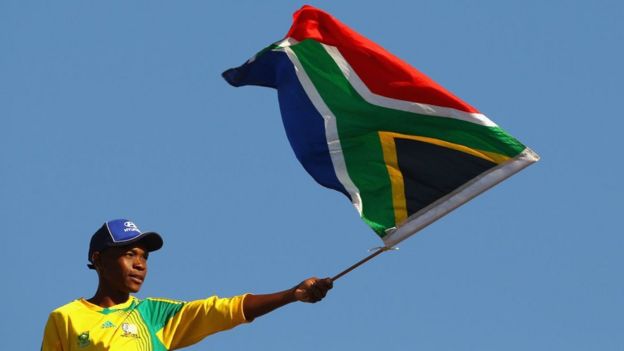
This has been the flag of South Africa since 1994
It was finally replaced in 1994 by one which sought to represent the entire "Rainbow Nation", as South Africa came to be called.
It was later revealed to have been personally approved by Mr Mandela and the current President, Cyril Ramaphosa.
So why do some people still fly it?
According to the Nelson Mandela Foundation's news release, Afriforum - which focuses on the rights of South Africa's Afrikaans population - said they understood the flag "offends dome people".
However, it argued it should not be banned as it was part of history.
Others on social media have said banning the flag would impinge on their freedom of expression.
Would it be a total ban?
No, the foundation is not calling for it to be wiped from history.
The flag would still be allowed in "museums, documentaries and cathartic creative works", it said.
Latest Stories
-
White House bars CNN from travelling with Trump on Air Force One
4 minutes -
Fennis wins second consecutive ITF J60 title in Accra
9 minutes -
Spain beat England in thriller after Kane penalty miss
15 minutes -
GPL 2026/27: Zaidan’s late goal ends Hearts of Oak unbeaten start
18 minutes -
CEOs demand clarity on pay harmonisation, board autonomy as FWSC engages SOEs bosses over IPEC transition
20 minutes -
2026 Women’s Super Cup: FC Savannah, Epiphany Warriors maintain top spots ahead of final group games
30 minutes -
‘Is EOCO responsible for determining lawyers’ fees?’ – Baffour Awuah
30 minutes -
David Beckles claims second J60 Accra title
57 minutes -
No France cocaine suspect linked to Mahama, Vice President’s security details – NACOC
1 hour -
Anwelle Foundation launched in Jirapa to tackle poverty, youth unemployment
1 hour -
Joy Sports Editor Fentuo Tahiru Fentuo to moderate inaugural Music Meets Football Summit in Zambia
2 hours -
Court premises too volatile for Baffour Awuah’s attempted arrest by EOCO – Inusah Fuseini
2 hours -
Drug bust: Under no circumstances will NACOC leadership be compromised – Twum-Barimah
2 hours -
VIDEO: EOCO’s attempted arrest of Baffour Awuah was flawed beyond saving – Law Lecturer
2 hours -
Genuine Ghanaian exporters may face heightened foreign inspections over drug busts – Lawyer
2 hours