


Audio By Carbonatix
The US space agency (Nasa) has formally outlined its $28bn (£22bn) plan to return to the Moon by 2024.
As part of a programme called Artemis, Nasa will send a man and a woman to the lunar surface in the first landing with humans since 1972.
But the agency's timeline is contingent on Congress releasing $3.2bn for building a landing system.
Astronauts will travel in an Apollo-like capsule called Orion that will launch on a powerful rocket called SLS.
Speaking on Monday afternoon (US time), Nasa administrator Jim Bridenstine said: "The $28bn represents the costs associated for the next four years in the Artemis programme to land on the Moon.
"SLS funding, Orion funding, the human landing system and of course the spacesuits - all of those things that are part of the Artemis programme are included."
But he explained: "The budget request that we have before the House and the Senate right now includes $3.2bn for 2021 for the human landing system. It is critically important that we get that $3.2bn."
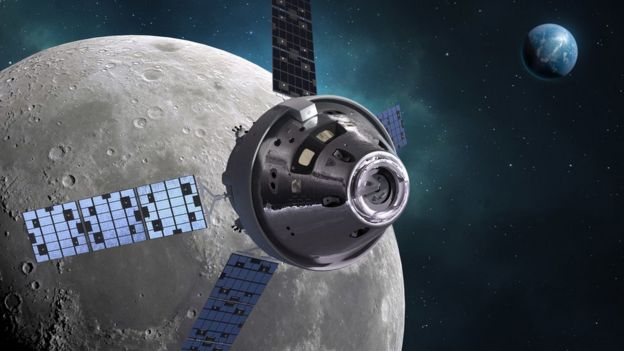
The US House of Representatives has already passed a Bill allocating $600m towards the lunar lander. But Nasa will need more funds to develop the vehicle in full.
Mr Bridenstine added: "I want to be clear, we are exceptionally grateful to the House of Representatives that, in a bipartisan way, they have determined that funding a human landing system is important - that's what that $600m represents. It is also true that we are asking for the full $3.2bn."
In July 2019, Mr Bridenstine told CNN that the first woman astronaut to walk on the Moon in 2024 would be someone "who has been proven, somebody who has flown, somebody who has been on the International Space Station already". He also said it would be someone already in the astronaut corps.
At the time of this interview, there were 12 active woman astronauts. They have since been joined by five other female Nasa astronauts who graduated from training earlier this year. But it remains unclear whether they can fulfil the criteria in time to fly on the first landing mission in 2024.
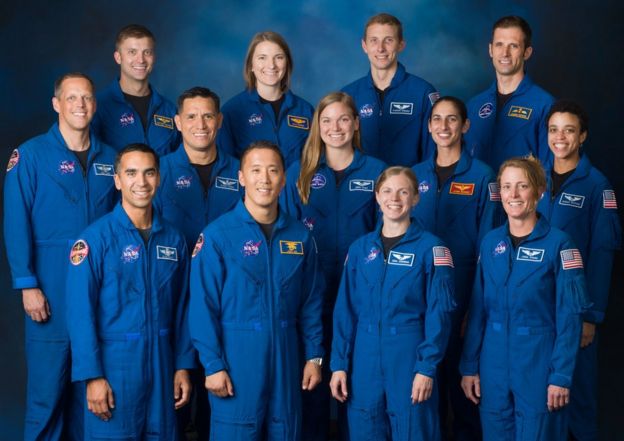
Asked about the timeline for choosing crew members for Artemis, the Nasa chief said he hoped to pick a team at least two years prior to the first mission.
However, he said: "I think it's important we start identifying the Artemis team earlier than not... primarily because I think it will serve as a source of inspiration."
By sending astronauts back to the Moon, the White House wants to renew American leadership in space. There are also plans to extract valuable deposits of water-ice from the lunar South Pole. These could be used to make rocket fuel on the Moon - at a lower cost than carrying it from Earth - serving as the foundation for a lunar economy.
But Vice President Mike Pence has also cited concerns about China's spacefaring ambitions. In January 2019, the East Asian superpower became the first nation to softly land a robot rover on the far side of the Moon. The country is now preparing for its first mission to deliver samples of lunar soil to labs on Earth.
It has been developing a next-generation spacecraft for Chinese astronauts that could fly to deep space destinations such as the Moon. Though China isn't on a timeline to get there by 2024, it could make considerable progress towards such a goal this decade.
The new Nasa document outlines Phase 1 of the US plan, which includes an uncrewed test flight around the Moon - called Artemis-1 - in the autumn of 2021.
Nasa's human spaceflight chief Kathy Lueders said that Artemis-1 would last for about a month to test out all the critical systems.
She said that demonstration flight would reduce the risk for Artemis-2, which will repeat the trip around the Moon with astronauts.
A new test has been added to this mission - a proximity operations demonstration. Shortly after Orion separates from the upper-stage of the SLS rocket - known as the interim cryogenic propulsion stage - astronauts will manually pilot the spacecraft as they approach and back away from the stage.
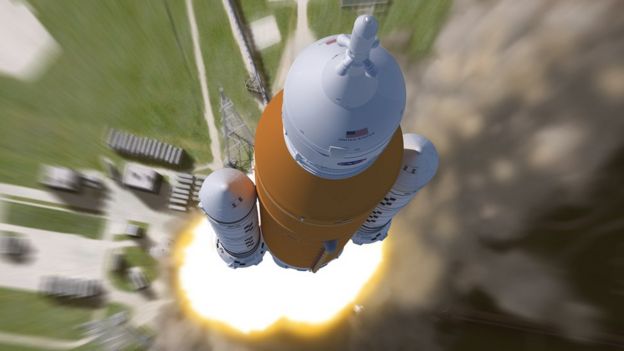
This will assess Orion's handling qualities, along with the performance of the spacecraft's hardware and software.
Artemis-3 will become the first mission to send astronauts to the lunar surface since Apollo 17 some 48 years ago.
Nasa has provided $967m (£763m) to several companies to work on designs for the landing vehicle that will take them there.
Later in the decade, the plan calls for Nasa to establish a base for humans, called Artemis Base Camp, that would include the infrastructure needed for long-term exploration of the Moon.
By comparison with Artemis, the Apollo programme in the 1960s and 70s cost upwards of $250bn in inflation-adjusted US dollars.
However, the $28bn for this new plan does not include money already spent developing the Orion spacecraft and Space Launch System (SLS) rocket.
Latest Stories
-
World Bank affirms Ghana’s growth rate at 4.8% in 2026
6 minutes -
Cedi was worst African currency in quarter 2, 2026 – World Bank
22 minutes -
AI gains can lift three times as many people out of poverty in Ghana – World Bank
50 minutes -
Police arrest suspect over jewellery theft during fire outbreak
3 hours -
EOCO returns Hanan’s £6,700, GH¢2,750 and devices after defence challenge
3 hours -
Opplift Youth Entrepreneurs Summit 2026 equips entrepreneurs with skills, mentorship and support
4 hours -
Rival clubs want range of punishments for Man City
4 hours -
Tear gas in Paris and Marseille as school protests grow across France
4 hours -
Kane inspires England to win over Czech Republic in UEFA Nations League
4 hours -
Finland orders halt to work on two Google data centres
4 hours -
Substitute Merino scores twice as Spain win in Croatia
4 hours -
Ronaldo wants Portugal ‘punishment’ but not retiring
4 hours -
White House defends Trump comment to let Iran ‘take out’ LA and San Diego
5 hours -
Asos confirms hackers sent ‘unauthorised’ notification to app users
5 hours -
US televangelist Jim Bakker, disgraced from sex scandal and fraud, dies at 86
5 hours