

Audio By Carbonatix
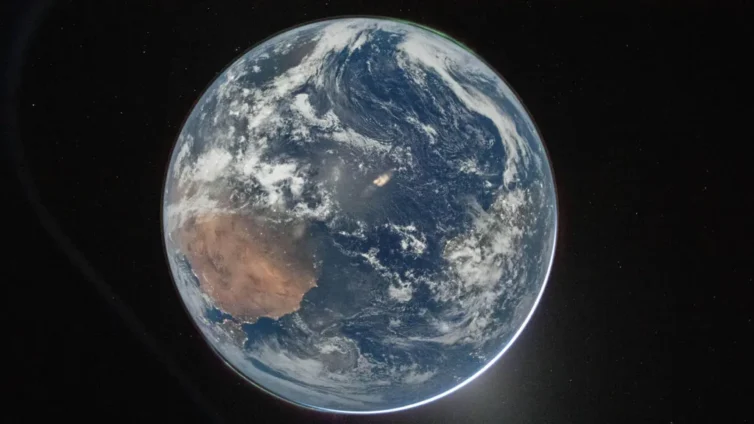
Nasa has shared the first high-resolution images of the Earth taken by the Artemis II crew as they head on their trip around the Moon.
The mission's commander, Reid Wiseman, took the "spectacular" images, Nasa says, after the crew completed a final engine burn that set them on a trajectory towards our closest celestial neighbour.
The first image, called Hello, World, shows the vast expanse of blue that is the Atlantic Ocean, framed by a thin glow of the atmosphere as the Earth eclipses the Sun and green auroras at either pole.
The Earth appears to us as upside down, with the western Sahara and Iberian peninsula visible to the left and the eastern portion of South America to the right.
Nasa identified the bright planet to the bottom right as Venus.
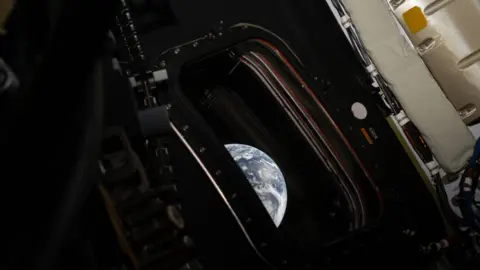
The images were taken after the crew successfully completed a trans-lunar injection burn in the early hours of Friday.
The burn took the Orion spacecraft out of Earth orbit as the four astronauts aboard aim to travel the more than 200,000 miles to the Moon.
Artemis II is now on a looping path that will carry the crew around the far side of the Moon and back again. It is the first time since 1972 that humans have travelled outside of the Earth's orbit.
The crew should pass around the far side of the Moon on 6 April and return to Earth on 10 April.
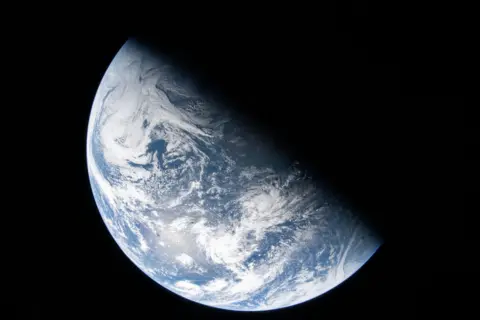
After the burn was completed, the crew were "glued to the windows" taking pictures, mission specialist Jeremy Hansen told mission control in Houston.
"We are getting a beautiful view of the dark side of the Earth, lit by the Moon," he said.
Wiseman later called back down to mission control in Houston to ask how to clean the windows, as the astronauts' enthusiasm to see into space had left them dirty.
The commander had initially found it difficult to take pictures of our planet from the spacecraft, saying taking photos at such a distance made it hard to adjust exposure settings.
"It's like walking out back at your house, trying to take a picture of the moon," he told mission control. "That's what it feels like right now."
But that is no longer an issue.
Another view captured by Wiseman shows the Earth divided by night and day. That frontier between light and darkness is known as the terminator.
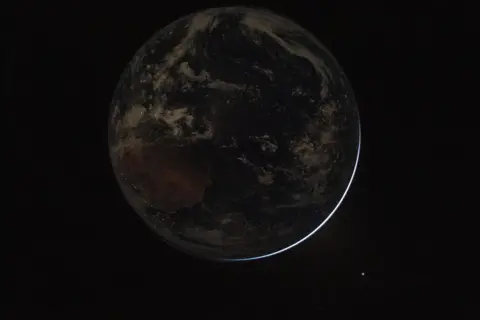
Later, Nasa published another image showing the Earth in near-complete darkness, with the electric lights of humankind twinkling in the nighttime.
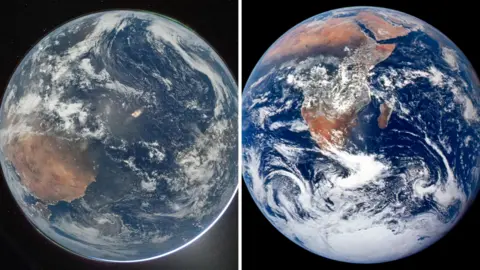
It also produced a side-by-side comparison of 2026's view of the Earth and a similar one taken by the Apollo 17 team in 1972 - the last time humans set foot on the Moon.
"We've come so far in the last 54 years, but one thing hasn't changed: our home looks gorgeous from space!" it wrote.
Latest Stories
-
Stephen Amoah criticises 20% digital services tax as excessive
1 minute -
Ghana secures $3.5bn investment commitments to revive oil and gas sector – Jinapor
6 minutes -
Court to hear Wontumi’s bail application today
7 minutes -
DPC flags six companies for data protection breaches
12 minutes -
Chief Justice appointment from outside Supreme Court possible but unlikely – Bentil
13 minutes -
NEDCo replaces faulty transformer at Saasigli
16 minutes -
Dr Seidu Jasaw urges climate financiers to align funding with farmers’ planting seasons
20 minutes -
Bank of Ghana urges public to uphold dignity of local currency
21 minutes -
Global Chairman of World Assemblies of God Fellowship lauds Mahama’s sterling leadership
26 minutes -
Global economy’s resilience nearing limits – IMF
33 minutes -
Trust-building is crucial for sustaining confidence with communities – Police Commander
38 minutes -
Government to redevelop Aboabo Market in Tamale – Mahama Ayariga
44 minutes -
We haven’t handed over our forex role to Goldbod – BoG Governor Asiama
48 minutes -
AG urges Legal Aid Commission to expand services to districts
49 minutes -
Ghana calls for stronger African cooperation to tackle maritime threats
54 minutes