


Audio By Carbonatix
A new species of bone-eating worm has been discovered by scientists during a study in which they dropped alligator carcasses into the Gulf of Mexico to investigate the deep ocean's ecosystem.
The worm, which has yet to be named, is the first of its kind found in the Gulf of Mexico.
The species was discovered when it crawled on the corpse of an alligator on the ocean floor -- and completely consumed its soft tissue within 51 days.
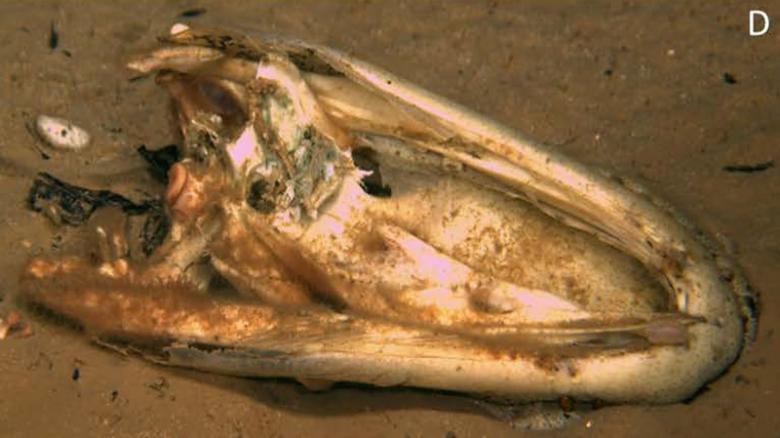 Scientists said the new worm species was the cause of the red hue seen on the alligator's lower jaw
In April, scientists posted a video of one of the alligator carcasses as they first dropped it on the ocean floor, which showed several pink-colored giant isopods crawling on the remains.
Clifton Nunnally, study co-author and researcher from the Louisiana Universities Marine Consortium, said in the video that he hoped to find evidence of any new bone-eating worms that may also be present deep under the Gulf of Mexico.
"The deep ocean is a food desert sprinkled with food oases," he said, while explaining that it may be common for dead alligators, which are native only to the United States and China, to fall to the ocean floor.
"Alligator carcasses are regularly found on beaches and coastlines, and after big storms or hurricanes, alligators have been seen alive 18 miles (29 kilometers) offshore," he added.
Scientists said the new worm species was the cause of the red hue seen on the alligator's lower jaw
In April, scientists posted a video of one of the alligator carcasses as they first dropped it on the ocean floor, which showed several pink-colored giant isopods crawling on the remains.
Clifton Nunnally, study co-author and researcher from the Louisiana Universities Marine Consortium, said in the video that he hoped to find evidence of any new bone-eating worms that may also be present deep under the Gulf of Mexico.
"The deep ocean is a food desert sprinkled with food oases," he said, while explaining that it may be common for dead alligators, which are native only to the United States and China, to fall to the ocean floor.
"Alligator carcasses are regularly found on beaches and coastlines, and after big storms or hurricanes, alligators have been seen alive 18 miles (29 kilometers) offshore," he added.
Scientists said the new worm species was the cause of the red hue seen on the alligator's lower jaw
In April, scientists posted a video of one of the alligator carcasses as they first dropped it on the ocean floor, which showed several pink-colored giant isopods crawling on the remains.
Clifton Nunnally, study co-author and researcher from the Louisiana Universities Marine Consortium, said in the video that he hoped to find evidence of any new bone-eating worms that may also be present deep under the Gulf of Mexico.
"The deep ocean is a food desert sprinkled with food oases," he said, while explaining that it may be common for dead alligators, which are native only to the United States and China, to fall to the ocean floor.
"Alligator carcasses are regularly found on beaches and coastlines, and after big storms or hurricanes, alligators have been seen alive 18 miles (29 kilometers) offshore," he added.
DISCLAIMER: The Views, Comments, Opinions, Contributions and Statements made by Readers and Contributors on this platform do not necessarily represent the views or policy of Multimedia Group Limited.
DISCLAIMER: The Views, Comments, Opinions, Contributions and Statements made by Readers and Contributors on this platform do not necessarily represent the views or policy of Multimedia Group Limited.
Latest Stories
-
Trade Minister applauds GUTA as a pillar of economic growth; Prez Mahama honoured
49 minutes -
President’s brother’s takeover of Damang Mines is ‘untidy’ – Alhassan Tampuli
55 minutes -
It’s not true that gov’t decided not to renew the lease for Gold Fields – Bobby Banson
59 minutes -
Ghana to boost tomato production with 60-hectare irrigated farms and processing initiatives
1 hour -
E&P’s takeover process of Damang Mines was very clean – Inusah Fuseini
1 hour -
Damang takeover: There is not going to be any job loss; it is a lease change – Bobby Banson
2 hours -
Gold Fields didn’t stop mining at Damang mines; such claims are untrue – Bobby Banson
2 hours -
Engineers and Planners currently operate only in Ghana – Bright Simons
2 hours -
Lands Minister has no legal basis to restrict lease to Ghanaian firms – Bright Simons
2 hours -
Gov’t’s refusal to renew Gold Fields’ lease was simply untenable – Bright Simons
2 hours -
SOS Children’s Villages Ghana deepens partnership with Gender Ministry
3 hours -
Gender Ministry celebrates Christina Koch, reaffirms commitment to empowering girls
3 hours -
Live stream: Newsfile digs into E&P’s takeover of Damang Mines, OSP powers and Anti-LGBTQ Bill
3 hours -
Moody’s maintains Ghana’s rating at Caa1, revises outlook to positive
4 hours -
Zambia elevates tourism education to national priority as President Hichilema backs continental summit
4 hours