

Audio By Carbonatix
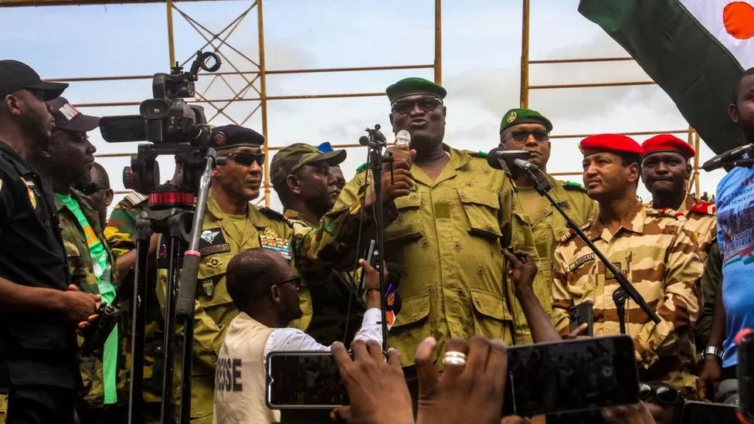
The Regional Organised Crime Observatory Director of the Institute Of Security Studies, Oluwole Ojewale has expressed optimism that a diplomatic solution is the key to addressing the ongoing tensions and incidents in Niger.
Echoing concerns about the potential consequences of military intervention, the security analyst stressed the shared cultural affinity across West African nations and stressed the importance of avoiding fratricidal conflicts.
Mr Ojewale's comments come at a crucial juncture when there has been a series of coup d’états in countries across the West African sub-region. Many believe the Economic Community of West African States (ECOWAS) should adopt firmer tactics to restore constitutional rule in these military-ruled nations.
However, in his assessment, military intervention could lead to brother turning against brother, a scenario that contradicts the very essence of ECOWAS and its foundational objectives.
He made his assertions known during a discussion on the JoyNews’ PM Express on Monday.
“In terms of cultural affinity, we are almost one across the West African Region. When it is the Niger-Nigeria border, Togo-Benin border, and Benin-Nigeria border it is the same set of people that you find on both sides of the border so if ECOWAS decides to use military intervention my humble assessment will be that it is brothers going against brothers.
“It is going to be a fratricidal war it is going to be a civil war because it is the same people that you find on both sides of the border and I don’t think this is the strategic objective of the founding of ECOWAS - that one day we’ll raise guns against each other in the region,” he told JoyNews’ Evans Mensah.
The analyst's optimistic stance is rooted in his belief in the efficacy of diplomatic solutions.
He expressed confidence that the ongoing tensions can be effectively addressed through dialogue and negotiation at the diplomatic table.
Mr Ojewale underscored the importance of exploring all avenues for peaceful resolution and working toward preserving stability and unity in the region.
“I remain extremely optimistic that what we are seeing on the part of the Junta is mere military propaganda for some form of rhetoric possibly to get some form of soft landing."
“Because going to war, irrespective of the assessment on paper, you can only predict the beginning no one can tell how it is going to end. I remain optimistic that it will be solved on the diplomatic table,” he stated.
Latest Stories
-
Drug bust case: Only Customs officers, MPS officials in scanning room – NACOC
27 minutes -
I don’t mind being insulted; I have a crocodile skin – President Mahama
40 minutes -
Samson’s Take: Verify the badge – and verify the story
52 minutes -
President Mahama explains why Ghana must rethink regulation of TikTok, other new media platforms
1 hour -
Rule of law must be protected – GBA condemns EOCO action against Baffour Awuah
2 hours -
950,000 barrels of Sankofa crude head to TOR as GNPC deepens domestic refining
3 hours -
Scales of deception removed – Annoh-Dompreh attacks new cocoa price
3 hours -
Young Positivist Writes : My Experience with GCLP
4 hours -
Strong Day 1 turnout sets tone for Day 2 of Republic Bank-JoyNews Habitat Fair Clinic
5 hours -
Ghana Army warns new soldiers against social media misuse, uniform abuse
5 hours -
AMA calls for science-led action to tackle environmental health risks in Accra
5 hours -
NPP Canada Organizer BigMo urges Diaspora to support Kodua Frimpong
6 hours -
He entered at eight; he is now 16: Ghana’s children growing up in prayer camps
9 hours -
‘Development must not always begin from Accra’ — Anwelle Foundation launched in Jirapa
9 hours -
PKO trio eye victories at Odwira Festival
12 hours