

Audio By Carbonatix
France's ambassador has remained in Niger despite being given a 48-hour deadline to leave the country last Friday, French President Emmanuel Macron confirmed in a defiant speech.
Ambassador Sylvain Itte had been ordered to go amid rapidly deteriorating bilateral ties.
But hours after the coup leaders' deadline had passed, the president said he "applauds" Mr Itte for staying put.
The junta overthrew Niger's elected president last month.
In a major foreign policy speech to ambassadors gathered in Paris as well as others listening remotely, Mr Macron said: "France and its diplomats have faced particularly difficult situations in some countries in recent months, from Sudan, where France has been exemplary, to Niger at this very moment.
"I applaud your colleague and your colleagues who are listening from their posts."
Niger's President Mohamed Bazoum was toppled on 26 July in a coup that has been condemned by France and many of Niger's neighbours, including the West African regional bloc Ecowas.
Ambassador Itte had refused to meet Niger's new leaders after the coup, the junta said on Friday, as it announced the French ambassador had 48 hours to leave.
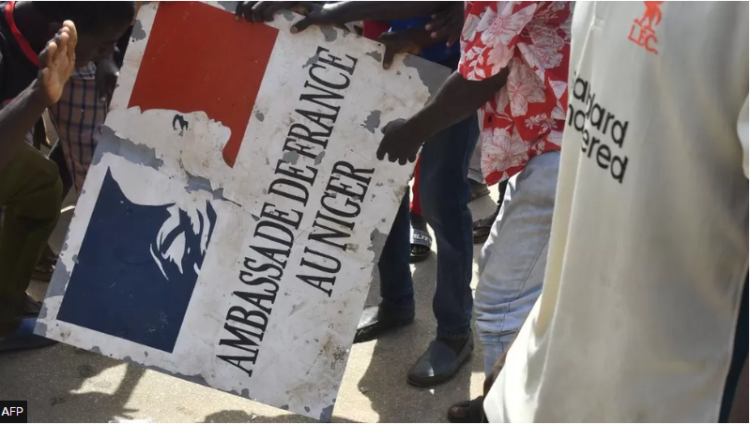
Thousands of Nigeriens in favour of the coup demonstrated on Sunday near the French military base in the capital, Niamey.
Some held signs demanding the departure of French troops, while footage posted on social media appears to show local Muslim imams leading prayers outside the base.
In Monday's speech, Mr Macron defended France's military presence in Niger, stating that without intervention from Paris, the country would "no longer exist" with its "existing borders".
Neighbours Mali and Burkina Faso would also have suffered the same fate without France, Mr Macron said.
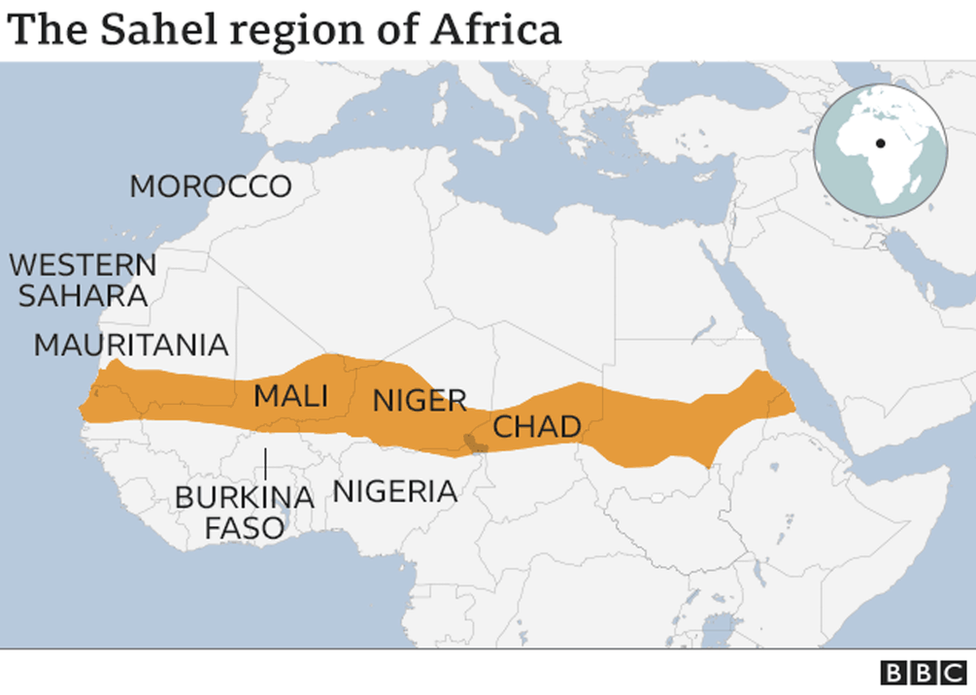
France carried out a decade-long operation to fight Islamic insurgents in Niger, Mali, Burkina Faso, Chad and Mauritania - all former French colonies - up until last year.
At its high point, around 5,500 French soldiers were stationed in the African countries.
However, anti-French sentiment and protests in the region intensified recently, with some opponents complaining France's intervention was a modern form of colonialism.
Others noted that the troops have not been able to overcome the threat from jihadists, whose deadly attacks on communities continue.
Amid this insecurity, soldiers in Mali, Burkina Faso and more recently Niger launched coups, saying a change of leadership was necessary to tackle the jihadists.
Mali's military government has called on the Russian mercenary group Wagner to help fight the Islamist militants. It is suspected that the mercenaries could be active in the wider region.
Latest Stories
-
Shell to sell its Nigeria gas business to Vaaris Energy
26 minutes -
Judge extends White House access for CNN, MS NOW, Politico amid legal fight
34 minutes -
EU expands migration cooperation with eastern Libya through new funding
42 minutes -
Actress Selma Blair faces charges for kicking nurse and officer after plane incident
51 minutes -
Private political loyalties deserve scrutiny too in EC appointments – Osae-Kwapong
60 minutes -
EC safeguards must check partisan bias among commissioners – Osae-Kwapong
1 hour -
Oil prices climb as traders weigh Saudi supply risk, Russian diesel flow
2 hours -
Zimbabwean author denies using AI to write award-winning story
2 hours -
Bank of America hit with $1.2bn fine for money laundering failings
2 hours -
Robot seized by German police after allegedly groping teenage girl
2 hours -
Subject EC appointment to ‘Akufo-Addo test’ – Kwapong
2 hours -
English football’s independent regulator would quit over Man City interference
3 hours -
Anthropic seeks rehearing of case over Pentagon’s security risk branding
3 hours -
Torrential rains in Libya’s Tripoli kill two
3 hours -
Guinea-Bissau says it has not approved hepatitis B vaccine trial in newborns
3 hours