

Audio By Carbonatix
Ghana’s fight for food security is no longer an abstract policy talking point, it’s a reality felt every day in markets, kitchens, and on the national balance sheet. The country spends hundreds of millions of dollars each year importing food products it could grow and process itself.
In 2023 alone, Ghana imported nearly $133 million worth of palm oil and its fractions, much of it shipped in from Malaysia, Indonesia, and Côte d’Ivoire. Even with local palm oil production approaching 300,000 metric tons, a shortfall of about 35,000 tons left the country dependent on foreign supplies to fill the gap. The picture isn’t much different for other crops: Ghana’s mango industry, while celebrated for its sweet, export‑grade fruit, still exports less than half of its production, and its coconut potential, sprawling along the southern belt, remains largely untapped.
This dependence creates a vicious cycle. Each container of imported palm oil or mango concentrate chips away at foreign reserves. Each gap in processing capacity leaves farmers with unmarketed harvests, forced to sell cheap or watch produce rot. And yet, the irony is stark: Ghana has the land, the climate, and the history to change this narrative. More than half of the country’s land is suitable for agriculture, with fertile belts perfectly suited for tree crops like oil palm, mango, and coconut. What it has lacked is the kind of large, unencumbered parcels of land that can support scaled‑up production and processing, land that allows policy to turn into practice.
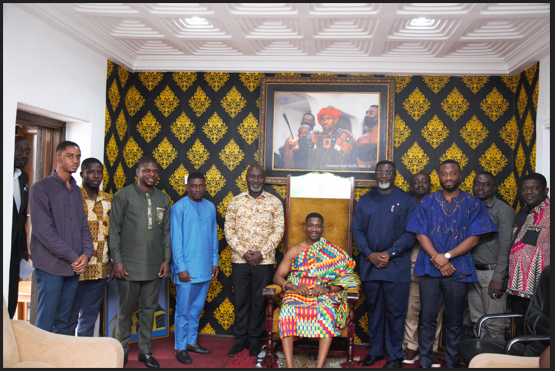
That is why the decision by Okuapehene Oseadeeyo Kwasi Akuffo Ababio III, Paramount Chief of the Akuapem Traditional Area, to donate 3,000 acres under the OKWAF Foundation to the Government of Ghana through the Tree Crops Development Authority (TCDA) is more than a ceremonial gesture. It is an intervention at the heart of Ghana’s agricultural struggle. It connects the dots between import dependency and domestic potential, between fragmented smallholder plots and the need for consolidated, modern farming blocks.
Akuapem, after all, has been an agricultural heartbeat for generations. Its hills and valleys have long nurtured oil palm, mango, and coconut, crops woven into daily life and tradition. Oil palm, in particular, was once “as common as the morning mist,” the Okuapehene recalled, shading homesteads, fueling kitchens with palm oil, and feeding markets with kernels used for soap‑making. Mango trees dropped golden fruit into waiting baskets, and coconuts lined the slightly lower zones, their water and flesh a steady source of nourishment and trade.
But for decades, this abundance has been undercut by underinvestment and fragmentation. Smallholders worked in isolation. Processing plants were few. Export pipelines sputtered. The region’s crops, rich as they were, never scaled into the industries they could become.
The 3,000 acres donated through the OKWAF Foundation changes that equation. For the first time, TCDA has a secure, contiguous stretch of land to demonstrate what coordinated agriculture can achieve: oil palm estates that close the import gap, mango orchards that finally meet export potential, coconut groves that fuel both local consumption and a pipeline of coconut oil for global markets.
Akuapem has long been a beacon of agricultural richness in Ghana. Nestled in the Eastern Region’s lush hills, its fertile soils and moderate climate have made it one of the country’s most naturally endowed farming zones. For centuries, the land has quietly sustained mango groves, coconut stands, and oil palm clusters, weaving these crops into the fabric of daily life and culture.
During the meeting announcing the donation, Oseadeeyo Kwasi Akuffo Ababio III shared a vivid historical account of oil palm in Akuapem, recalling how it has been more than just a crop, it has been a way of life. He noted that oil palm was once “as common as the morning mist,” growing along homesteads, lining footpaths, and shading village boundaries. Families relied on it for palm oil for cooking, palm kernels for soap-making, and even palm fronds for traditional ceremonies.
Nana recounted that every compound had at least one oil palm tree, describing how the crop fueled local markets and trade generations before modern agribusiness came into the picture. Beyond its economic role, oil palm held cultural weight, its byproducts featured in festivals, rites of passage, and communal gatherings.
But while oil palm remains a signature crop, Nana highlighted that Akuapem’s hills are equally blessed for mango and coconut farming. The region’s rich volcanic soils and cool breezes nurture mango trees that bear sweet, export-grade fruit. Meanwhile, coconut thrives in the slightly lower, warmer zones, providing farmers with steady yields for food, drink, and industry.
These three crops, oil palm, mango, and coconut, are not new introductions to Akuapem; they are part of its DNA. Yet, as Nana pointed out, decades of underinvestment and fragmented smallholder efforts have kept their potential capped. Large-scale cultivation, processing, and export have been sporadic, with the area lacking the infrastructure to match its natural abundance.
For the Government of Ghana, the Okuapehene’s donation is nothing short of a breakthrough. Access to large, unencumbered land parcels has long been one of the biggest bottlenecks in rolling out large-scale agricultural programs. With this 3,000-acre stretch now secured, the Tree Crop Development Authority (TCDA) has the platform to build a flagship demonstration hub for its tree crop agenda.
Latest Stories
-
‘Our missing players are more important’ – Gambia coach fires shot at Ghana
56 minutes -
Today’s front pages: Tuesday, September 29, 2026
59 minutes -
Ghana ‘showing up differently’ on global stage – Joyce Bawah Mogtari
1 hour -
Ghana’s tuna industry in crisis as 20 hook-and-line vessels collapse
2 hours -
South Tongu MP launches apprenticeship programme for 159 young people
2 hours -
The Pusiga connection behind Gertrude Atongi’s work in New York
3 hours -
Teachers took promotion exams in December to beat government clearance deadline – GNAT
3 hours -
NPA launches 2026 staff welfare week with focus on teamwork and employee wellbeing
3 hours -
Ghana, Saint Kitts and Nevis sign labour deal to strengthen protections for Ghanaian nurses
3 hours -
Delayed promotions put teachers’ retirement benefits at risk – GNAT
3 hours -
No ‘Bawumia candidates’ in NPP executive elections – Anthony Karbo
3 hours -
Over 3,000 displaced as flooding overwhelms Hohoe communities
3 hours -
Sunyani East NPP executives begin reconciliation drive ahead of 2028 polls
3 hours -
Agric Minister engages Ga Mantse on agriculture transformation agenda
3 hours -
Aayalolo expansion targets private car users, not trotro operators – Mahama Ayariga
3 hours