

Audio By Carbonatix
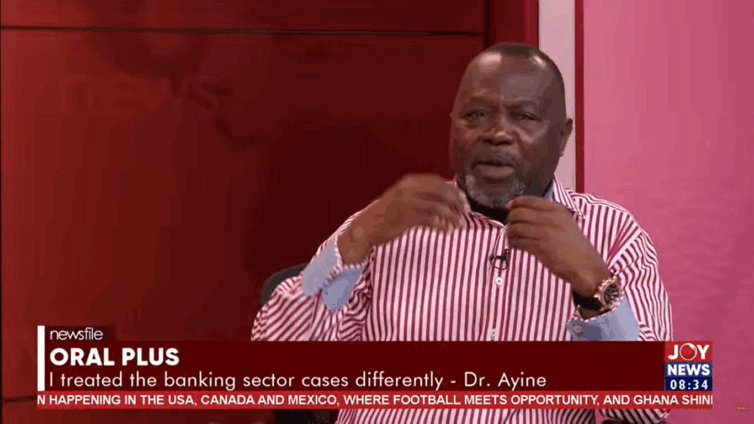
The Attorney-General and Minister of Justice, Dr Dominic Ayine, has explained why he adopted a different approach to the prosecution of banking sector cases, arguing that the charges were largely weak and risked criminalising ordinary banking activity.
Speaking on JoyNews’ Newsfile, Dr Ayine said his assessment of the cases led him to the conclusion that many of the allegations did not meet the threshold for criminal prosecution.
According to him, a central issue in several of the cases was the claim that financial loss had been caused because some banks received liquidity support from the Bank of Ghana and allegedly misapplied those funds.
Dr Ayine questioned the basis of such accusations, stressing that the concept of “misapplication” had not been clearly demonstrated.
“If you take banks generally, banks are in the business of taking risks,” he explained on Saturday, January 10.
“They lend, and sometimes those who take the loans default, probably not due to any fault of theirs, but because the business has gone bust.”
He warned that treating such outcomes as criminal conduct would set a dangerous precedent for the entire financial system. In his view, if banks were to be criminalised simply because liquidity support was granted and loans subsequently failed, then virtually every bank operating in the system could be exposed to prosecution.
“It doesn’t make sense for you to say that because liquidity support was given, they did not apply it in a manner that you thought they ought to apply it,” he stated.
Dr Ayine also addressed specific cases, including that involving former Finance Minister Dr Kwabena Duffuor. He stressed that the allegations were not about theft or personal enrichment.
“In the case of Duffuor, it wasn’t the case that they stole the money. It wasn’t the case that they pocketed the money,” he said.
Rather, the Attorney-General noted that the issues under consideration related to possible negligence and, in some instances, the making of fictitious entries in banks’ books to present a healthier financial position.
He explained that such practices, if proven, may have been aimed at enabling banks to continue operating and to secure further support from the central bank.
“At the end of the day,” Dr Ayine said, “what I then said was that for all the banking cases, I had assessed them, and the evidence was also weak just like the rest of the cases.”
Latest Stories
-
Kwabena Boamah appointed Board Chair for Impact Investing Ghana
4 minutes -
Striking teacher unions to meet Fair Wages and Salaries Commission on October 6
18 minutes -
EOCO working with AG to arraign Nana Baffour Awuah before weekend court
22 minutes -
Duraplast reassures customers after fire, announces October 5 reopening
30 minutes -
Call off strike, gov’t will not renege on promotion arrears pledge – Haruna Iddrisu appeals to teacher unions
32 minutes -
Committee set up to validate teachers eligible for 20% deprived-area allowance – Education Minister
36 minutes -
Five-member committee to search for new Black Stars coach after Sports Ministry-GFA meeting
1 hour -
Pinktober: Breast cancer survival exceeds 90% when detected early – Breast Society of Ghana
1 hour -
TCDA to adopt Upper West’s MATCO mango farm as northern prototype, issues warning against felling shea trees
1 hour -
‘Fear delegates’ tag: Afoko touts genuineness among delegates ahead of NPP delegates conference
2 hours -
John Boadu: The leader our party needs at this time – Amb. Edward Akwasi Boateng
2 hours -
Baffour Awuah: EOCO arrested, detained MP after hours of waiting, questioning – Afenyo-Markin
2 hours -
EOCO court warrant authorised search of Baffour Awuah’s law firm, not residence – Afenyo-Markin
2 hours -
NPP delegates conference: 3,000 to 4,000 police personnel deployed for security in Kumasi – Anthony Karbo
2 hours -
KGL Foundation commits $200,000 to support juvenile football for the next two years
2 hours