

Audio By Carbonatix
The Pig Farmers Association of Ghana (PFAG) is urging the government to establish a dedicated policy to expand pig production, strengthen the value chain, and drive economic growth.
The leadership of the Association argues that, despite pig farming being a highly significant and rapidly growing agricultural sector in Ghana, the subsector continues to suffer from limited policy attention compared to cattle and poultry.
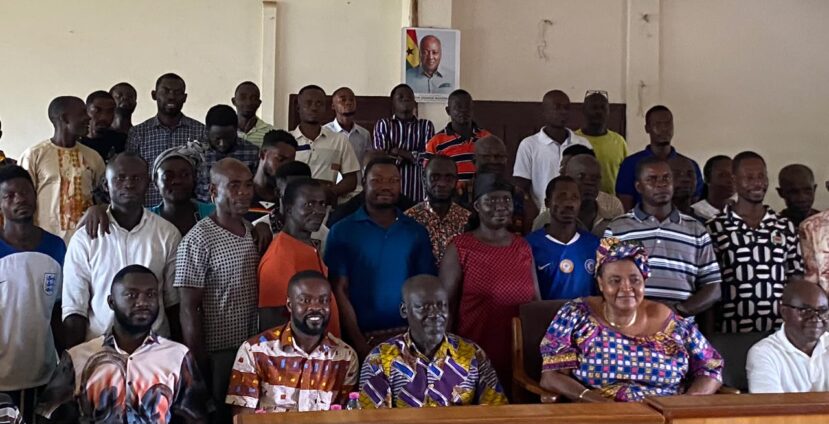
This was disclosed at the inauguration of the Asante Akyem Central Municipal branch of the Association.
In an interview, the Ashanti Regional Chairman of the Pig Farmers Association, Daniel Yaw Saim revealed that government’s livestock initiatives have historically favored cattle and poultry, leaving pig farmers to navigate market, price, and disease risks largely on their own.
He maintain that this neglect is hindering the industry’s growth potential and denying the economy valuable contributions to GDP and job creation.
"The government currently has no dedicated policy for pig farmers. As an association, our priority is to push for a comprehensive policy to guide Ghana’s pig-farming industry. We’re battling finance gaps, poor veterinary services, poor-quality feed, frequent disease outbreaks, and weak market connections. Unlike poultry farmers who receive compensation when their birds die, pig farmers get no government support at all," he stated.
Daniel Yaw Saim also called on the government to extend support to pig farmers by providing starter stock of small pigs, what he termed “prako nkitinkiti” to the farmers.
He said this would mirror the benefits of the “Nkoko Nkitinkiti” initiative and help smallholder pig farmers build their herds, improve productivity, and contribute to the growth of the local pork industry as the program rolls out.
“Pork is gaining popularity, with some people even referring to it as ‘Borga Meat.’ In this way, we are contributing to the economy by providing an affordable protein source for every Ghanaian household. Since the government spends foreign currency to import protein sources, investing in Ghana’s pig farming industry could help reduce that burden and strengthen the local economy," he said.
He added that "we welcomed the ‘Nkoko Nkitinkiti’ initiative, and we were hoping the government would introduce a similar ‘Prako Nkitinkiti’ program for pig farmers. Since we haven’t heard of any such plans, we are appealing to the government to consider it, as Ghanaians are expecting it too.”
Speaking at the event, Martha Ashami Armah, the Agric Municipal Director for Asante Akyem Central, addressed long-standing misconceptions surrounding pork consumption and pig farming.
She firmly rejected claims that pork is not suitable for human consumption, stressing that, with proper handling and cooking, it is a safe and nutritious source of protein.
Madam Armah also challenged the common perception that pigs are “dirty animals.”
She explained that pigs are naturally clean creatures and that poor sanitation is usually a result of improper housing and management by farmers, not the animals themselves.
“When raised in hygienic conditions and fed quality feed, pigs are no dirtier than any other livestock,” she said. “The issue is management, not the animal.”
The Agric Director added that promoting pork as part of a balanced diet, alongside poultry and other meats, can help improve nutrition in the district.
Municipal Chief Executive for Asante Akyem Central, Rev. Dr. Ebenezer Ekow Aidoo, called on Ghanaian youth to venture into pig farming.
Drawing on his own experience in the sector, the MCE said pig farming presents a viable source of income and a practical way to tackle youth unemployment.
Dr. Aidoo also commended pig farmers for forming an association, noting that the collective body would strengthen their ability to access government support and address industry challenges.
The leadership of the Association is therefore calling on the government and policymakers to provide the sector with strategic support through targeted interventions, investment incentives, and inclusion in national agricultural development plans in order to unlock its full economic potential.
They argue that pig farming is one of the most profitable livestock enterprises, with higher potential returns, and for that reason, full integration of the pig value chain into national livestock development policies will elevate pork production from a localized consumption model to a major economic driver.
Latest Stories
-
South Tongu MP launches apprenticeship programme for 159 young people
12 minutes -
The Pusiga connection behind Gertrude Atongi’s work in New York
39 minutes -
Teachers took promotion exams in December to beat government clearance deadline – GNAT
41 minutes -
NPA launches 2026 staff welfare week with focus on teamwork and employee wellbeing
44 minutes -
Ghana, Saint Kitts and Nevis sign labour deal to strengthen protections for Ghanaian nurses
50 minutes -
Delayed promotions put teachers’ retirement benefits at risk – GNAT
53 minutes -
No ‘Bawumia candidates’ in NPP executive elections – Anthony Karbo
54 minutes -
Over 3,000 displaced as flooding overwhelms Hohoe communities
59 minutes -
Sunyani East NPP executives begin reconciliation drive ahead of 2028 polls
1 hour -
Agric Minister engages Ga Mantse on agriculture transformation agenda
1 hour -
Aayalolo expansion targets private car users, not trotro operators – Mahama Ayariga
1 hour -
KNUST, GMTF explore AI partnership to transform healthcare delivery
1 hour -
MTTD records 9,000 preventable crashes, over 900 deaths in eight months
1 hour -
UN Secretary-General expresses optimism about future, pledges support for Mahama, AU
1 hour -
Ghana’s desalination lesson: A water project must work on paper and at the tap
2 hours