

Audio By Carbonatix
A powerful case for modernising Ghana's judiciary was made on Sunday, August 31, during an interview on JoyNews' The Law, where Shem Khoo, the Managing Director of Focus Law Asia, offered insights from Singapore's successful judicial reforms.
Mr Khoo highlighted Singapore's decision to abandon the traditional judicial wig and archaic titles, arguing that the move was a crucial step in transforming the country's legal system into a modern, efficient, and respected institution.
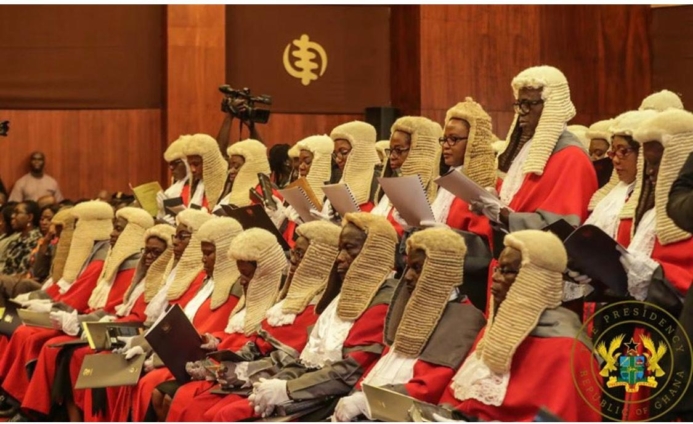
Conversely, for many years, the image of justice in Ghana has been inextricably linked to the remnant of 17th-century Britain of judges adorned with powdered horsehair wigs, complemented by high-collar inner clothes and robes.
According to Khoo, Singapore’s abolishment of judicial wigs and titles like "my lord" and "your lordship" at the beginning of the 1990s was a key initiative driven by then-Chief Justice Yong Pung How.
The motivation behind this bold reform was to shed the symbolic vestiges of colonial rule.
Mr Khoo stated that the wigs and ornate collars were seen as "out of place" in an independent and pragmatic Singapore.
He further noted the impracticality of wearing such attire in the country's hot, tropical climate, a sentiment that resonates deeply within Ghana's legal fraternity.
“The thinking was that it was out of place in an independent, pragmatic Singapore,” Khoo explained. “And also, you must understand, in our tropical climate, it was really uncomfortable to be all dressed up and wearing wigs and high collars.”
He added that the change was "certainly welcomed by many lawyers" and was a move "consistent with a young nation becoming confident in its own ways and comfortable in its own skin."
For countries like Ghana, which have inherited a similar colonial legal framework, the central question is whether doing away with these traditions would diminish the dignity and formality of the court.
Mr Khoo was unequivocal in his response: "Oh no... not at all."
He asserted that the change was "only in an outward form" and had not compromised the integrity of the judiciary.
Instead, the Singaporean courts are now perceived as "more approachable and culturally relevant", while still maintaining the seriousness and decorum of a "world-class judiciary".
Mr Khoo concluded that the dignity of the court now comes from "the conduct of the judges and the conduct of the lawyers and the integrity of the legal system, not from wigs or archaic phrases."
This perspective offers a compelling lesson for Ghana, where the judicial wig carries significant weight.
Supporters argue that it embodies the dignity, solemnity, and respect that the court commands. They believe that the anonymity it provides helps shield judges from personal attacks, representing the law rather than individual personalities. For many, tradition is not a burden but a bedrock of institutional integrity and stability.
However, a growing number of voices—especially from the youth and legal reform advocates—are calling for a shift. The arguments for moving away from wigs are both practical and symbolic, with cost, comfort, decolonisation and public perception as some reasons.
The debate over the judicial wig is not merely an aesthetic one; it is a fundamental discussion about national identity and the perception of justice.
The Singaporean experience demonstrates that a judiciary can maintain its solemnity and integrity by focusing on professional conduct, ethical standards, and a commitment to justice, rather than relying on outdated colonial symbols.
Latest Stories
-
Drug cartels may be seeing Ghana as easy route – Lenin Anane Agyei
15 minutes -
Ghana risks gaining notoriety as drug-trafficking hub – Bobby Banson
24 minutes -
Government dismissed my drug trafficking warning, then tried to arrest me – Ntim Fordjour
26 minutes -
Day Two: 3rd Republic Bank-JoyNews Habitat Fair Clinic underway at Junction Mall
26 minutes -
NACOC addressing inherited gaps in fight against drug trafficking – Deputy Director-General
38 minutes -
Taekwondo goes to school as GTF launches five-region youth campaign
41 minutes -
The issues Mourinho is struggling to fix at Real Madrid
48 minutes -
Hundreds throng EducationUSA College Fair in Kumasi in pursuit of abroad studies
51 minutes -
Drug bust: NACOC should be part of port inspection team – Twum-Barimah
54 minutes -
Ward appointed Liverpool’s sporting director
54 minutes -
This isn’t the first cocaine bust; NPP must stop the politicisation – NACOC deputy boss
58 minutes -
Drug bust case: Only Customs officers, MPS officials in scanning room – NACOC
2 hours -
I don’t mind being insulted; I have a crocodile skin – President Mahama
2 hours -
Samson’s Take: Verify the badge – and verify the story
3 hours -
President Mahama explains why Ghana must rethink regulation of TikTok, other new media platforms
3 hours