

Audio By Carbonatix
Over 1.6 million metric tonnes of rice are consumed annually in Ghana with only 40% of the amount being locally produced rice. With the country’s strive for rice sufficiency, the sustainable production of rice is fraught with numerous challenges, including the prevalence of insect pests and diseases and soil health challenges.
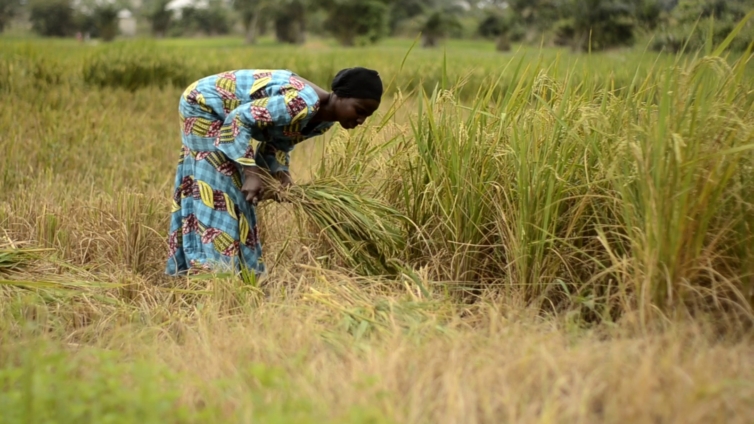
On a 5-acre rice field in Kayera, a small farming community in the Offinso North district of the Ashanti region of Ghana, Alhassan Akologo Williams, a farmer, together with his wife tend to the rice farm they have cultivated in the past six months.
Rice farming is the sole income generation venture of the duo. They are essentially farming labourers looking after a parcel of land whose owner is in the city. But in order to fend for themselves and family, they grow on the field to make a living.
With their sickle, they cut every grown rice stalk as they harvest matured rice paddy to process them for the nearest market. But their yields have not been encouraging in the past year. They are only able to stack up five bags of rice from the farm as compared to the 15 bags they could harvest in previous years.

“We struggle to even get a bag of rice lately after harvest. This year has not been easy for us at all. We invest so much into farming yet, we get little” Alhassan with a worried face recounted.
Diseases, Weeds and Soil Health Challenge
An observable challenge has been the soil in which they grow the crop coupled with poor management of pest and diseases which attack their fields.
A cursory look at the parcel of land revealed a dried out clayey soil – looking unsuitable for plant growth. Research by the Soil Research Institute of the Council for Scientific and Industrial Research in Ghana confirms the declining soil fertility of the country’s farmlands.
The rains have also been erratic to irrigate the water-loving crop. Alhassan had hoped the water beds mounted around his plantation would collect enough water for the plant. He has no other means to irrigate his farms but only to pray to his deity to wet his farms with rainwater.
The soil nutrients, like Potassium and Phosphorus, are now insufficient with acidity levels of the soils on the rise. These nutrients are critical for plant growth and enhancing plant health against diseases and infections.
On Alhassan’s farm, the rice had begun growing false rice smut – a fungus infection that attacks the rice grain covering it in a yellowish cloud of the microorganism. The disease affects the rice yields and reduce the quality of it. The false smut of rice is only one of the many diseases that infest rice either caused by bacteria, viruses or fungi.
Alhassan’s woes are compounded by the mass growth of rice-like weeds that compete with the actual plant for soil nutrients. They deprive the rice plant of the requisite nutritional levels to grow.
“The weeds are really worrying us. The grow in between the plant rows competing with the rice. When it’s time to harvest. It’s only waste we get,” Alhassan’s wife, Sakina, said.
Their situation reflects that of the plight many rice farmers across the country encounter.
Resource availability
The Offinso North enclave is one of the food baskets of the Ashanti region, producing varieties of food crops for various households and markets. But farmers like Alhassan and his wife do not receive sufficient farm inputs of high-quality to ensure continuous production of their produce.
Affordable, high-quality seeds and fertilizers for their farms are elusive. Despite the government announcing subsidy on fertilizers for the farmers, they still don’t get enough to tend to their farms. Under the government’s Planting for Food and Jobs (PFJ) initiative, the rice farmers were expected to receive implements to support their production.
However, President of the Ghana Rice Inter-professional Body (GRIB), Nana Adjei Ayeh II explained rice farmers in the country are yet to enjoy from the second phase of the PFJ.
“We saw a very good programme, the PFJ 2.0. I don’t know if it has been implemented. I am a farmer, and most of my farmers haven’t seen anything from the PFJ 2.0. We’re yet to see,” he said during the signing of a Memorandum of Understanding between the GRIB and an agro-company to assist rice farmers with support schemes.
As the country strives for self-sufficiency, the farmers are eagerly anticipating a less costive production and smart-agriculture practice to adapt to the changing climate. They believe an immediate solution to these aggravating challenges can support the initiative to produce more than what Ghana eats
Latest Stories
-
Man reportedly mistaken for game and shot by hunter dead in forest
12 seconds -
19-year-old mason jailed 15 years for defiling seven-year-old pupil
5 minutes -
Ghana’s banking sector assets rise 20.47% to GH¢500.2bn – BoG Governor
9 minutes -
22 injured as Sprinter bus overturns at Sege after tyre burst
10 minutes -
UN housing expert urges Ghana to strengthen Rent Control Department amid housing affordability concerns
19 minutes -
Delta-BCI partnership reaches 166,000 people with breast cancer education
28 minutes -
Power restoration fault suspected in Kumasi Central Market fire
6 hours -
The 7-foot giant of Ngleshie Amanfro: Seven-foot Ghanaian Ephraim Saawa dreams of joining the national basketball team
6 hours -
Government promises support for Kumasi Central Market fire victims
6 hours -
Vibes The Movie: Big Ghun’s Ghanaian film earns five nominations at 2026 REFFA
7 hours -
‘I’m a fulfilled man’—Justice Korbieh on missing out on Supreme Court despite two nominations
7 hours -
MamaCare CEO warns unresolved conflicts among health workers could undermine maternal and neonatal care
7 hours -
Health professionals urged to translate medical knowledge into practice to save mothers
7 hours -
Retired judge Justice Francis Korbieh charges 1,568 new lawyers to uphold integrity
9 hours -
Conflicts among care providers linked to maternal, neonatal deaths – Expert
9 hours