

Audio By Carbonatix
Stakeholders in Ghana’s legal sector have welcomed the Legal Education Act, 2026, particularly the abolition of the Ghana School of Law entrance examination and the expansion of professional legal training through accredited universities.
They expressed optimism that the new law marks a watershed moment in legal education and the justice delivery system, citing its potential to transform legal training at multiple levels.
However, they cautioned that while expanding access to legal education is necessary, it must be carefully balanced with maintaining the high standards expected of the legal profession.
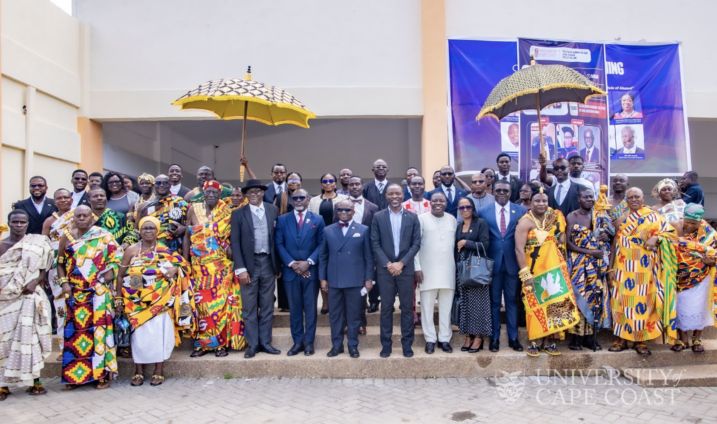
The stakeholders shared their views at the 13th Jurists’ Confab organised by the Faculty of Law of the College of Humanities and Legal Studies at the University of Cape Coast (UCC).
The conference brought together judges, academics, lawyers, policymakers, politicians, traditional leaders and students to deliberate on the theme: “Access versus standards: The future of legal education in Ghana.”
Justice Kweku T. Ackaah-Boafo, a Justice of the Supreme Court, said legal education in Ghana had reached a defining moment following the enactment of the Legal Education Act, 2026.
He observed that the previous system had long been criticised as unfair and exclusionary, with thousands of qualified LL.B. graduates denied admission into professional legal training despite meeting university requirements.
As a result, many aspiring lawyers sought professional legal training abroad, imposing significant financial costs on both individuals and the country.
Justice Ackaah-Boafo said the new Act expands access by allowing accredited universities to offer professional legal training, effectively ending the Ghana School of Law’s monopoly.
“A single national gate that admitted some and turned away many who had met every requirement was a real wrong, and a country that cares about fairness was right to be troubled by it,” he said.
“We answered a real wrong by opening the doors of this profession wider, and that was the right thing to do.”
He argued that access and quality should not be viewed as competing objectives, urging Ghana to pursue both broader access and high professional standards.
To ensure the reforms achieve their intended objectives, Justice Ackaah-Boafo called for stronger investment in foundational legal education, including faculty development, infrastructure and other essential resources. He stressed that the quality of professional legal training depends largely on the strength of undergraduate legal education.
“The first condition is that we attend honestly to the academic foundation, because the reform leaves it untouched and the quality of a lawyer is largely settled there.
“If we will not say openly whether our law degrees are producing graduates who are ready to be trained, then we are building the new system on a foundation we have refused to inspect,” he said.
He also underscored the need for a strong and independent regulator to safeguard standards under the new system.
He said the new Council must possess “both the capacity to do its work and the independence to do it well,” warning that “a regulator that cannot police a dozen scattered providers will preside over a decline it cannot see.”
Defending the reforms, Mr Rockson Nelson Dafeamekpor, Member of Parliament for South Dayi, dismissed claims that expanding access to legal education would undermine the quality of the legal profession.
He maintained that the Legal Education Act, 2026, was designed not to lower standards but to eliminate unnecessary barriers to legal education.
Mr Dafeamekpor explained that the reforms establish a council to regulate legal education, introduce uniform admission criteria and accreditation standards, and institute a National Bar Examination to ensure quality while broadening access.
He further argued that the new Act would facilitate the production of more competent lawyers, strengthen public institutions, improve compliance within state agencies and create employment opportunities.
Prof Daniel Agyapong, Provost of the College of Humanities and Legal Studies at UCC, said universities must align fully with the new Act by reviewing their curricula, teaching methods and institutional structures.
He also advocated a more practice-oriented approach to legal education through stronger collaboration between universities and legal practitioners, improved teaching methodologies, faculty development and better remuneration for lecturers.
Prof Agyapong further called for legal education that embraces regional integration and digital transformation, urging universities to integrate artificial intelligence and other digital technologies into their programmes.
Latest Stories
-
Special Initiatives Minister urges Wa Technical Institute to enrol more girls as EU-backed solar training lab opens
10 minutes -
In the matter of my first year at the Bar
22 minutes -
ActionAid Ghana calls for an end to child marriage, greater investment in girls’ rights
27 minutes -
Newsfile to tackle World Cup visa scandal, beach demolitions, education strikes, BRICS bid
50 minutes -
UK-Ghana Trade & Investment Summit: Trade Resource Centre to help businesses maximise UK-Ghana trade opportunities
1 hour -
Embassy of Denmark celebrates World Maritime Day
1 hour -
Linking LEAP to productive inclusion could cut extreme poverty by 2030 – UNICEF
2 hours -
Trade Ministry backs use of creative arts to rehabilitate prison inmates
2 hours -
Negotiations with government to continue despite strike suspension – GNAT
2 hours -
‘Ghana cannot afford to waste public resources; every cedi has a job’ – Ato Forson
2 hours -
Ghana expects economic boost as World Assemblies of God Congress brings 10,000 delegates to Accra
3 hours -
Joy in Nayilifong as Farouk Aliu Mahama donates 100kVA transformer to improve power supply
3 hours -
Chief Justice urges employers to tackle mental health stigma in workplaces
4 hours -
Analysis: Ghana’s yellow fever numbers reveal a gap between vaccination and protection
4 hours -
Education Ministry welcomes suspension of teachers’ strike
4 hours