

Audio By Carbonatix
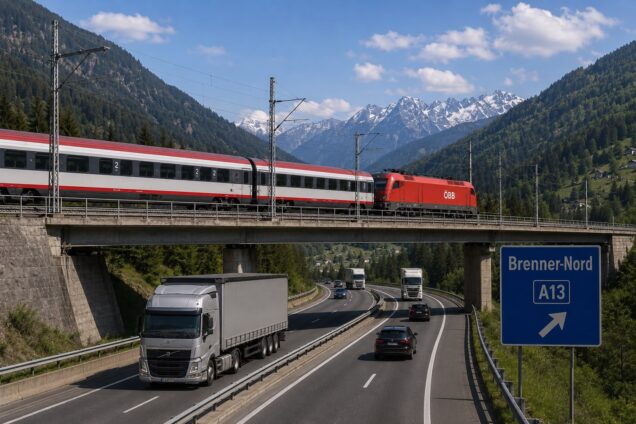
Every day, thousands of trucks cross the Brenner Pass, carrying goods between Germany, Austria and Italy. As one of Europe’s busiest Alpine freight corridors, the Brenner Pass is a key link in the European Union’s single market, supporting the movement of food, medicines, machinery and industrial goods across the continent. According to the Austrian transport organisation VCÖ, more than 2.4 million heavy goods vehicles used the route in the previous year, underscoring its importance to European trade.
Today, the Brenner Pass is at the centre of a legal dispute that extends far beyond transport. The case raises a broader question for the European Union: how can governments reduce pollution while safeguarding the free movement of goods, one of the bloc’s core principles?
Austria’s western state of Tyrol has introduced measures to reduce congestion, noise and air pollution caused by heavy truck traffic. These include restrictions on certain freight categories, limits on night-time driving and traffic controls during peak periods. Austrian authorities argue that the measures are necessary to protect the health of residents in Alpine valleys, where the surrounding terrain can trap pollutants.
Italy, backed by transport operators and business groups, argues that the restrictions delay deliveries, increase logistics costs and disrupt cross-border trade. The dispute has reached the Court of Justice of the European Union, where an Advocate General recently concluded that several of Austria’s measures are incompatible with EU law because they disproportionately restrict the free movement of goods. While the opinion is not legally binding, it is influential, and the court’s final judgment is expected to clarify how EU law balances environmental protection with the functioning of the single market.
The Brenner case illustrates a wider challenge facing Europe. The European Union is pursuing ambitious climate goals while seeking to maintain an open, competitive economy. Yet climate policy and economic integration can pull in different directions, particularly when national environmental measures affect businesses and supply chains across borders.
The Brenner corridor is a vital route for European commerce. Delays can increase transport costs, disrupt production schedules and affect manufacturers, retailers and consumers across the continent. The effects may also extend beyond Europe, including exporters in Africa whose products travel through European logistics networks before reaching global markets.
Many transport specialists argue that expanding rail freight is the most sustainable long-term solution. The Brenner Base Tunnel, currently under construction between Austria and Italy, is expected to shift freight from road to rail, thereby reducing emissions and preserving one of Europe’s most important trade corridors.
Whatever the European Court of Justice ultimately decides, its ruling is likely to influence transport and environmental policy across the European Union. More broadly, the Brenner dispute highlights one of the EU’s defining policy challenges: reducing emissions without undermining the free movement of goods, which underpins the EU’s economy.
How Europe strikes this balance will likely shape transport, trade and climate policy for years to come.
Latest Stories
-
Team Volta wins NPA 2026 Staff Welfare Week Quiz
4 minutes -
Team Eternity Ghana releases new album “The Promise – Phase 1”
8 minutes -
Inside the human genome: Why scientists are still discovering who we are
11 minutes -
PAC grills Central Regional Coordinating Council over GH¢14.9m payments processed outside GIFMIS
19 minutes -
Ghana’s industrial dream at risk? How the Yuan policy could deepen China dependence
19 minutes -
Teachers’ strike: Government has funds, but processes are causing delays – Education Committee Vice Chair
25 minutes -
Afenyo-Markin urges Christian Council to intervene over arrests linked to free speech
26 minutes -
GCB Bank urges MSMEs to formalise businesses for easier access to finance
27 minutes -
Criminal cases must be tried in ordinary courts – Prof. Oquaye opposes tribunals
28 minutes -
Ghana, India sign MoUs to deepen cooperation in agriculture, healthcare, railways and ICT
56 minutes -
Pete Edochie becomes first Pan-African honouree of Ghana’s Legacy Project
60 minutes -
GCB MSME Caravan Clinic unfolds in Accra, boosting support for Ghanaian small businesses
1 hour -
AMA urged to crack down on unauthorised billboards in Accra
1 hour -
Obuasi East Assembly orders removal of containers from road reservation
1 hour -
From selling body splash to Best Female Graduating Student at UDS – Hamdia’s inspiring journey
1 hour