

Audio By Carbonatix
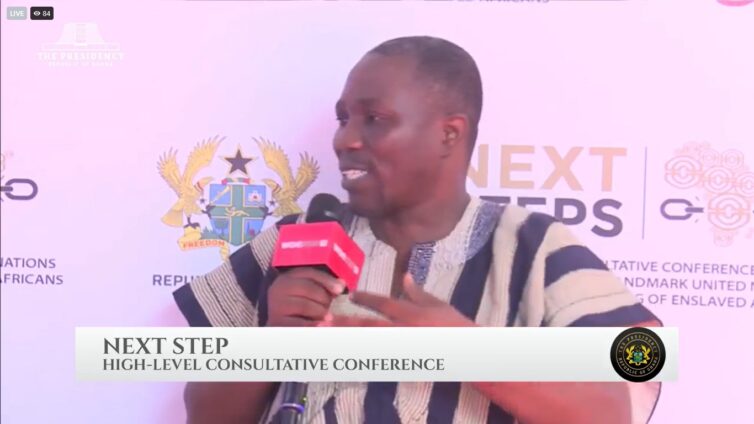
A researcher and historian at the University of Ghana, Legon, Accra, Kweku Darko Ankrah, has argued that Europe’s economic transformation and industrial advancement were significantly driven by the enslavement and forced labour of Africans.
Speaking on the sidelines of the ongoing Next Steps Conference on Reparatory Justice in Accra, Mr Ankrah said historical evidence suggests that Africa was economically advanced prior to European contact, particularly before the onset of the transatlantic slave trade.
He contended that African societies were largely self-sustaining, with families able to meet their basic needs and maintain stable livelihoods before external disruption through enslavement and colonial expansion.
According to him, European economies at the time faced internal social and labour challenges, but later experienced rapid growth after millions of Africans were forcibly transported and made to work on plantations and in domestic service, forming what he described as a key foundation of European wealth accumulation.
""When the slave trade occurred, what happened was that the African strong men who ought to work in the agrarian sector, because Africa's economy was highly propelled by the agrarian sector, were taken to Europe, that labour was used in the farms and plantations in Europe, and as a result, it boosted the economy of these Western places while they were able to get the consumable outcomes from their sweat," he noted.
Mr Ankrah argued that this system of forced labour played a critical role in transforming European agriculture and industry, enabling economic expansion at the expense of African societies.
He further referenced historical records and publications from the Gold Coast era, which he said documented comparative conditions between Africa and Europe prior to colonial rule, reinforcing claims of Africa’s earlier economic strength.
The historian made the remarks in the context of growing global conversations on historical accountability and reparatory justice, which have gained momentum following the adoption of UN Resolution A/RES/80/250.
The Accra conference, convened under the auspices of President John Dramani Mahama, continues to serve as a platform for scholars, policymakers and global stakeholders to examine the legacy of slavery and its continuing socio-economic impact on Africa and the diaspora.
Latest Stories
-
Amazon eyes Ghana for broadband expansion after talks with Mahama
3 minutes -
National Investment Quiz 2026: Six schools qualify for quarter-finals
31 minutes -
‘Do not let Russia pay for its madness with lives of your people’ – Zelensky to Ghana, 46 other countries
37 minutes -
6,079 promotion cases fully processed and paid – CAGD says amid nationwide teachers’ strike
57 minutes -
Teacher unions to meet government Monday over nationwide strike
1 hour -
Photo story: Republic Bank-JoyNews Habitat Fair clinic wraps up after three days of housing solutions, expert engagement
1 hour -
National Peace Council urges investment in youth to sustain Ghana’s peace
2 hours -
Afenyo-Markin urges youth to speak up against injustice
2 hours -
CAF annuls Edo Queens victory, orders WAFU B final to resume from extra time
2 hours -
Interior Minister urges traditional authorities to enforce anti-bushfire bye-laws
2 hours -
3rd Republic Bank-JoyNews Habitat Fair Clinic ends on a high note after three days of strong patronage
2 hours -
Ten climbers missing after avalanche hits Himalayan base camp
3 hours -
NPP had more permanent fuel relief measures than current GH¢2 diesel cut – Amin Adam
3 hours -
Photos from the 3rd Republic Bank-JoyNews Habitat Fair Clinic
3 hours -
Ethiopia’s army promises restraint amid fears of new civil war
3 hours