

Audio By Carbonatix
Artificial intelligence giant Nvidia's most advanced chips will be reserved for U.S. companies and kept out of China and other countries, U.S. President Donald Trump said.
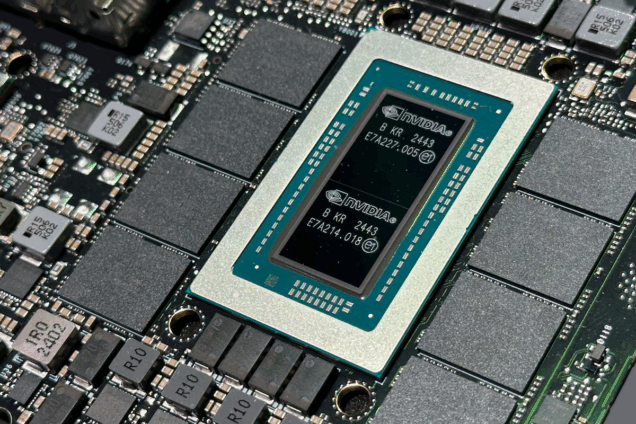
During a taped interview that aired on Sunday on CBS' "60 Minutes" program and in comments to reporters aboard Air Force One, Trump said only U.S. customers should have access to the top-end Blackwell chips offered by Nvidia, the world's most valuable company by market capitalisation.
The Reuters Daily Briefing newsletter provides all the news you need to start your day. Sign up here.
"The most advanced, we will not let anybody have them other than the United States," he told CBS, echoing remarks made earlier to reporters as he returned to Washington from a weekend in Florida. "We don't give (the Blackwell) chip to other people," he said during the flight.
The remarks suggest Trump may impose tighter restrictions on cutting-edge American AI chips than U.S. officials previously had indicated, with China and potentially the rest of the world barred from accessing the most sophisticated semiconductors.
In July, the Trump administration released a new artificial intelligence blueprint seeking to loosen environmental rules and vastly expand AI exports to allies, in a bid to maintain the American edge over China in the critical technology.
And just last Friday, Nvidia said it would supply more than 260,000 Blackwell AI chips to South Korea and some of the country's biggest businesses, including Samsung Electronics.
Questions have also swirled about whether Trump would allow shipments of a scaled-down version of Blackwell chips to China since August, when he suggested he might allow such sales.
Trump told CBS he would not allow the sale of the most advanced Blackwells to Chinese companies, but he did not rule out a path for them to obtain a less capable version of the chip. "We will let them deal with Nvidia but not in terms of the most advanced," he said during the "60 Minutes" interview.
The possibility that any version of Blackwell chips might be sold to Chinese firms has drawn criticism from China hawks in Washington, who fear the technology would supercharge China's military capabilities and accelerate its AI development.
Republican Congressman John Moolenaar, who chairs the House Select Committee on China, said such a move "would be akin (to) giving Iran weapons-grade uranium."
Trump had hinted he might discuss the chips with Chinese President Xi Jinping ahead of their summit in South Korea last week, but ultimately said the topic did not come up.
Nvidia has not sought U.S. export licenses for the Chinese market because of Beijing's stance on the company, CEO Jensen Huang said last week.
"They've made it very clear that they don't want Nvidia to be there right now," he said during a developers' event, adding that it needed access to China to fund U.S.-based research and development.
Latest Stories
-
Obuasi SHTS case: Eduwatch calls for sex offenders’ register and mandatory background checks for teachers
2 minutes -
GloMeF CEO urges intensified public education on new road traffic regulations
14 minutes -
‘Any tax on ChatGPT is an attack on education and innovation’- Akim Swedru, MP
17 minutes -
Obuasi SHTS sexual abuse scandal exposes systemic failure in child protection – Moving Masculinity
18 minutes -
Hubtel CEO calls for national data-sharing framework to boost AI development
20 minutes -
Twelve Golden Rules of real estate development in Ghana, Africa
25 minutes -
Five new telephony cell sites in Ashanti Region to be activated in October 2026 – Sam George
25 minutes -
Mahama cuts sod for Afienya Industrial Park, targets 120 enterprises
30 minutes -
Rush for fuel from accident tankers is stealing, punishable by law – NPA boss, Edudzi Tamakloe
36 minutes -
GhIG pushes for legislation to regulate geoscientists’ activities
42 minutes -
Mfantsipim @150: Ace Anan Ankomah leads project to preserve school’s musical heritage
46 minutes -
Gov’t launches rCOMSDEP in Ahanta West, Mpohor Fiase to promote responsible community mining
47 minutes -
AI is forcing professionals to rethink how they deliver value – Hubtel CEO
50 minutes -
Daily Insight for CEOs: Strengthening the CEO’s Leadership Legacy
51 minutes -
Jimmy Aglah’s ‘When the River Testified’ approved by NaCCA as Supplementary Reader
60 minutes