

Audio By Carbonatix
The UN's International Court of Justice is to hear a case brought by South Africa accusing Israel of committing genocide against Palestinians in Gaza.
The submission also calls on the court to order Israel to stop military operations there.
The ICJ will deliver only an opinion on the genocide allegation as the case is not a criminal trial, although it is being keenly watched.
Israel has vehemently rejected the accusation as baseless.
In its submission, South Africa says Israel's actions "are intended to bring about the destruction of a substantial part of the Palestinian national, racial and ethnical group".
It says Israel's actions include "killing Palestinians in Gaza, causing them serious bodily and mental harm, and inflicting on them conditions of life calculated to bring about their physical destruction".
It calls for "provisional measures" to be implemented by the court, including that Israel cease all military activities in Gaza.
Israeli President Isaac Herzog called the accusations "atrocious and preposterous".
"We will be in the International Court of Justice and we will present proudly our case of using self-defence… under humanitarian law," he said.
He added that the Israeli army was "doing its utmost under extremely complicated circumstances on the ground to make sure that there will be no unintended consequences and no civilian casualties".
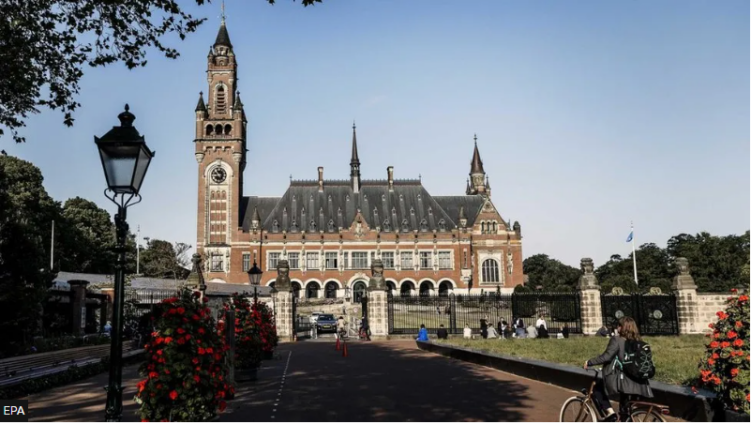
The ICJ - the UN court based in the Hague in the Netherlands - could rule quickly on South Africa's request for Israel to suspend its military campaign - but a final ruling on whether Israel is committing genocide could take years.
ICJ rulings are theoretically legally binding on parties to the ICJ - which include Israel and South Africa - but are not enforceable.
In 2022, the court ordered Russia to "immediately suspend military operations" in Ukraine, an order that was ignored.
South Africa has been highly critical of Israel's military operation in Gaza, and its governing African National Congress has a long history of solidarity with the Palestinian cause.
It sees parallels with its struggle against apartheid - a policy of racial segregation and discrimination enforced by the white-minority government in South Africa against the country's black majority, until the first democratic elections, in 1994.
In Gaza, more than 23,350 people have been killed, according to the Hamas-run health ministry, since the war began in the aftermath of Hamas's 7 October attacks on southern Israel. In those attacks some 1,300 people were killed - mainly civilians - and about 240 others taken hostage.
Latest Stories
-
Brandon Asante and Coventry all but promoted to Premier League despite Sheffield Wednesday draw
16 minutes -
GPL 2025/26: Late Kwartemaa strike downs Hearts in Tema
23 minutes -
Ghana Faces Sierra Leone Moment as Prosecutorial Powers come under strain
32 minutes -
Don’t consume fish or seafood from Tema Shipyard until further notice – FDA warns
37 minutes -
Why volunteering might be Africa’s most underrated career accelerator
44 minutes -
ActionAid Ghana raises concern over gender gaps in Feed Ghana Programme
45 minutes -
Windstorm wreaks havoc in Gushegu, displacing nearly 2,000 residents and damaging schools
48 minutes -
Friends of Bridget Bonnie Marks her 35th birthday with donation to Kasseh Model Health Centre
2 hours -
From Ekumfi Kokodo to the Pulpit Stage: Essi Donkor’s gospel journey takes shape
2 hours -
Landfilling waste management creates no value, it’s an economic waste
2 hours -
Photos: Speaker Bagbin Commissions MPs constituency office under parliamentary decentralisation programme
2 hours -
Black Stars technical advisor Winfried Schäfer sacked as GFA shakes up backroom staff
2 hours -
Wenchi water project almost complete, critical to gov’t agenda – GWL MD
3 hours -
Anti-LGBTQ+ bill not part of government’s legislative agenda – Inusah Fuseini
3 hours -
Anti-LGBTQ Bill: Forget the rumour mongers, I’m a man of action, and will pass the bill – Speaker
3 hours