

Audio By Carbonatix
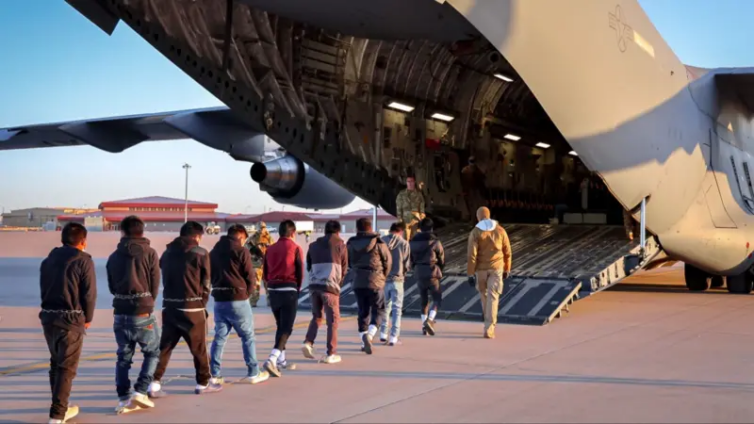
A flight carrying 199 Venezuelans deported from the US to their homeland has landed at Simón Bolívar airport near Caracas.
US repatriation flights to Venezuela had ground to a halt weeks ago after the Trump administration revoked a licence allowing Venezuela to export some of its oil to the US despite sanctions.
But on Saturday the two governments, which have no diplomatic relations, reached an agreement on resuming the flights, as part of the Trump administration's plan to remove undocumented migrants.
Venezuelan President Nicolás Maduro described the flights as a chance to "rescue and free migrants from prisons in the US".
As they disembarked from the plane early on Monday, some of the deportees raised their arms and waved.
They had earlier been transferred from the US state of Texas to Honduras, in Central America, from where they were flown by Venezuelan flag carrier Conviasa to Maiquetía, north of Caracas.
The US Bureau of Western Hemisphere Affairs described them as "illegal aliens" who "had no basis to remain in the United States".
The head of Venezuela's National Assembly, Jorge Rodríguez, on the other hand stressed on Saturday that migration was "not a crime".
Venezuela had originally agreed to take in Venezuelan deportees from the US in a deal struck by President Donald Trump's special envoy, Richard Grenell, in Caracas in January.
It was widely seen as a victory for Trump, who has made deporting undocumented migrants a priority.
However, Maduro said on 8 March that the US administration's decision to revoke the licence of oil giant Chevron to operate in Venezuela had created "a little problem".
"They damaged the line of communication we had opened, and I was interested in those lines of communication... because I wanted to bring home all the Venezuelans they have in custody they have unjustly persecuted," he said.
A week later, the Trump administration deported 238 Venezuelans to a mega-prison in El Salvador, arguing that they were members of the Tren de Aragua criminal gang.
It caused an outcry in Venezuela, where several relatives of those deported to El Salvador insisted their loved ones had no criminal connections.
On Monday, Trump said on Truth Social that Venezuela "has been very hostile to the United States".
He said its government "purposefully and deceitfully sent to the United States, undercover, tens of thousands of high level, and other, criminals, many of whom are murderers and people of a very violent nature."
He also announced a "secondary tariff" on Venezuela, meaning that any country purchasing oil and gas from Venezuela would be hit with a 25% tariff when trading with the United States.
The deportation of Venezuelans to El Salvador's feared Cecot prison was followed by a warning posted on X by US Secretary of State Marco Rubio last week that Venezuela would face "severe and escalating" sanctions if it refused to accept its citizens deported from the US.
The following day, Maduro ordered his government to "step up the action needed to guarantee return flights for detained migrants".
Tariffs are a tax on imports. They are paid by the company that is buying the goods as opposed to the overseas business that is selling the product.
Since taking office in January, Trump has repeatedly used tariffs - or the threat of them - in an attempt to gain leverage in a range of disputes, only some of which are related to trade.
He said on Monday he still planned to impose tariffs on specific products, including cars, lumber and computer chips, claiming the possibility of such measures were already helping to spur investment in the US.
His latest threat against Venezuela is expected raise pressure on current buyers of oil - which include China, India and Spain - to reduce their dealings in the country, which have provided a critical financial lifeline to the Venezuelan government.
Trump has already raised tariffs on Chinese imports to at least 20% since February. He told reporters he intended to the latest announcement to be added on top of existing levies.
For Venezuela, China is a major buyer of its oil. But Venezuela is not a big source of crude for China, which imported more than 11 million barrels per day last year.
The US is a major buyer of Venezuelan oil, as a result of exemptions from economic sanctions granted to US oil firm Chevron.
The Trump administration has previously signalled its intention to end those exemptions.
On Monday, the administration updated its order, giving Chevron until 27 May to wind down its operations in Venezuela, extending the deadline by two months.
Chevron declined to comment.
Oil prices rose more than 1% after the announcement.
Latest Stories
-
Oil prices climb as traders weigh Saudi supply risk, Russian diesel flow
14 minutes -
Zimbabwean author denies using AI to write award-winning story
23 minutes -
Bank of America hit with $1.2bn fine for money laundering failings
32 minutes -
Robot seized by German police after allegedly groping teenage girl
43 minutes -
Subject EC appointment to ‘Akufo-Addo test’ – Kwapong
53 minutes -
English football’s independent regulator would quit over Man City interference
1 hour -
Anthropic seeks rehearing of case over Pentagon’s security risk branding
1 hour -
Torrential rains in Libya’s Tripoli kill two
2 hours -
Guinea-Bissau says it has not approved hepatitis B vaccine trial in newborns
2 hours -
NDC Deputy National Organizer Aspirant Hamza Umar targets grassroots mobilisation
2 hours -
Partisan appointment cycle will persist without meaningful reforms – Osae-Kwapong
3 hours -
‘This cycle is not going to be broken any soon’ – Osae-Kwapong on partisan appointments
3 hours -
Partisan appointments won’t help restore trust in EC – Osae-Kwapong
4 hours -
Villarreal fight back to beat Napoli and end losing run
4 hours -
Tresoldi nets hat-trick as Club Brugge win Inter thriller
4 hours