

Audio By Carbonatix
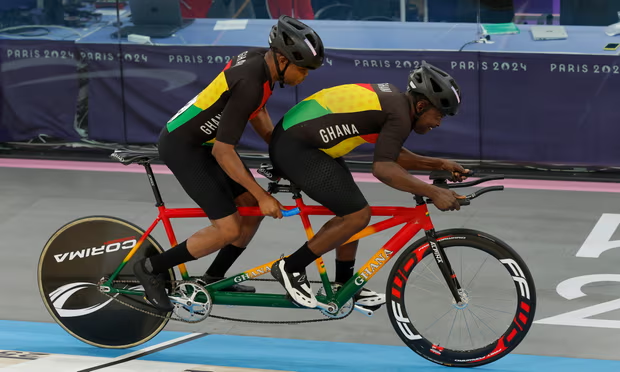
There are no velodromes in Ghana. But there is a Paralympic track cyclist. His name is Frederick Assor and at the Paris velodrome he and his pilot, Rudolf Mensah, loop the track on a brightly-coloured tandem with spoked wheels and a Heath Robinson air.
Assor and Mensah finished last in the men’s B 4,000m individual pursuit on the first day at the track, their time of 6min 30.071sec, a Ghanaian and African record, 2min 35sec slower than the winner Tristan Bangma of the Netherlands, who broke the world record with an average speed of over 61km/h. Assor and Mensah’s average was 36.9km/h. They returned on Sunday, whooped along by the crowd, this time in the B 1,000m time trial, where they also finished last.
The huge gap isn’t much of a surprise: the bike Assor rides compared to the bikes of other nations is the difference between a pawing thoroughbred and a weary donkey.
“It’s nice riding on a big platform like the Paralympics,” says Assor. “But the issue is that we are using a very, very old bike. You can see that we are riding with all our energy, our strength, because you pedal, you pedal a lot. But you see the other countries, they pedal slowly because their crank is very, very big. They have a 144 crank, but we are using a 50 crank so if they go once, we have to go three times.”
Assor loved sport as a child, playing football, volleyball and athletics. But he became blind at 14. “We were writing exams and then I couldn’t see again. Just like that.” There was a huge period of adjustment as he learned braille. When he went to university he was introduced to cycling and fell in love with it.
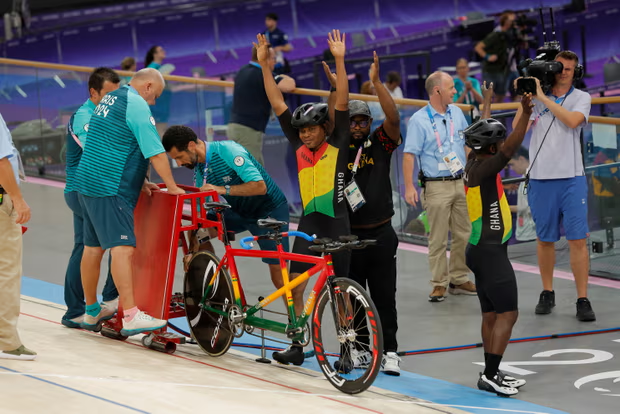
“It has given me more confidence and boldness. It means I don’t fear when I’m walking, because when you are riding you can’t see anything but you are moving fast.”
He is Ghana’s first blind Paralympic cyclist and this is his and Mensah’s second Games after Tokyo – where their bike was lost in transit and they had to borrow one from the Japanese federation. This time they have also had bike problems, the French team later lending them some wheels, which they have now returned.
Mensah isn’t only the eyes of the bike, he also is the coach and the (volunteer) team mechanic. He and Assor both live in Accra, where Assor does some odd jobs and Mensah works as a mechanic. He spends his spare time repurposing bikes and trying to put together improvised tandems that other blind people can ride.
There are only a handful of velodromes in Africa, including one in Egypt and a concrete one in Lagos, and when Mensah first saw one he wasn’t convinced.
“I was afraid. I asked myself, can I ride on that? I saw two ladies from Britain, the way they rode on the velodrome, their speed and skills, then I saw that I can do it. And I told him [Assor], it’s easy, we can do it. He tried before and he fell down, but I was good to him, I said to him, let me ride you, let’s do it.”
When the two go out training on the road, the sight of them on the tandem causes some surprise. “When people see us, they think we are having leisure,” says Assor, “because they have not seen two people sitting on one bike before. Sometimes when we tell them, it amazes them that a blind man is riding.”
Ghana has sent one of the smaller Paralympic teams to Paris, just four athletes: Assor, Zinabu Issah, who got through qualifying in the wheelchair discus and will compete in the shot put on Wednesday, Patricia Kyeremaa, who lost the last 16 of the women’s K44 +65kg taekwondo, and the powerlifter Tahiru Haruna, who will compete in the +107kg final on Sunday. Resources are scarce.
How are people with disabilities treated in Ghana? “Not good,” says Assor. “We are far behind. We have a lot of abilities in people with disabilities. There are people who would be interested in doing sports. There are people who would be interested in doing other things, like sewing, shoe making. But with all these things, it boils down to the resources and the facility for doing this
“I hope someone will read this and say: ‘Have some wheels.’ And then we could get a lot of people who could qualify for a competition like this. But with just one person all the time and no equipment, it’s not healthy.”
Latest Stories
-
Demand and savings deposits decreased in August 2026, but currency outside banks increased by 4%
2 minutes -
Fiscal policy implementation poses downside risk to inflation – BoG
36 minutes -
Organised Labour should seek fair adjustment, not excessive pay rise – Labour consultant
40 minutes -
BoG maintains medium-term inflation target of 8 ± 2%
47 minutes -
Sammi Awuku urges NPP Germany to unite ahead of 2028 elections
1 hour -
The Inconvenient Truth: We cannot pray for the cure while protecting the disease
2 hours -
MTN Ghana trains civil society organisations on artificial intelligence
3 hours -
GoldBod FX framework aims to make dollar supply predictable – Acheampong
3 hours -
How does a Ghanaian team make it to the BAL?
3 hours -
Ghana’s investment climate presents opportunities for industrial growth and job creation.
3 hours -
‘I paid thousands to a company for jobs that never came’
4 hours -
SSNIT intensifies informal sector enrolment drive with Techiman float
4 hours -
Ghana seeks long-term mining investments that benefit local communities – Armah-Kofi Buah
4 hours -
GHATOF demands compensation for 85 businesses affected by La Pleasure Beach demolition
4 hours -
Bono Regional Minister calls for investor education to drive economic growth
4 hours