

Audio By Carbonatix
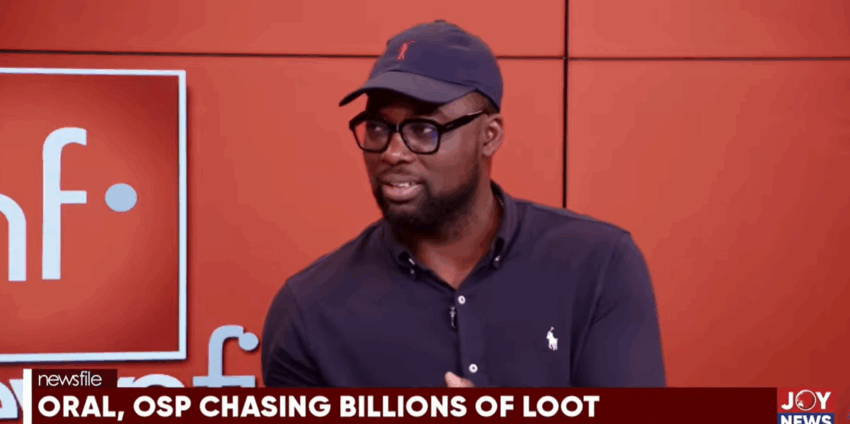
Lawyer and lecturer at the Ghana School of Law, Bobby Banson, has cautioned against tackling corruption through propaganda and public sensationalism, arguing that only strong legal procedures can sustain Ghana’s anti-corruption efforts.
Speaking on JoyNews’ Newsfile on Saturday, October 25, during a discussion on “ORAL and OSP Chasing Billions of Loot,” Mr. Banson questioned the legal basis under which the Office for the Recovery of Assets and Loot (ORAL) was operating.
He noted that existing laws, such as the Whistleblower Act, already outline a clear process for reporting and investigating suspected crimes, making it essential for all anti-corruption bodies to act within established legal frameworks.
“If you look at how ORAL even started operating, I raised the point — what was the legal ambit within which it operated? We already have the Whistleblower Act, which provides mechanisms for people to disclose information when they suspect a crime,” he said.
Mr. Banson explained that the Act requires such disclosures to be documented and submitted to the appropriate authorities, such as the Attorney-General’s Office, within seven days. However, he expressed concern that ORAL’s process appeared to sidestep these legal requirements.
“You have a group of people who say they received complaints from the public and decided to compile them in their own way before submitting them to the Attorney-General. I’m not surprised it has become difficult to prosecute some of these cases,” he said.
Mr. Banson stressed that Ghana’s fight against corruption must be grounded in law and evidence, not publicity.
“As a country, we cannot uproot corruption based on propaganda — that’s a fact. Whether it’s NPP or NDC, when propaganda becomes the approach, it undermines the process,” he stated.
He, however, clarified that he did not consider the Attorney-General’s recent press briefings as propaganda, noting that it was within the AG’s right to inform the public about the government’s anti-corruption actions.
“It is okay for the Attorney-General to announce the steps being taken in the discharge of his obligations. I have no problem with that — he’s a public officer and must be accountable,” he said.
That said, Mr. Banson warned that public officials must avoid making “conclusive statements of guilt” before cases are determined in court.
“Where they cross the line is when conclusions of fact are made before trial. The Attorney-General, with all his experience, has the right to determine his style,” he added.
Latest Stories
-
Kwame Dadzie: Did Stonebwoy’s ‘Jejereje’ really give NDC “significant” electoral impact?
22 minutes -
Lands and Mines Watch Ghana commends Armah-Kofi Buah for transparent Damang Mine Lease Transition
2 hours -
GTVETS announces resumption of work as PSWU strike is called off
2 hours -
AratheJay brings “The Odyssey” to life with stunning live performance release
2 hours -
Gender Minister engages unemployed persons with disabilities
2 hours -
Formal education is a key to success, not the only path – Klef Carter
3 hours -
Why Africa’s creators must lead the movement To build Africa’s 1.5 Billion-consumer single market
3 hours -
IMANI-Africa flags ‘decade and a half of policy failure’ as SIM card re-registration returns
3 hours -
9th Africa Business Tourism & Mice Masterclass to spearhead regional integration and infrastructure readiness
3 hours -
South Africa’s premier sustainable tourism province to welcome Pan-African tourism industry leaders
3 hours -
Photos: Mahama leads wreath-laying ceremony honouring enslaved Africans in New York
3 hours -
Sulemana Braimah urges probe into ‘Big Push’ contracts
4 hours -
Honda Football Championship 2026 officially launched
4 hours -
Salah to leave Liverpool at end of season
4 hours -
Photos: President Mahama’s high-level session on reparatory justice at United Nations
4 hours