

Audio By Carbonatix
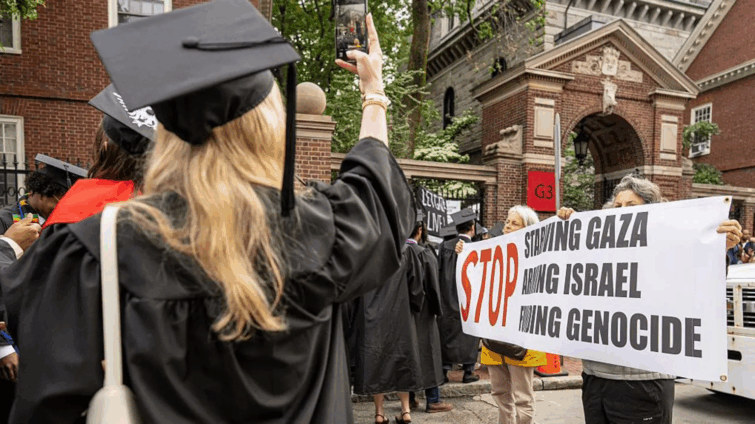
The Trump administration says that Harvard University violated civil rights laws over its treatment of Israeli and Jewish students, potentially further endangering its federal funding.
In a letter sent to Harvard, the administration accused the university of deliberate indifference towards the concerns of Jewish students who felt threatened on campus.
The move is the latest in a series of legal and financial battles between Harvard and the White House - the stakes of which have dramatically escalated over the last few months.
Harvard says it has made "significant strides" to combat discrimination and "strongly disagrees" with the government's findings.
The letter, viewed by the BBC, says that "failure to institute adequate changes immediately will result in the loss of all federal financial resources" for Harvard.
"Harvard may, of course, continue to operate free of federal privileges, and perhaps such an opportunity will spur a commitment to excellence that will help Harvard thrive once again," says the letter addressed to Harvard University President Alan Gerber.
According to the letter, federal investigators found that a "majority" of Jewish students reported discrimination or bias against them, with one quarter having felt physically threatened.
Among the behaviours detailed in the letter are Jewish students being spat upon or assaulted, and images being widely circulated depicting a dollar sign in the Star of David and antisemitic stickers being distributed, including one showing an Israel flag with a swastika in place of the Star of David.
"Harvard's inaction in the face of these civil rights violations is a clear example of the demographic hierarchy that has taken hold of the university," the letter adds. "Harvard's commitment to racial hierarchies—where individuals are sorted and judged according to their membership in an oppressed group identity and not individual merit—has enabled anti-Semitism to fester."
The letter is what is known as a "notice of violation" that often precedes a lawsuit or a voluntary resolution if corrective measures are taken.
In a statement, Harvard said that it had taken "substantive, proactive steps" to combat antisemitism on campus, and had made "significant strides to combat bigotry, hate and bias".
"We are not alone in confronting this challenge and recognise that this work is ongoing," the statement added.
Speaking at the White House on Monday, Press Secretary Karoline Leavitt said that negotiations between the administration and Harvard are taking place "behind closed doors", without elaborating.
Leavitt added that incidents of antisemitism on campus are "facts that Harvard cannot dispute".
In April, Harvard released the findings of an internal investigation which found that the university was deeply polarised by the ongoing war in Gaza, with students on both sides feeling unsafe.
In a message from Mr Garber which accompanied the report, the university president apologised for "moments in which we failed to meet the high expectations we rightfully set for our community".
The university has also taken a number of steps to address the issue, including facilitating dialogue problems, expanding non-discrimination and anti-bullying policies and enhancing antisemitism training.
The letter is the latest in a series of clashes between Harvard and the Trump administration, which has ramped up its crackdown on universities it claims have failed to tackle antisemitism amid protests against the war in Gaza.
Earlier, in May, the administration directed US federal agencies to review Harvard University's grants to potentially end or redistribute funding. The administration estimated about 30 contracts, collectively worth $100m (£74m), could be reviewed.
It already had frozen $2.65bn in federal grants and tried to revoke Harvard's ability to enrol international students.
The Trump administration also issued Columbia University a similar notice last month, accusing it of violating civil rights law for allegedly failing to protect Jewish students from harassment. Columbia is also negotiating with the administration over its federal funding and autonomy.
Latest Stories
-
Photos: IGP Yohuno decorates 22 newly promoted DCOPs
10 seconds -
We didn’t deliberately delay negotiations with teacher unions – FWSC
44 seconds -
‘Go back to the drawing board’ – Polo urges Black Stars to find solutions
2 minutes -
Kaerbo For Africa hands over three-classroom block to Gomoa Nyanyano SHS
4 minutes -
KNUST students win Pan African AI Summit Hack-AI-Thon with cocoa waste solution
4 minutes -
Cocoa prices risen by 95% since March 2026, to average US$5,670 in 2026
16 minutes -
British national arrested in connection with RAF Fairford incident
22 minutes -
‘Strike is the only language government understands’ –IFEST backs teachers
23 minutes -
Teachers must not be blamed for maintaining strike; the gov’t failed to act earlier – IFEST
32 minutes -
Attijariwafa’s acquisition of Societe Generale likely to be ratings neutral; Ghana’s banking environment healthy – Fitch
41 minutes -
Mahama’s Reset Agenda will make resource wealth benefit citizens – Dr Djokoto
46 minutes -
La Pleasure Beach to reopen after demolition exercise
50 minutes -
La Pleasure Beach demolition victims to receive compensation
1 hour -
NPP Germany congratulates new national executives, calls for unity ahead of 2028 elections
1 hour -
Avaricious elitism and intellectualism
1 hour