

Audio By Carbonatix
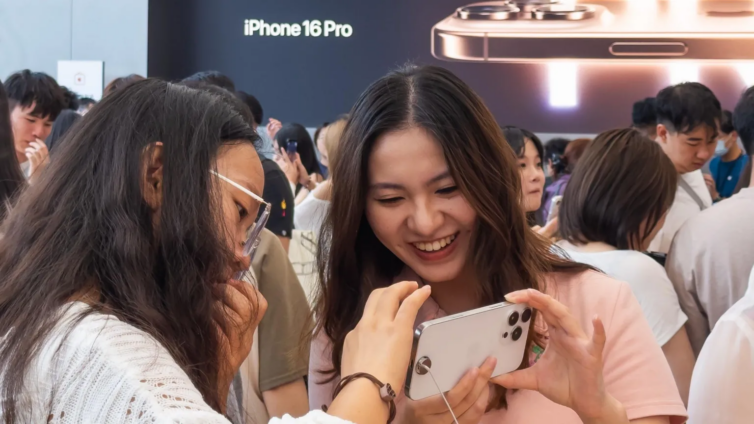
Shoppers in China are getting rare discounts on iPhones as Apple faces growing competition from local brands.
The four-day promotion, which starts this Saturday (4 January), includes discounts of as much as 500 yuan ($68.50, £55.30) on some of the US technology giant's newest handsets.
Chinese phone maker Huawei has also cut prices of its high-end mobile devices by as much as 20%.
The discounts come as consumers in China remain hesitant about spending because of the country's economic challenges.
The offer covers Apple's top models as well as older handsets and some other devices.
The biggest discount of 500 yuan will apply to Apple's flagship iPhone 16 Pro, which has a starting price of 7,999 yuan, and the iPhone 16 Pro Max which currently costs 9,999 yuan.
The firm held a similar promotion in China last year ahead of the Lunar New Year holiday. This year, the festival starts at the end of January.
Changing behaviour
"Apple's strategy has changed to adapt to the change in Chinese consumers' shopping behaviour," said Will Wong, a senior research manager for market intelligence firm International Data Corporation (IDC).
"The value-seeking trend has made price discounts more attractive to consumers. Apple may fall behind other competitors if it doesn't adopt such a pricing strategy."
The discounts being offered by Apple and Huawei reflect a wider trend in China.
From online retail giants to the country's car makers, deals are being offered in a bid to attract customers who have been reluctant to spend as the world's second largest economy slows.
The Chinese government has also stepped up efforts to boost consumption.
Last year, Beijing launched a trade-in programme to encourage consumers to replace old products such as cars and household appliances.
The plan was expanded on Friday to include mobile phones, tablets, smartwatches and fitness bands.
Local competition
Against this backdrop, Apple's share of the Chinese market has come under increasing pressure from local rivals, such as Vivo and Xiaomi.
The US firm re-entered China's top five smartphone makers in the third quarter of 2024 after briefly dropping off the list.
According to IDC's latest research, Vivo was China's best-selling smartphone maker in the period as its sales jumped by more than 20%.
During the same period, Apple saw sales dip by 0.3%. Huawei's jumped by more than 40%.
"We've seen market competition increase with almost everyone launching a flagship last quarter," said Ivan Lam, a senior analyst at Counterpoint Research.
Huawei has seen demand for its products surge after its return to the premium smartphone market in August last year.
The Shenzhen-based firm has since launched several new devices powered by advanced technology despite the company facing US restrictions.
Latest Stories
-
Huge crowds greet Pope in Paris for open-air Mass
10 minutes -
‘I never said I’ll declare a state of emergency’ – President Mahama on galamsey
51 minutes -
Bobby Banson condemns EOCO’s attempted arrest of Nana Agyei Baffour Awuah
1 hour -
When Kumasi begins to look like somebody is in charge
1 hour -
Parliamentary probe into cocaine seizure would be a waste of time – Inusah Fuseini
1 hour -
Cocaine seizure: Focus on Ghana’s reputation, not partisan blame – Osae-Kwapong
1 hour -
Two Invitations, Three Interrogations: Did Baffour Awuah tell the whole story?
2 hours -
Drug cartels may be seeing Ghana as easy route – Lenin Anane Agyei
3 hours -
Ghana risks gaining notoriety as drug-trafficking hub – Bobby Banson
3 hours -
Government dismissed my drug trafficking warning, then tried to arrest me – Ntim Fordjour
3 hours -
Day Two: 3rd Republic Bank-JoyNews Habitat Fair Clinic underway at Junction Mall
3 hours -
NACOC addressing inherited gaps in fight against drug trafficking – Deputy Director-General
3 hours -
Taekwondo goes to school as GTF launches five-region youth campaign
3 hours -
The issues Mourinho is struggling to fix at Real Madrid
3 hours -
Hundreds throng EducationUSA College Fair in Kumasi in pursuit of abroad studies
3 hours