

Audio By Carbonatix
The world's oldest boomerang is older than previously thought, casting new light on the ingenuity of humans living at the time.
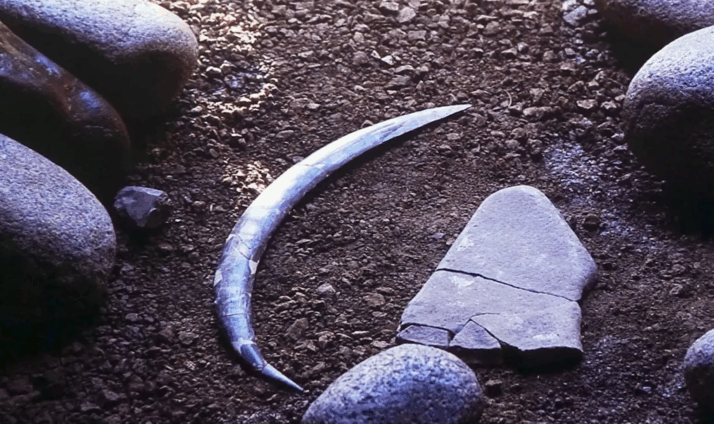
The tool, which was found in a cave in Poland in 1985, is now thought to be 40,000 years old.
Archaeologists say it was fashioned from a mammoth's tusk with an astonishing level of skill.
Researchers worked out from its shape that it would have flown when thrown, but would not have come back to the thrower.
It was probably used in hunting, though it might have had cultural or artistic value, perhaps being used in some kind of ritual.
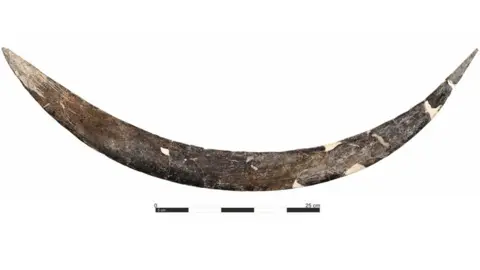
The mammoth ivory boomerang was unearthed in Oblazowa Cave in southern Poland.
It was originally thought to be about 30,000 years old. But new, more reliable radiocarbon dating of human and animal bones found at the site puts the age at between 39,000 and 42,000 years old.
"It's the oldest boomerang in the world, and the only one in the world made of this shape and this long to be found in Poland," said Dr Sahra Talamo of the University of Bologna, Italy.
It gives a "remarkable insight" into human behaviour, she said, particularly how Homo sapiens living as long as 42,000 years ago could shape "such a perfect object" with the knowledge it could be used to hunt animals.
The boomerang is exceptionally well preserved, with score marks suggesting it had been polished and carved for use by a right-handed individual.

Boomerangs are generally associated with Aboriginal culture in Australia.
However, rare finds in the historical record outside Australia suggest they were used across different continents.
The oldest known boomerang from Australia dates to about 10,500 years ago, made from wood. But the oldest images of boomerangs in Australia are rock art paintings 20,000 years old, according to the National Museum of Australia.
A wooden boomerang dating back 7,000 years has been found in Jutland, a peninsula between Denmark and Germany, while fragments of a 2,000-year-old oak boomerang, which does come back, has been found in The Netherlands.
The research by a team of scientists from Poland, Italy, Germany, France, Switzerland and the UK is published in the journal PLOS One.
Latest Stories
-
‘Go back to the drawing board’ – Polo urges Black Stars to find solutions
54 seconds -
Kaerbo For Africa hands over three-classroom block to Gomoa Nyanyano SHS
2 minutes -
KNUST students win Pan African AI Summit Hack-AI-Thon with cocoa waste solution
3 minutes -
Cocoa prices risen by 95% since March 2026, to average US$5,670 in 2026
14 minutes -
British national arrested in connection with RAF Fairford incident
21 minutes -
‘Strike is the only language government understands’ –IFEST backs teachers
22 minutes -
Teachers must not be blamed for maintaining strike; the gov’t failed to act earlier – IFEST
31 minutes -
Attijariwafa’s acquisition of Societe Generale likely to be ratings neutral; Ghana’s banking environment healthy – Fitch
39 minutes -
Mahama’s Reset Agenda will make resource wealth benefit citizens – Dr Djokoto
44 minutes -
La Pleasure Beach to reopen after demolition exercise
48 minutes -
La Pleasure Beach demolition victims to receive compensation
1 hour -
NPP Germany congratulates new national executives, calls for unity ahead of 2028 elections
1 hour -
Avaricious elitism and intellectualism
1 hour -
Speeding tipper truck kills 2 basic school students at Ekumfi
1 hour -
‘I’m 16, passed my BECE and want to become a lawyer’ – Adanwomase ‘smallish’ SHS boy
1 hour