

Audio By Carbonatix
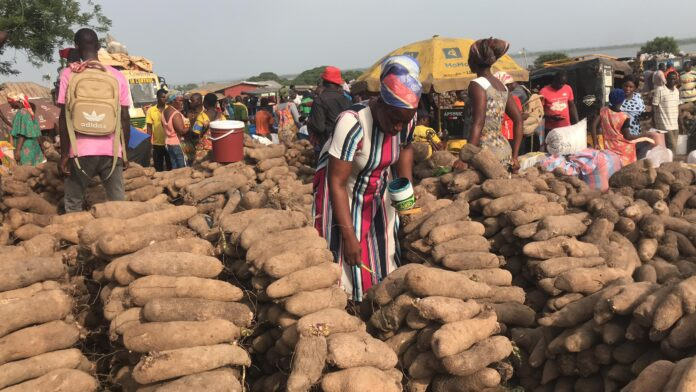
Dambai Market in the Krachi East Municipality of the Oti Region is currently experiencing a significant surge in yam prices as the harvesting season unfolds.
A visit to the market by Adom News reporter Obrempongba Owusu revealed that the price of a bundle of 100 tubers has skyrocketed from an average of 3,000 Ghana cedis to between 5,000 and 7,000 cedis, depending on the quality and size of the tubers.
This dramatic increase has left many buyers and sellers grappling with the implications of rising costs.
Speaking with some farmers at the market, they attributed the price hike to a combination of factors, including the fluctuating high prices of agro-chemicals and farm inputs, as well as increased demand as the season peaks.
However, buyers have expressed frustration over soaring prices, particularly as they also encounter issues related to spoilage and rotten tubers.
They raised concerns about spoilage due to extreme weather conditions and the lack of storage facilities at the market, along with the use of chemicals during the farming process. They noted that the yams often appear good on the outside, but once cut open, they can be rotten inside, which is disheartening and negatively impacts their finances.

Buyers are appealing to the government and the Minister of Agriculture to regulate the use of agro-chemicals by farmers to enhance the value of yam production.
The Public Relations Officer (P.R.O.) of the Yam Buyers and Sellers Association in Dambai, Wisdom Awuranyi, has called for the establishment of a modern market facility to address these challenges.
According to him, with improved infrastructure and better market practices, the Dambai market can thrive, ensuring that yam remains an accessible staple for all.
“We need more organized storage facilities and a hygienic environment for trading,” he stated.
He noted that a modern facility would not only reduce spoilage but also ensure that buyers receive quality products.
The P.R.O. also appealed to the government to improve education on the use of agro-chemicals and fertilizers among farmers to promote yam production on a competitive level with other countries.
Latest Stories
-
A source of excellence across generations – Vice President Opoku-Agyemang lauds Mfantsipim
35 minutes -
(Photos) Mfantsipim School launches historic 150th anniversary
58 minutes -
Knights and Ladies of Marshall group backs Catholic Bishops’ stance on anti-LGBTQ+
2 hours -
Bright Simons writes: All the Filla in the Ibrahim Mahama/E&P – Gold Fields Saga
2 hours -
Monetise Idiocy In Ghana
2 hours -
The Ghanaian prophet and the mysterious death of his scottish wife Charmain Speirs
3 hours -
Nearly 400 sentenced in Nigeria for links to militant Islamists
4 hours -
Ghana’s recovery supported by gold strength despite global oil price pressures – Standard Bank Research
4 hours -
Methodist Church hails Mfantsipim@150; calls for “fresh consecration” to excellence
4 hours -
‘Excellence is our inheritance’ – Nana Sam Brew-Butler hails Mfantsipim’s 150-year reign in leadership
4 hours -
Kwaku Azar writes: A-G vs OSP
4 hours -
Mfantsipim–Adisadel rivalry built excellence, not division – Sam Jonah
5 hours -
Vice President launches Mfantsipim’s 150 years of shaping Ghana’s greatest mind
5 hours -
I assure Otumfuo, Mahama will join him to commission KNUST Teaching Hospital by end of this year – Haruna Iddrisu
6 hours -
Barcelona dominate derby to extend La Liga lead
6 hours