

Audio By Carbonatix
A total of 33 cities, including Los Angeles, Amsterdam, and Edinburgh, have backed a call for a global Plant-Based Treaty, aiming to align the food system with the Paris Agreement and encourage the adoption of plant-based food policies at the local level.
Additional cities supporting the initiative include Tavira (Portugal), Didim (Turkey), Rainbow Lake (Canada), and several in the United Kingdom, such as Belfast, Exmouth, Haywards Heath, Lambeth, and Norwich.
In India, 16 cities have joined the movement, including Ahmedabad, Mundra, Rajkot, and Cadodara. In Africa, two cities are featured: Manduar in The Gambia and Kyotera in Uganda.
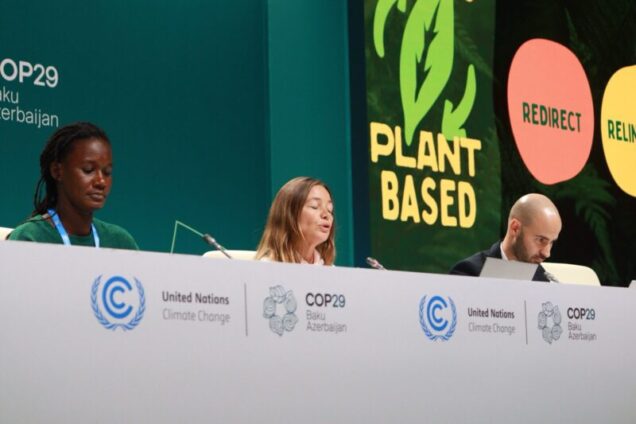
Plant-Based Treaty advocates Enric Noguera and Cindy Veltens introduced “Plant-Based Treaty in Action” to showcase how cities worldwide have begun implementing the 40 recommended proposals from the treaty.
“We need a global treaty and international cooperation to scale up plant-based solutions,” says Cindy Veltens, Plant-Based Treaty campaigner for Belgium and The Gambia.
During a press conference marking the opening of COP29, case studies from Edinburgh and Amsterdam were highlighted.
Edinburgh, which endorsed the Plant-Based Treaty in 2023, is implementing carbon labelling in schools and universities.
Meanwhile, Amsterdam, which signed the treaty in 2024, plans to partner with major employers and public institutions—including hospitals, community centres, and care facilities—to introduce Vegan Fridays and work toward a 60/40 plant-based-to-animal protein ratio by 2030.
“We urge world leaders to start negotiating a Plant-Based Treaty at COP29, and we need cities and countries to act on it and work on implementation,” says Enric Noguera, Plant-Based Treaty Europe cities campaigner.
Dr. Anita Krajnc, Global Campaign Director of the Plant-Based Treaty, emphasized that the demand at COP29 is clear: food policy is 30 years behind energy policy, and it’s time for the world to begin negotiations for a global Plant-Based Treaty.
According to Dr Krajnc, the treaty would complement the UN Paris Climate Agreement and help tackle one-third of global greenhouse gas emissions stemming from food systems.
“It will further protect our planetary boundaries by guiding the human community back to plant-based food systems,” says Dr Anita Krajnc, Global Campaign Director of the Plant-Based Treaty.
Latest Stories
-
Interest payments to average a high 20% of government revenue over next 4 years
2 hours -
Strategy of accumulating foreign reserves, gold carries high fiscal cost – S&P Global
3 hours -
Weak institutional arrangements, high debt servicing constrain Ghana’s rating – S&P
3 hours -
Bond market: Turnover declined by 28% to GH¢1.56bn
3 hours -
Volta Region National Public Speaking contest advances drug prevention conversation
3 hours -
New health training facility at Ampoma-Jema to address admission shortfalls, but Minister flags missing amenities
4 hours -
Black Challenge unveiled with sights set on Amputee World Cup glory
4 hours -
Pay striking teachers before expressway spending, Dr Kingsley Agyemang tells government
5 hours -
Customs intercepts assault rifle, two pistols and 610 rounds of ammunition at Tema Port
5 hours -
PKO boxers secure wins at Odwira Festival
5 hours -
South Tongu Records Rise in Teenage Pregnancy
6 hours -
Cabinet threw out US health compact faster than anything I’ve seen – Mahama
6 hours -
MoFA urges Finance Ministry to reverse World Bank food programme withdrawal over GH¢643m commitments
6 hours -
NAGRAT demands signed timelines before calling off strike
6 hours -
National Investment Quiz: West Africa SHS, St. Louis SHS advance to semi-finals
6 hours