


Audio By Carbonatix
Scientists have discovered a rare molecule in the clouds of Venus, which suggests colonies of living microbes could be thriving in the oxygen-free environment high in the planet's atmosphere.
While the surface of Venus is far too hot to sustain life, with a mean temperature of around 464 degrees celsius (867 Fahrenheit), astronomers have speculated that life could survive high in the planet's atmosphere where conditions are much more moderate.
Now an international team of astronomers led by Professor Jane Greaves of Cardiff University have announced the discovery of phosphine gas in these high clouds, a molecule which is produced on Earth by microbes that live in similar oxygen-free environments.
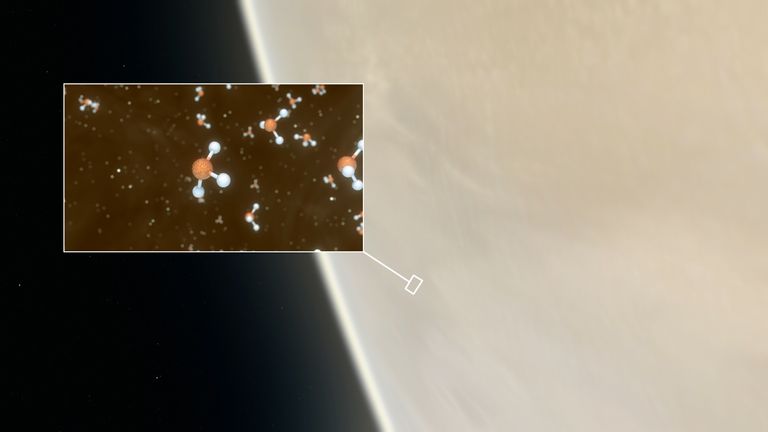
The phosphine molecules, which consist of hydrogen and phosphorus atoms, were first detected from the James Clerk Maxwell Telescope (JCMT) near the summit of Mauna Kea in Hawaii.
"This was an experiment made out of pure curiosity, really - taking advantage of the JCMT's powerful technology," said Professor Greaves, who led the study published in the journal Nature Astronomy.
"I thought we'd just be able to rule out extreme scenarios, like the clouds being stuffed full of organisms.
"When we got the first hints of phosphine in Venus' spectrum, it was a shock!"
They caution that natural processes couldn't be ruled out due to the lack of information about the prevalence of phosphorus on Venus.
But work by Dr William Bains at the Massachusetts Institute of Technology on natural ways to produce phosphine found that there was no way to produce the amount detected in Venus' atmosphere.
To create the observed quantity of phosphine on Venus, organisms on Earth would only have to output the gas at about 10% of their maximum productivity, according to calculations by Dr Paul Rimmer of the University of Cambridge.

Microbial life on Venus is expected to be very different to that on Earth, however, as it would need to survive in the hyper-acidic conditions of the planet's clouds - made almost entirely from sulphuric acid.
On Earth, bacteria produces phosphine gas after absorbing phosphate minerals and adding hydrogen to it.
This process is curious, as it costs the bacteria energy rather than gives it to them - so the evolutionary purpose for the process is unclear.
Some scientists believe phosphine is just a waste produce of another process, while some believe it could have an alternative purpose - such as warding off rivals.
The discovery offers a potential explanation for the mysterious dark streaks on the surface of Venus, detected by the Japanese space agency JAXA, which bizarrely absorb ultraviolet light.

These dark streaks could be colonies of microbes, surviving in a pleasant 30C (86F) temperature of the high clouds, although the clouds themselves are incredibly acidic - made of about 90% sulphuric acid.
Professor Emma Bunce, president of the Royal Astronomical Society, congratulated the team on their work and called for a new mission to Venus to investigate their findings.
"A key question in science is whether life exists beyond Earth, and the discovery by Professor Jane Greaves and her team is a key step forward in that quest," said Professor Bunce.
"I'm particularly delighted to see UK scientists leading such an important breakthrough - something that makes a strong case for a return space mission to Venus," she added.
After confirming the presence of phosphine, the international team of astronomers ran a number of calculations to see where it could have come from.
Latest Stories
-
Richard Dogbe declares bid for NDC Greater Accra Deputy Youth Organiser
11 minutes -
M.anifest questions toxic fan culture amid fresh music industry tensions
12 minutes -
469 farmers paid compensation as Accra-Kumasi Expressway clearance progresses
15 minutes -
Malaysian boy acquitted for murder of schoolgirl on grounds of insanity
23 minutes -
Arabic, Chinese teaching debate should end after Mahama’s clarification – Asah-Asante
24 minutes -
Ashanti Regional Minister halts 24-Hour Market project in Mankranso over school demolition concerns
26 minutes -
The Forgotten “Little Children”
33 minutes -
Zambians warned not to eat dead wildlife after anthrax kills dozens of animals
35 minutes -
AG urges GBA to remain the conscience of Ghanaian society
48 minutes -
24-Hour Economy: Minority questions demolition of schools, markets and other public assets
50 minutes -
China criticises idea it is in ‘malicious competition’ over AI
52 minutes -
Russia hits Ukrainian train shortly after Boris Johnson and top European officials leave station
52 minutes -
Sista Afia reveals fears about becoming a single mother
55 minutes -
Gov’t 24-Hour Economy markets programme is an afterthought – Minority
57 minutes -
Minority wants traders, residents heard before 24-Hour Market projects
57 minutes