

Audio By Carbonatix
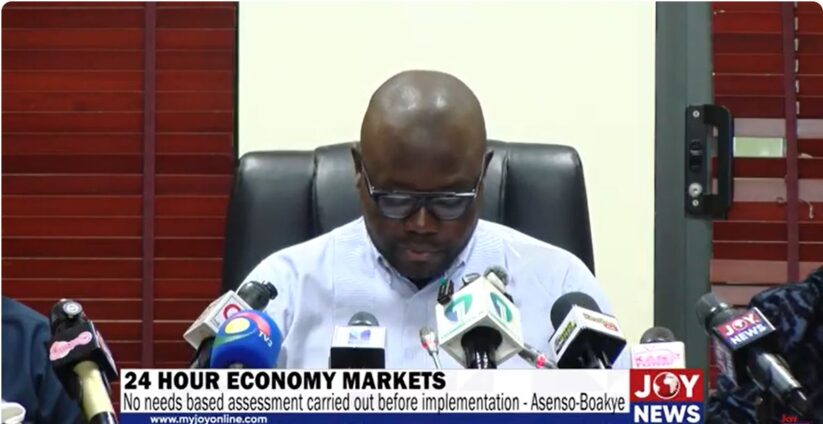
The Minority in Parliament has criticised the government’s implementation of the 24-Hour Economy Market Programme, describing it as an “afterthought” that lacks proper planning and does not adequately respond to the needs of local communities.
Ranking Member of Parliament’s Local Government Committee, Francis Asenso-Boakye, who addressed the media on behalf of the Minority, said the programme appears to be disconnected from the development priorities of several districts.
He stressed that the Minority is not opposed to the construction or modernisation of markets, nor to markets operating for extended hours where there is genuine economic demand.
However, he questioned the basis for what he described as a nationwide approach to constructing 24-hour economy markets without sufficient consideration of the different needs of districts.
“The programme appears to be an afterthought, as it was not presented to Ghanaians as a nationwide market infrastructure programme in the governing party’s 2024 manifesto,” he said.
Mr Asenso-Boakye said the government must explain the needs assessments, feasibility studies and local development plans guiding the projects.
He noted that under Ghana’s local governance framework, District Assemblies serve as planning authorities within their jurisdictions, making it important for development projects to reflect local priorities.
“Some districts need new markets. Others need their existing markets rehabilitated or expanded. Some already have markets under construction,” he said.
According to him, other districts may have more pressing development needs, including roads, drainage, schools, health facilities and sanitation infrastructure.
He therefore cautioned against imposing a uniform market development model on districts with different population sizes, economic activities and existing infrastructure.
“Development, especially a market development programme, cannot be one-size-fits-all,” Mr Asenso-Boakye said.
He argued that such an approach could undermine the principles of decentralisation by failing to adequately involve local authorities in determining the priorities of their communities.
Latest Stories
-
Hawa Koomson pledges experienced and mature leadership of NPP women’s wing
48 minutes -
Young woman found dead at Kasoa Peace Town
1 hour -
Playback: The Law examined lawful arrest in Ghana
2 hours -
Mahama urges African governments to treat healthcare as an investment, not budget cost
2 hours -
Bawumia congratulates John Boadu and new NPP executives, pledges support ahead of 2028
2 hours -
‘No talent should be left out’ – Bawumia pledges inclusive NPP campaign for 2028
2 hours -
Prof. Mike Oquaye recounts how he blocked the Special Prosecutor’s attempt to arrest Bawku Central MP
3 hours -
Make health sovereignty a priority for Africa – Mahama
3 hours -
Dorimon Naa, Wa West DCE lead massive clean-up exercise; threaten sanctions against recalcitrant residents
3 hours -
Photos from Adom FM Y2K Jam
3 hours -
Praye Tiatia steals the show at Adom FM Y2K Jam [Watch]
3 hours -
Boakye Agyarko congratulates John Boadu, pledges support for NPP leadership
4 hours -
Antwi HiMight thrills fans with Antwi ne Antwi hits at Adom FM’s Y2K Jam [Video]
4 hours -
Amb. Edward Boateng congratulates Boadu, Kodua on election wins
4 hours -
John Boadu pledges to rebuild NPP from grassroots and restore ‘winning machinery’
4 hours