

Audio By Carbonatix
More than 50 people were killed and many more wounded in a missile strike on a train station in the eastern city of Kramatorsk on Friday. One day later, people are attempting to pick up the pieces from the deadly attack.
They're still searching through the wreckage and debris at Krematorsk station.
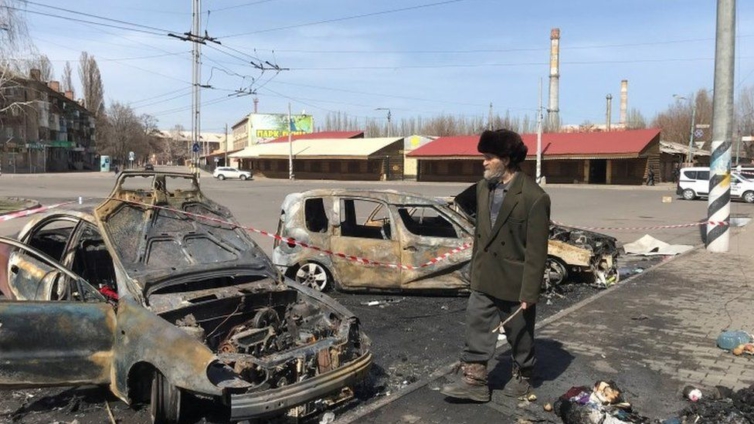
The bodies of the dead were soon removed from the scene of a missile strike on Friday, but you can still see the dried blood and some evidence of human remains 24 hours later. The uncollected travel bags of those who did not survive have been gathered together and now lie in an empty ticket office.
Sergei, a volunteer with the Ukrainian Army, was still looking through the wreckage of destroyed cars, parked outside the station. There was evidence in one of a burnt child's body.
Sergei is used to death. He's been recovering the bodies of Ukrainian soldiers killed in battle. But on Friday, he was having to gather the corpses and the remains of unarmed civilians - the innocents of this war. He has no doubt that Russia is to blame for the attack that has left more than 50 people dead and many more injured.
Watching mothers grieve over children killed in the blast has clearly taken its toll on Sergei.
"When you see our future, the future of Ukraine being killed, you can't control your emotions," he says. He calls it a genocide.
"You just don't understand the motivation of the people who did this. What was this for?"
Thousands of people were gathered at Kramatorsk station when the missile struck at 10:30 in the morning. They were waiting for a train to take them west, to relative safety. The region's authorities had told civilians to leave as Russia steps up its offensive in the Donbas. Kramatorsk and a number of other cities in eastern Ukraine have recently been targeted by Russian airstrikes, artillery and missiles.
Russia has denied it was responsible for Friday's attack. It even claims that it wasn't their missile. It's still not clear what exactly happened.
Ukraine's state railway says the station was hit by two missiles. The damage is certainly spread over a wide area. It's possible there were three missiles - and one was shot down by Ukraine's air defences.
On Saturday, investigators were examining the remains of what looks like a Tochka missile which landed just yards from the station. Part of the casing remains intact. In white paint, someone has written in Russian: "For the Children". Was it meant as some kind of revenge? If so, for what?
Eyewitnesses also describe seeing multiple explosions, raising questions as to whether the missile, or missiles, had been fitted with cluster munitions. Banned by many countries, they're designed to kill and maim over a wide area.
At Kramatorsk hospital, medical staff had been working through the day and night to treat the many injured.
Surgeon Victor Borisovich said six people died before they had a chance to operate. Another two died after surgery - including a young child. Victor says many were life-threatening injuries, which he lists as "amputations, torn limbs, torn feet, stomach wounds and brain injuries". He tells me he has no doubt that the injuries and deaths were the responsibility of Russia.
"I can't imagine what kind of person takes the decision to launch a missile into a place where civilians are gathering," he says. "It just cannot be explained."
When we arrived at the hospital, a small number of patients were being loaded into ambulances to be taken to Dnipro, further west, for surgery. They still had pieces of shrapnel embedded in their bodies. Some were clearly still in shock. One woman said it was a miracle she'd survived. She described the scene.
"There were a lot of explosions. I fell down, then I started running, but people started to shout, 'Get down,' so I fell on the ground again."
When she got up again, she says, she realised many were dead. "God saved me," she says.
Few of those we spoke to were willing to say who was responsible for their injuries. One woman did blame Russia, but she also suggested that the target might have been a train carrying military equipment. We saw no evidence of that when we arrived a few hours after the blast.
It is still possible that the people waiting for a train were not the intended target. Western officials say that a Tochka missile, also known as an SS-21 Scarab, can miss its target by up to 30m.
Even that suggests that whoever fired the missile knew that lots of people could be in harm's way. But if the missile was designed to kill unarmed civilians waiting for a train, then Western politicians are in no doubt that it would amount to a war crime.
Latest Stories
-
Who to allow into your home, who should come into your cyberspace? Trust is becoming unbecoming
1 minute -
At least 11 dead in mass shooting at house party in South Africa
19 minutes -
MoMo Fintech Lab attracts close to 1K entries from innovators across, applications end on Sept 30
30 minutes -
Black Stars face Ivorian test as injuries force major squad changes
44 minutes -
Save Nations Foundation donates learning materials to Nooria Islamic Basic School, calls for more support
51 minutes -
From selling food to solving problems: How Esther Owusu Nkwantabisah rethought entrepreneurship
1 hour -
Explained: Ghana’s water plant deal that produced a $235m judgment debt instead of water for 500,000 people
1 hour -
High Cost of Domestic Airline Fares: Can government do something about it?
1 hour -
Inflation, cedi depreciation put BoG’s MPC under pressure as policy rate decision looms
2 hours -
Lawyer denies Salomey Baffoe received money from ‘Ghana Jollof’ account operator
2 hours -
Beyond politics: Why Kwame Nkrumah’s ideals still matter for today’s leaders
2 hours -
Top South African policeman charged with sexual offences
2 hours -
More than 170,000 respiratory cases recorded in haze-choked Indonesia
2 hours -
Narrowed space, intolerance – Sammy Crabbe says NPP is driving talented members away
2 hours -
We’re not analytical enough – Sammy Crabbe calls for data-driven decision-making
3 hours