

Audio By Carbonatix
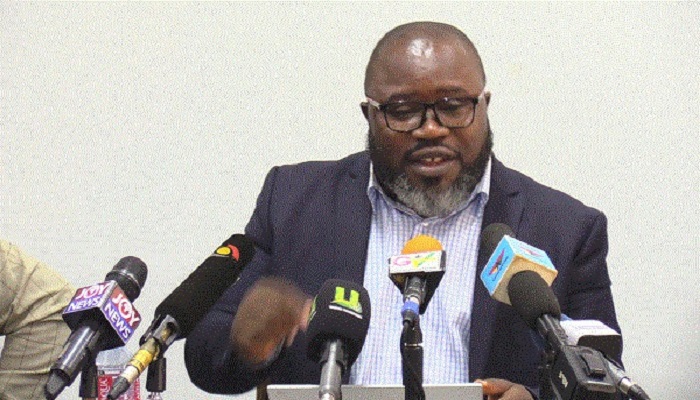
The Executive Director of EduWatch Ghana, Kofi Asare, says government must adapt cost efficient methods in expanding access to secondary education in Ghana other than the boarding system if it is to reach universal secondary education by 2030.
According to him, calls for a cost-efficient new approach is not to hinder the government’s Free Senior High School policy, but rather a call to rethink the country’s unhealthy obsession towards the traditional boarding system which is far more expensive to manage.
He explained that due to the expensive boarding system at the secondary school level, whenever there is an attempt to expand access to secondary education, it negatively impacts the basic education system depriving the base of essential funds to operate.
Describing the relationship between secondary education and basic education as an inverse one, he noted that till a sustainable solution is reached, the quality of basic education in the country will suffer.
“Well, education is an input-output relationship, the quality of your input including of course supervision determines to a large extent, the quality of your output. And so if you invest little and you monitor or supervise poorly obviously you’ll churn out low quality.
“According to UNICEF for instance, only 7% of children in grade 3 can read grade appropriate text well in Ghana, so only 7% of children in grade 3 can read as expected of a grade 3 child in Ghana. It tells you that there are critical foundational issues,” he said on JoyNews’ PM Express.
Kofi Asare explained that the prevailing issues further buttress the point that there is a declining investment in basic education.
Speaking on findings from research conducted by his organization, he revealed that investment into basic education began decreasing from 2011.
“In 2011 for instance we were committing close to about half of the education budget to basic education, about 47% and it started declining since then. In 2012 we committed close to 8% of the GDP of Ghana to education that was when we were doing a lot… but the number of pupils has increased in line with population growth and the demand for education.
“Now if you look at the basic input indicators at the school level, we have huge infrastructure deficits. If the class room environment is not interesting, children will not be happy to learn. 40% of children in basic schools do not have access to desks, according to the Ministry of Education, that is not our data.
“When you have over 5000 of your basic schools taking place under trees and sheds and dilapidated structures where the slightest sight of rain means that school is closing down, it means that the school environment is not conducive for learning.”
He stated that while the national teacher-student ratio paints a rosy picture of 15 students to one teacher, suggesting a teacher surplus in the country, the situation on the ground is far from what is recorded.
“Apart from that there still are classrooms without teachers. Our research suggests that there are about 5000 primary school classrooms that do not have teachers in the deprived part of this country even though we seem to have a teacher surplus at the national level.
“If you look at pupil-teacher ratio data it looks so beautiful that almost every 15 students in Junior High School have one teacher. But there are schools that you’ll go you’ll see two teachers handling the whole Junior High School 1-3 so the input situation also has not been equitably distributed.”
He further stated that due to the insufficient investment into the basic and secondary education system, it has created an inverse relationship where often basic education suffers insufficient funding while government tries to improve secondary school access.
“So anytime you’re spending more on secondary, basic comes down and vice versa. That is why we are saying that this is not just about the free senior high school thing. In 2011 government was spending almost 3 times more on every secondary school child than basic education. So it is not that free senior high school has suddenly made secondary education expensive that is not the case.
“The point we’re making is that if we are to pursue the target of universal secondary education by 2030, we need to adapt cost efficient methods or approaches in expanding access to secondary education other than the boarding system where feeding alone is an albatross around government’s neck.
“And so we must begin to rethink the obsession towards this traditional boarding system which has made our secondary education system so expensive that anytime we attempt to expand access to secondary education it affects the raw material base that is basic education.”
Latest Stories
-
Obuasi SHTS case: Eduwatch calls for sex offenders’ register and mandatory background checks for teachers
59 seconds -
GloMeF CEO urges intensified public education on new road traffic regulations
12 minutes -
‘Any tax on ChatGPT is an attack on education and innovation’- Akim Swedru, MP
16 minutes -
Obuasi SHTS sexual abuse scandal exposes systemic failure in child protection – Moving Masculinity
17 minutes -
Hubtel CEO calls for national data-sharing framework to boost AI development
19 minutes -
Twelve Golden Rules of real estate development in Ghana, Africa
24 minutes -
Five new telephony cell sites in Ashanti Region to be activated in October 2026 – Sam George
24 minutes -
Mahama cuts sod for Afienya Industrial Park, targets 120 enterprises
29 minutes -
Rush for fuel from accident tankers is stealing, punishable by law – NPA boss, Edudzi Tamakloe
35 minutes -
GhIG pushes for legislation to regulate geoscientists’ activities
41 minutes -
Mfantsipim @150: Ace Anan Ankomah leads project to preserve school’s musical heritage
45 minutes -
Gov’t launches rCOMSDEP in Ahanta West, Mpohor Fiase to promote responsible community mining
46 minutes -
AI is forcing professionals to rethink how they deliver value – Hubtel CEO
49 minutes -
Daily Insight for CEOs: Strengthening the CEO’s Leadership Legacy
50 minutes -
Jimmy Aglah’s ‘When the River Testified’ approved by NaCCA as Supplementary Reader
59 minutes