

Audio By Carbonatix
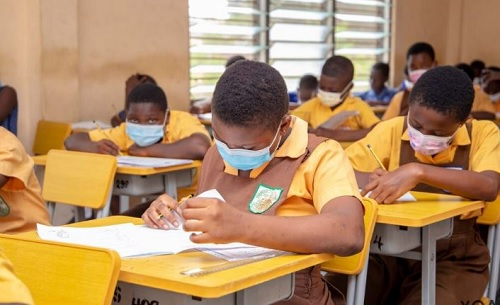
The Executive Director of Africa Education Watch (Eduwatch), Kofi Asare, has proposed that the number of subject papers written during the Basic Education Certificate Examination (BECE) should be reduced from the current 10/11 to four.
That, he said, was to reduce the five/six days used to write the examination, which is now mainly used for school placement and the associated cost that came with it.
He thus proposed that the examination be written in two days and candidates be examined in Mathematics, English, General Science and General Paper.
Currently, candidates are assessed in English Language, Religious and Moral Education, Social Studies, Creative Arts and Design, Science and Career Technology, Mathematics, Ghanaian Language, French, Computing, and Arabic for those in Islamic schools.
“We can decide that we do only the three core subjects: English, Mathematics, and Science, and then the remaining subjects will be a General Paper.
I'm saying general paper because we don't want to create a situation where students will not learn the other subjects.”
“They will only learn the ones that they are likely to be examined on. So all the other subjects—Computing, Ghanaian Language, and Social Studies—will be in the General Paper at various sections; they will all be compulsory, except for your optional language section, so that you will be compelled to learn everything because the General Paper will encompass the whole curriculum,” Mr Asare told the Daily Graphic yesterday.

Certification
Mr Asare said before the introduction of the Free SHS in 2017, BECE largely determined whether a candidate qualified to enter secondary education.
At the time, he said candidates typically needed at least an aggregate of 35 to gain admission, and less than 65 percent were meeting this threshold.
In effect, he said BECE functioned as a screening examination that separated those who passed to progress to secondary school from those who did not.
“With the introduction of Free SHS, however, access to secondary education became near universal for BECE candidates.
“Today, about 98 percent of candidates qualify annually for secondary education. In fact, candidates with an aggregate of 54 are all in school,” he said.
That, Mr Asare said, meant that BECE results no longer primarily determined whether a student proceeds to secondary, but rather which school they were placed in.
Relevance
He said, given the shift in relevance, the “question arises: why do candidates still sit 10 subjects over five days for what is essentially a placement exercise?”
He said in many systems, school placement was guided by aptitude tests and continuous assessment rather than a broad high-stakes examination.
“If BECE is to remain relevant in its current school placement context, its structure should reflect its purpose.
It is no longer a proficiency examination.
A more focused model could retain Mathematics, English and Science, while merging the remaining subjects into a general paper.
“This would reduce assessment overload while ensuring students do not neglect any learning area.
Additionally, a reduced subject load could significantly cut examination costs, potentially by up to 40 per cent, while reducing stress on students and improving efficiency in the system.
Ghana spends over GH¢200 million annually on BECE,” he said.
Mr Asare said concerns that reducing the subject load would reduce the quality of learning, “though much appreciated, do not appear to be supported by evidence.”
He said they were not too different from the emotive concerns that “if you admit more into law and medical school, you dilute quality.”
“I welcome more evidence-based justifications for any concern that seeks to suggest maintaining 10 stand-alone subjects in BECE has a positive correlation to the quality of learning, while reducing it to four, yet maintaining all subjects dilutes quality,” he added.
Latest Stories
-
RCI Immanuel Temple donates supplies to Motherly Love Orphanage
28 minutes -
COCOBOD asks investors to fund cocoa purchases, but proceeds may also repay old debt
51 minutes -
Gov’t hands over site for construction of 160-bed Savannah Regional Hospital
58 minutes -
NCPTA clarifies GH¢200 cap on PTA dues and levies per parent
1 hour -
Asante Kotoko part ways with coach Eric Tinkler
1 hour -
GTA calls for ultra-modern Cocoa Museum in Western North
1 hour -
NPP says concerns over delegates’ register addressed ahead of October 3 polls
1 hour -
PwC Ghana appoints George Arhin as Country Senior Partner
1 hour -
New Economy will turn imports into opportunities for Ghanaian production – Ato Forson
1 hour -
Two Ada SHS students convicted, placed on 12-month good behaviour bond
1 hour -
Samson’s Take: Verify the badge – and verify the story
1 hour -
Treasury bill demand rebounds as investors submit GH¢3.66bn in bids
1 hour -
Listing 10 SOEs will strengthen governance, limit political interference – Mahama
1 hour -
Mahama announces 1,200MW state-owned gas power plant deal by end of 2026
1 hour -
COCOBOD sets up Cocoa Capital PLC to raise GH¢16.3bn for cocoa sector
1 hour