

Audio By Carbonatix
With the current increase in global water consumption and pollution, the United Nations projects that the demand for water to outstrip the supply by more than 40% in 2030.
This will affect about half of the world's population and damage the well-being of millions of people.
In Ghana, the Ghana Water Company Limited (GWCL) is responsible for the abstraction, production, transmission, and distribution of water in urban and peri-urban communities.
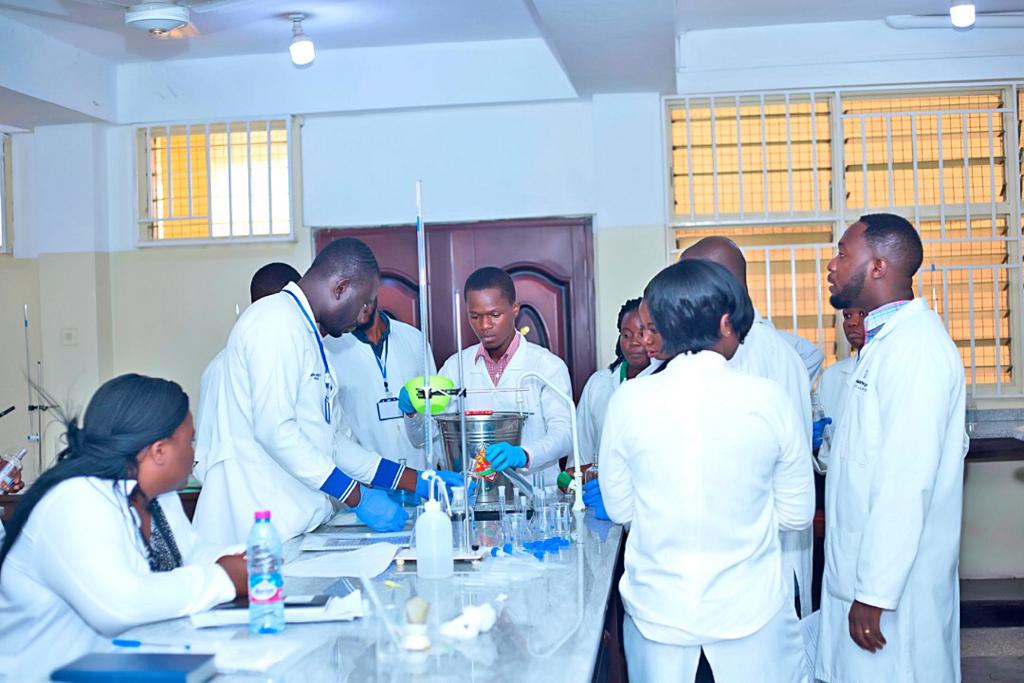
During drinking water treatment, chemical disinfectants like chlorine are used to inactivate microorganisms and avoid regrowth in distribution networks.
However, the disinfectants may interact with dissolved organic matter present in the water to produce undesired disinfection byproducts (DBPs), many of which are genotoxic and carcinogenic.
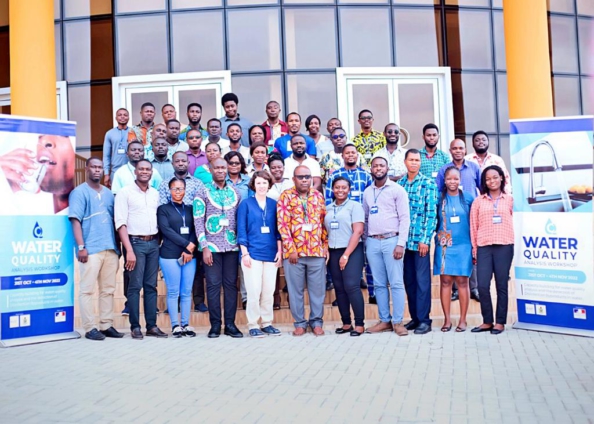
To this effect, the Department of Environmental Science, KNUST, and the Université de Lille, France, with funding from the French Embassy in Ghana through the Nyansapo Project, organized a workshop to build the capacity of researchers, postgraduate students, staff of GWCL and the Food and Drug Authority and other stakeholders in the water sector on samplings, analysis, monitoring, and prediction of DBPs.
The 5-day capacity building workshop at KNUST between 31st October and 4th November 2022 was under the theme "Water Quality Analysis and the Detection of Disinfection Byproducts in Water."
Opening the training workshop, the Provost of the College of Science, Prof. Leonard Kofitse Amekudzi indicated that often, attention is focused on the cost of treating polluted waters for human consumption without regard to the interaction between the pollutants and the chemicals used for treatment.
Prof. Geophrey Kwame Anornu emphasized that his research finding points to the fact that if the current trend of water pollution is not curtailed, soon, most of our water resources will be depleted.
This was corroborated by the GWCL Regional Chief Manager, Ashanti Production, Dr. Hanson Mensah-Akutteh who lamented the impact of activities such as illegal mining, sand winning, solid and liquid waste disposal, uncontrolled use of fertilizers and pesticides, algae proliferation on the increased cost of water treatment and production.
The project lead for KNUST, Dr. Junias Adusei-Gyamfi, who took participants through various chlorination and DBP formation potential hands-on sessions, revealed that even though more than 700 DBPs have currently been detected globally and many more are unknown, only seven are regulated in Ghana.
Even with that, the National Drinking Water Quality Management Framework, which is intended to regulate the seven DBPs, is not enforced due to the lack of capacity of local expertise to perform such analysis.
He also expressed worry about many individual homes that disinfect their wells, reservoirs, and swimming pools without regard to the potential formation of DBPs.
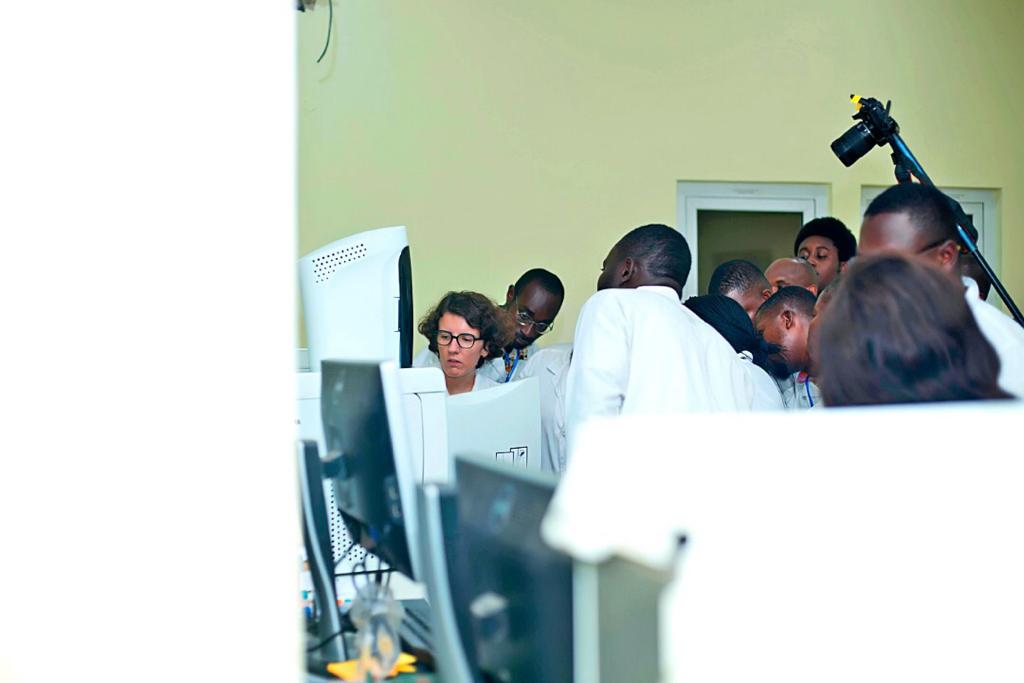
The Project lead for Université de Lille, Prof. Justine Criquet, trained participants on developing methods for DBP analysis with GC-MS. She indicated that there are more toxic unregulated DBPs, such as the iodinated DBPs, and expressed hope that the workshop would trigger discussions on enacting policies to regulate other more toxic DBPs in Ghana and establish a strong local network of researchers who can continue collaborating after this training.
The workshop had breakout sessions which featured a series of presentations delivered by faculty members of the Department of Environmental Science on the toxicological effects of chlorinated effluent on aquatic organisms, the impact of climate change on the potential for DBP formation, basic GIS for water quality monitoring, basic statistical tools for water quality monitoring, and drinking water treatment methods.
The Head of the Department of Environmental Science, Prof. Jonathan N. Hogarh called for a continual collaboration between academia and industry.
He expressed commitment and interest on his part and that of faculty members in his department for this collaboration as it is in line with the vision of the Vice Chancellor of KNUST, which is "to position KNUST as a competitive global research-intensive institution for advancement in science and technology for industrial and social uptake towards sustainable national and global development".
Participants expressed their contentment with the workshop and requested that more local institutions come on board to fund and sustain such training workshops.
Latest Stories
-
Maternal mortality is a women’s empowerment emergency!
2 minutes -
Kwame Pianim holds up Fidelity Bank as a model of sound governance and Ghanaian leadership
5 minutes -
GOIL defies market forecasts, holds petrol at GH¢15.43 and diesel at GH¢17.26
9 minutes -
When a wife helps build the dream: Celebrating Apostle Mrs. Rita Korankye Ankrah at 40 years of marriage
27 minutes -
NDPC, AGI and Coca-Cola engage on Ghana’s evolving food and nutrition policy
29 minutes -
Joyce Bawah Mogtari urges diaspora women to turn investment into generational wealth
42 minutes -
Dr Bawumia urges new NPP Ashanti Regional executives to prioritise inclusion for 2028 victory
43 minutes -
GIS urges public to channel donations to social welfare and credible NGOs instead of street beggars
1 hour -
Ghanaian businesses cautiously optimistic about 2026 performance – Chamber
2 hours -
Ghana Reference Rate drops to 10.18% in September, could ease borrowing costs
2 hours -
Ablakwa calls for new African leadership paradigm to tackle conflicts
2 hours -
Chief Imam backs optional Arabic in public schools
2 hours -
Mahama lauds Dr Kwame Nkrumah’s pioneering role towards NAM formation
2 hours -
UK pledges additional £50 million to help contain Ebola outbreak in Congo
2 hours -
Oil prices extend gains as US and Iran trade fresh strikes
2 hours